
Andrew Drew, 27 November 1792 - 19 December 1878
A Naval Biographical Dictionary: comprising the life and services of every living officer in Her Majesty's Navy, from the rank of Admiral of the Fleet to that of lieutenant, inclusive.
By William E. O'Byrne, Esq.
London: John Murray, Albemarle Street, Publisher to the Admiralty, 1849
Printed by William Clowes and Sons, Stamford Street.
[Note: Abbreviations: f-p "full pay"; H-p "half-pay"; Fst.-cl. Vol. "First Class Volunteer;]
DREW. (Captain, 1843. f-p., 15; H-p., 26.)
Andrew Drew was born 27 November 1792.
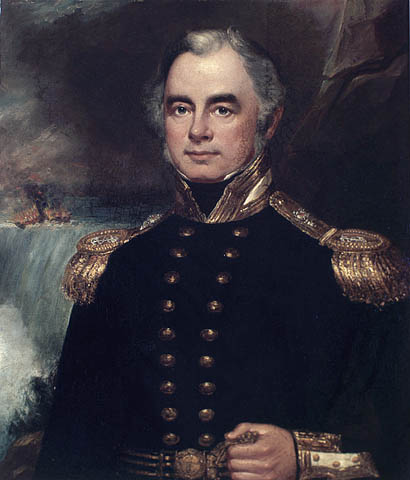
This officer entered the Navy, 4 May, 1806, as Fst.-cl. Vol., on board the Bellette 18 [note: often spelled as Belette] , Capt. John Phillimore. Under that officer he presently took part in an attack made by Commodore Owen on the Boulogne flotilla — was afterwards employed in convoying two transports to the timely relief of the town of Colberg, then obstinately defended by the celebrated Blucher — and, when at the siege of Copenhagen in Aug. 1807, assisted in the Bellette's gallant defeat of a flotilla of 16 gun-vessels sent for the express purpose of capturing her. After bringing home the despatches relative to the surrender of the Danish capital, and participating in one or two special services, Mr. Drew officiated for upwards of two years, as Midshipman, in the Virginie 38, Capt. Edw. Brace, Fortunée 36, Capt. Henry Vansittart, and Marlborough 74, Capts. J. Phillimore and Graham Moore — in which latter ship he attended the expedition to the Walcheren in Aug. 1809. Rejoining Capt. Phillimore, in July, 1810, on board the Diadem troop-ship, he was next employed in active co-operation with the patriots on the north coast of Spain, until his removal, in June, 1813, to the Eurotas of 46 guns and 320 men, commanded by the same Captain. In that ship, after witnessing the capture of La Trave French frigate, Mr. Drew shared, on 25 Feb. 1814, in a destructive action of two hours and ten minutes with La Clorinde, mounting 44 guns and 12 brass swivels, with a complement of 360 picked men, of whom 120 were killed and wounded, with a loss to the British of 20 slain and 40 wounded. Having passed his examination two years previously, he was promoted for his conduct on the occasion to the rank of Lieutenant, 4 March following, and re-appointed to the Eurotas — from which, however, he invalided, 6 Feb. 1815. Mr. Drew afterwards joined — 15 Dec. 1818, the Wye 26, Capts. Geo. Wickens Willes and Peter Fisher, on the Home station — and, 21 March, 1823, as First-Lieutenant, the Thetis 46, commanded by his old Captain, Sir John Phillimore. Proceeding to the coast of Africa, he there took an active part in the Ashantee hostilities at Cape Coast Castle, where he landed in command of the seamen and marines, and assisted at the final overthrow of the enemy, on 11 July, 1824. For these services he was rewarded, on the return home of the Thetis, with the rank of Commander, by commission dated 19 Oct. in the same year.
When afterwards in Canada, Capt. Drew materially aided in quelling the rebellion in that country, by the destruction, in Dec. 1837, of the Caroline steamer, which vessel he cut out from under Fort Schlosser, on the American side of the Niagara, and sent flaming over the Great Falls of that river! In admiration of this exploit, the Governor, and the two Houses of Parliament of Upper Canada, returned him their united thanks; and he was immediately appointed Commodore of the Provincial Marine. From Oct. 1838, until Aug. 1839, Capt. Drew, in the Colborne hired armed steamer, held the chief command on Lake Erie, for the purpose of resisting any intended attacks on the part of the rebels.
His last appointment was to the command, 6 Oct. 1842, of the Wasp 16, on the West India station, where he received the thanks of Sir Chas. Adam, the Commander-in-Chief, for discovering and accurately surveying a dangerous shoal, now known upon the Admiralty charts as "Drew's Hillock," lying in the direct Channel between the islands of Tobago and Trinidad, with only 17 feet water upon it. Since his Post-promotion, 16 June, 1843, Capt. Drew has been on half-pay.
He married, 17 March, 1832, Mary, daughter of the late Thos. Henderson, Esq., of Longborough, co. Cumberland, by whom he has issue five sons and one daughter. Agents — Messrs. Stilwell.
Other details
Andrew Drew was born London England 27 November 1792 and died in England 19 December 1878.
Further promotions: 30 January 1863, Retired Rear-Admiral; 20 May 1869, Retired Vice-Admiral; 30 July 1875, Retired Admiral.
In 1832 Drew entered into a partnership Henry Vansittart under whom he had served in the Fortunée (see above) to develop land. Drew took up land in Blandford Township, eventually leading to laying out the town of Woodstock, where he erected the first church and built some of the first houses. Later Drew and Vansittart quarrelled and the partnership was dissolved, However, Drew continued to improve the land he retained – about 350 of the 700 acres originally granted, of which some 40 acres constituted the town plot.
When he left Canada in 1842, under occasional death threats from die-hard McKenzie associates, and to obtain further Royal Navy career promotions, he sold his property at a loss. He remained bitter about his financial losses for decades, particularly after their Lordships of the Admiraly, the Secretary of State for the Colonies and the Prime Minister refused to compensate him.