
The case of Alexander McLeod
The rebellion of 1837 and its aftermath
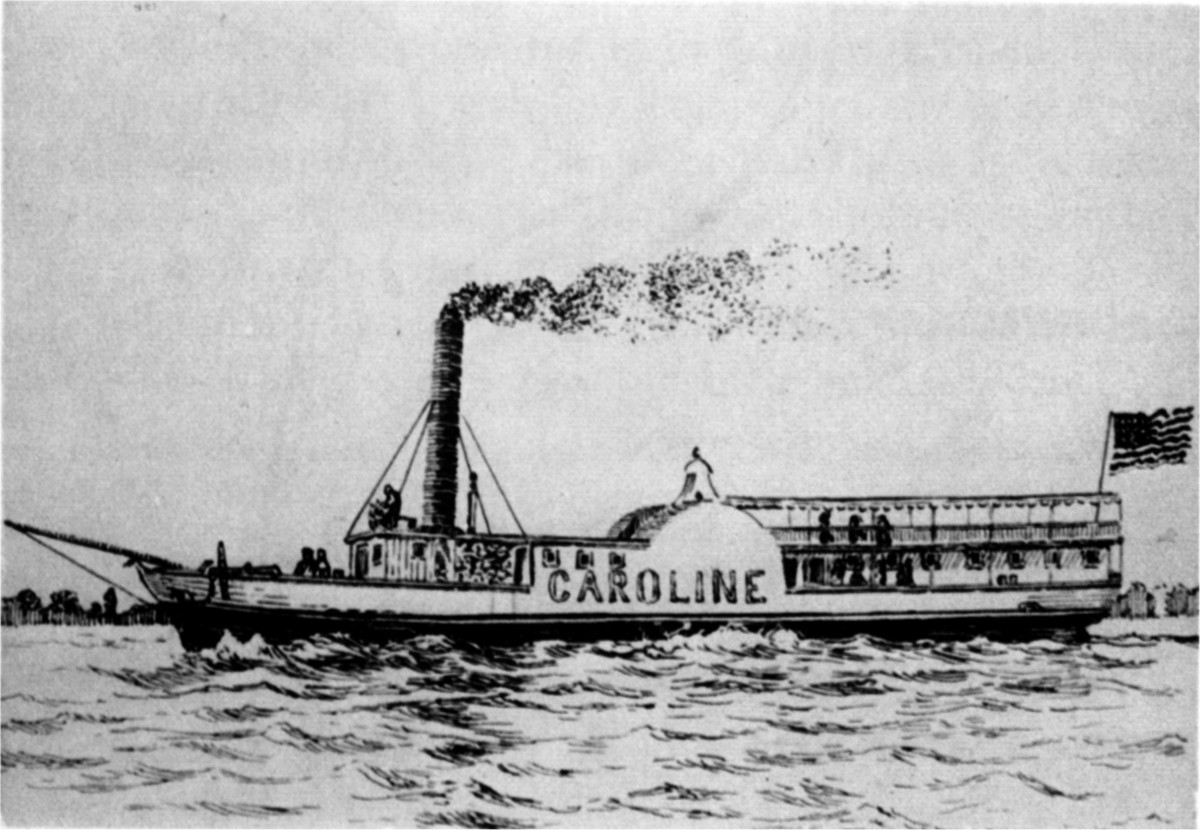
Adapted from the Canadian Historical Review, Vol. XII, 1931
by Alastair Watt
The case of Alexander McLeod, a Canadian storekeeper and deputy sheriff born 17 January 1796 at Carnoustie in Scotland and who died 27 September 1871, and the incident of the steam-boat Caroline out of which it arose, have been the subjects of a number of errors of fact and expressions of unwarranted opinion on the part of numerous writers. These errors and misstatements, irritating and perplexing when encountered seriatim in a course of reading, are not devoid of humour when brought together. For example, the location of Navy Island, the scene of the Caroline's operations and the national home of the short-lived Canadian republic, appears, if one consults a number of books, to be quite indeterminate. At least two writers place it on the American side of the international boundary line which threads the Niagara River,[1] many place it on the Canadian side, and one authority on international law has the line run through it.[2] Navy, or "Knavey" Island as the Tories termed it, is and has been Canadian territory ever since the line was drawn in 1783.[3] This fact is not without real importance in any discussion of the case, for, had Navy Island been wholly or partly American territory in December, 1837, the British justification of their intervention on the grounds of self-defence would have been a great deal weaker than it was.
On the American shore across from Navy Island was Fort Schlosser, the place near which the Caroline was moored on the night of her destruction. This name, Fort Schlosser, has proved tempting bait to historians who have not carefully consulted all the records. Eager to give heroic proportions to the Canadian enterprise of cutting out the Caroline, an imaginative historian writes: "The vessel lay moored for the night under the very guns of Ft. Schlosser, indeed the shadows of the fort enveloped the Caroline."[4] Sir Francis Bond Head, the lieutenant-governor of Upper Canada at the time, differs somewhat in his description of this stronghold. Referring to Fort Schlosser in an official despatch he said: "There is neither fort nor village there, but a single house occupied as a tavern."[5]
The honour of leading this forlorn hope which cut the Caroline out from under the guns of a non-existent fort is awarded by one writer to "that ardent Loyalist Sir Allan McNab",[6] and by another to Alexander McLeod.[7] So far from being leaders, neither of these men was on the expedition. Allan McNab (he had not yet been knighted) confined his ardour to headquarters, whilst Alexander McLeod, much to his ultimate satisfaction, was at the time five or six miles distant from the scene of the raid. The actual leader was, of course, Commander Andrew Drew, R.N.[8]
The date of the destruction of the Caroline and the resulting number of fatalities vary with almost every writer who treats the subject. The correct date is December 29, 1837: and only one man, Amos Durfee, an American citizen, was proved to have been killed in the affray.[9]
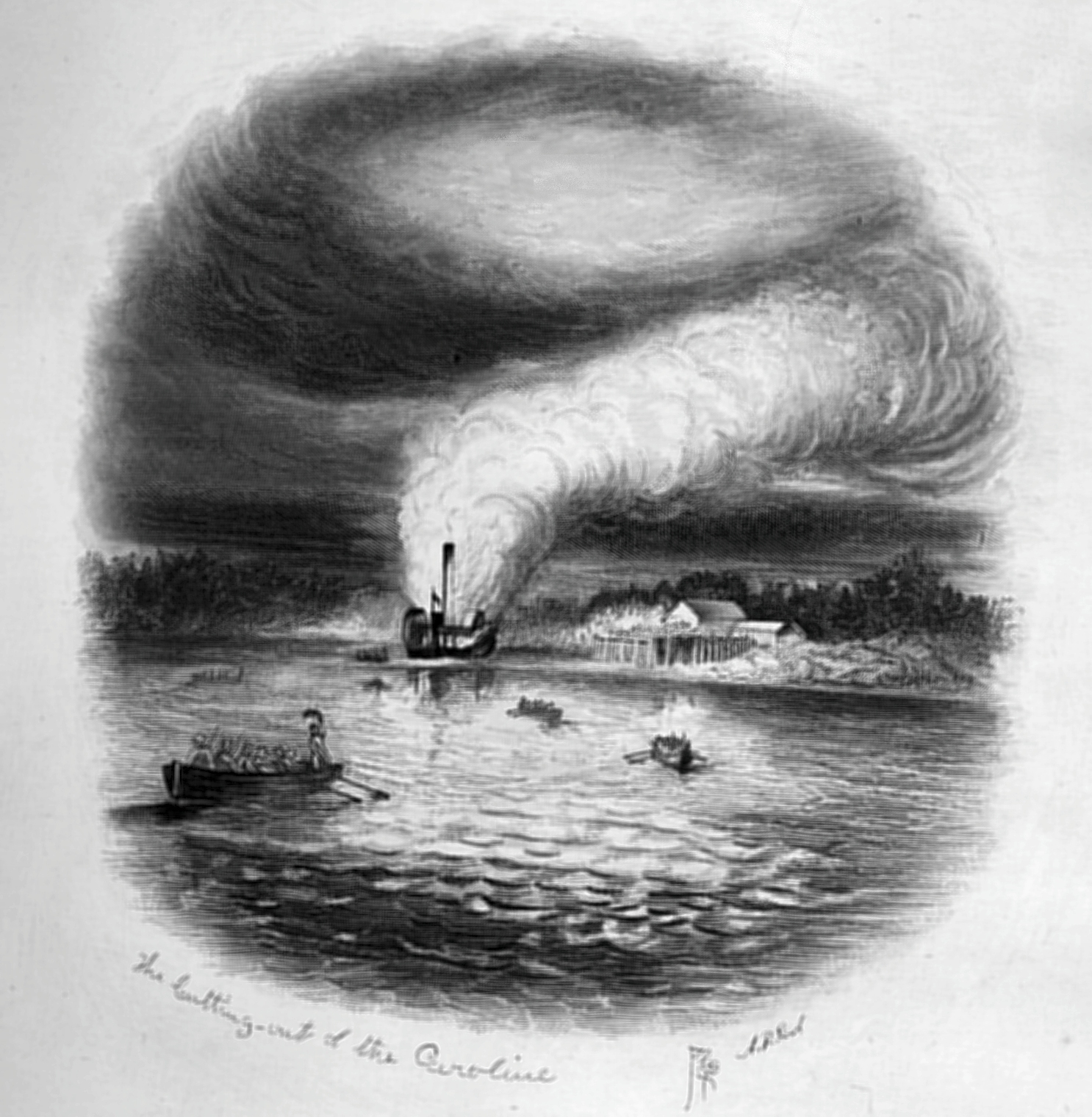
Following contemporary American accounts, most writers describe the Caroline as having gone over the falls of Niagara. The average version is not unlike this: "They surprised the crew, took everybody off the ship, set it afire, and allowed it to drift into the rapids and then over the falls - a truly magnificent spectacle. "[10] The Caroline unfortunately missed its opportunity of going down in history as "a truly magnificent spectacle" by sinking a mile or two above the falls. Had this not happened, there was still a wooden bridge, connecting Goat Island with the mainland, low enough to have prevented the fatal plunge.[11]
Of the questions arising out of the incident of the Caroline, three of the most important find a variety of answers, or no answer at all, in the textbooks. (1) When did Great Britain first assume responsibility for what was alleged by the United States to have been an act of war against that country? It is evident that, until responsibility for the destruction of the Caroline was assumed by Great Britain, the participants in the expedition could have been regarded in no other light than that of Canadian civilians liable to arrest for murder whenever they crossed the frontier of the state of New York, instead of being, as doubtless they were, members of an armed force under governmental order and thus immune from prosecution as individuals. (2) In order to avoid the responsibility of allowing the McLeod case to drag the United States into a war with Great Britain, as it threatened to do, what amount and kind of influence did the federal government of the United States exert in the state of New York in the effort to obtain the release of McLeod after his arrest at Lewiston, N.Y., on a charge of murder and arson in connection with the incident of the Caroline? (3) Even if it be admitted that the courts of the state of New York were technically correct in trying McLeod for his share in the .destruction of the Caroline, was he actually guilty of the main charge of murder, and also, as it was alleged, of boasting openly and publicly of his share in the event? These questions are here dealt with separately.
Part I
The question of. Great Britain's assumption of responsibility for the destruction of the Caroline is best introduced by a brief review of the diplomatic correspondence which took place on that subject between the governments of Great Britain and the United States.
The Caroline was destroyed on December 29, 1837. On January 5 and 19, 1838, Forsyth, the American secretary of state, addressed notes to Fox, the British minister at Washington, asking for an explanation of this "outrage." About the same time, Fox received full particulars of the occurrence from Sir Francis Bond Head, the lieutenant-governor of Upper Canada, who, in the course of a long narrative, stated that the destruction of the Caroline was a necessary measure of self-defence carried out by the military authorities of Upper Canada, and that it had his approbation. Head's account of the incident was forwarded to Forsyth by Fox, along with a note in which he claimed that the piratical nature of the Caroline and the necessity of acting in self-defence seemed to be sufficiently established. Forsyth, in return, asserted that the facts in his possession precluded any such view of the case, and added that, as soon as additional evidence was collected, a demand for reparation would be made to her majesty's government.[12] With this procedure Fox signified his compliance, on February 16, 1838.
On May 22, 1838, following instructions from his government, Stevenson, the American minister at London, presented a formal demand for redress to the British government. In this note, Stevenson, after relating the American view of the case and branding the Caroline's destruction as "a breach of American sovereignty by the armed forces of another power", asserted: "That outrage was planned and executed with the knowledge and approbation of the Lieutenant Governor of Upper Canada." Other similar phrases and several of the American affidavits enclosed in support of his contentions, indicate quite clearly that both Stevenson and his government considered the affair of the Caroline to be an act of public force for which her majesty's government was answerable. Palmerston's reply to this demand was a mere acknowledgement promising consideration.[13]
Two months elapsed before a copy of Stevenson's note was sent to the lieutenant-governor of Upper Canada by the colonial secretary, requesting additional information to enable the foreign office to reply. A draft of the intended reply is attached to this despatch, from which it is evident that her majesty's government, while admitting the public nature of the act, justified its commission upon a variety of grounds and was determined to refuse redress.[14] The information required to substantiate this refusal was forwarded to London without delay; but, as the American government did not press for an answer to its note, none was given, in the expectation, doubtless, that the matter would be allowed to drop.
That it was not allowed to drop was the result of a series of arrests throughout 1838 of British subjects by the state of New York on charges of murder and arson arising out of the affair of the Caroline.[15] The colonial office at once requested the foreign secretary to protest to the American government against this prosecution of individuals for what the world knew was a public act for which Great Britain was willing and able to answer. Palmerston, in reply, enclosed a copy of instructions, dated November 6, 1838, which he said had been sent to Fox for communication to the American government.[16] These instructions state: "The attack upon the Caroline was the public act of persons in Her Majesty's Service, and, according to the usages of nations, that proceeding can only be the subject of negotiations between the two governments, and cannot be made the ground of proceedings against individuals." As far as can be determined from subsequent correspondence between the two governments, these instructions were not communicated to the American government. Since the arrests complained of had come to nothing, Palmerston, if he could possibly avoid it, had no wish to reopen the original question of the American demand for redress for the attack on the Caroline - a question which Washington seemed to be forgetting.
It was not being forgotten on the New York border. On November 12, 1840, Alexander McLeod was arrested at Lewiston, N.Y., as one of the raiding expedition, and charged with murder and arson. The news of his arrest was sent by the lieutenant- governor of Upper Canada to Fox in a despatch dated November 24, 1840.[17] Fox immediately addressed a note to Forsyth in which he, while denying that McLeod was on the expedition, demanded his prompt release, probably on the basis of the instruction which he had received from Palmerston in 1838 and which has been already mentioned. That is, he avowed the attack upon the Caroline as a public act, and denied the right of the United States to proceed against individuals engaged in it. Forsyth countered by saying that, even if the federal government could release McLeod, it would make no attempt to do so. He added, that "if the destruction of the Caroline was a public act of persons in Her Majesty's service ... this fact has not been before communicated to the government of the United States by a person authorized to make the admission", and hinted that a reply to the American demand for redress was long overdue.[18]
Fox had, meanwhile, on December 24,1840, reported McLeod's arrest to the foreign office, giving the substance of his protest to the American government. Palmerston, in reply, approved the course adopted by Fox, ordered him to make a further demand for McLeod's release, and, in a supplementary despatch of the same date, instructed him to leave Washington in the event of McLeod's execution.[19] Webster, who had replaced Forsyth as secretary of state on March 4, 1841, received this formal demand in a note from Fox dated March 12, 1841. He at once adopted the British view of the case, contending that, whatever had been the situation previously, Britain had now positively assumed responsibility for the attack on the Caroline, and that, consequently, McLeod could not rightly be tried by American courts. While steps would be taken to procure his release, Webster declared that the United States would press its original claim for redress.[20]
Great Britain's answer to this claim, which had been presented on May 22, 1838, was not forthcoming till August 27, 1841, making a delay of three years and three months. Palmerston, in his official reply addressed to Stevenson, justified the attack upon the Caroline to his own satisfaction, refused to comply with the demand for redress, and intimated "that the government of the United States was perfectly aware even before Mr. Stevenson's note on May 22, 1838, was written that Her Majesty's Government considered the destruction of the Caroline as a justifiable act of self-defence properly done by the British authorities for the protection of British subjects." He implied that it was a conviction of the justice of this view which had prevented the government of the United States from pressing its claim.[21] Stevenson naturally took decided objection to this imputation, and the cross-fire of notes which followed resulted in his referring the question back to Washington. There it was finally smoothed over by Lord Ashburton and Daniel Webster, when, as part of a general settlement of Anglo-American difficulties, Ashburton admitted that it was regrettable "that some explanation and apology for this occurrence had not immediately been made".[22]
Throughout the correspondence described above two distinct subjects are treated. One is the demand on Great Britain by the United States for redress following an alleged violation of its territory. This redress, after long delay, was first refused by Palmerston, and then virtually conceded by Aberdeen through the mediation of Ashburton. The other subject is a dispute as to Great Britain's responsibility for the attack on the Caroline; that is, as to whether it was a private or a public act. At first sight, the reason for such a dispute is not very evident, since everyone in any way connected with the case knew that the attack was a public act. The American government gathered as much from Fox's note enclosing Head's narrative which has already been mentioned; the evidence collected by that government on its own account from American citizens repeated the authorized nature of the act; and the very language employed by Stevenson in his note of May 22, 1838 (also mentioned above), betrayed a similar recognition. Indeed, the fact alone that the government of the United States was formally demanding redress from the British government showed where the responsibility was being laid, and ordinarily should have prevented proceedings against individual British subjects until Great Britain had disavowed the act.
Her majesty's government, however, could not evade responsibility for the destruction of the Caroline had it so desired. An act performed by the loyal Canadian militia in quelling a rebellion against the crown, an act, moreover, expressly and publicly applauded by the representative of the crown in Upper Canada and by the legislature of that province, simply could not be disavowed.[23] But although Great Britain did not, indeed could not, deny her responsibility for this act, the foreign secretary was in no haste to confirm officially what was to be inferred by his silence; and it seems that some blame should attach to Palmerston for not making the position of his government unmistakably clear long before McLeod was arrested. For, even if he did not consider that international courtesy entitled the American government to some explanation of the British action, at least he knew that British subjects were being prosecuted throughout 1838 in New York courts for participation in the affair of the Caroline, as if that had been a case of common murder and destruction of property. Had the instructions sent, as we have seen, to Fox on November 6, 1838, been communicated to the American government at that time, Forsyth would have had no pretext for shifting his ground when the demand for McLeod's release was made in December, 1840.
When this demand was made, Forsyth, it will be remembered, stated that if the destruction of the Caroline was a public act, that fact had never been officially communicated to his government. Strictly speaking, this statement was true, yet he and his government had all along been proceeding on the assumption that it was a public act. Forsyth's real motive in taking advantage of Palmerston's dilatoriness was to strengthen, if possible, his refusal to take steps towards McLeod's release. The Democrats had been defeated in the presidential elections of November, 1840, Van Buren and his administration being, therefore, due to vacate office on March 4, 1841. During such an interval American executives are disinclined to make decisions in troublesome questions which may be postponed for their successors' attention. The British demand for McLeod's release was a troublesome question, for Britain was now, at any rate, prepared to admit the public nature of the affair of the Caroline. If Van Buren's cabinet accepted the British view, they would be denounced by the anti-British section of the electorate: if they refused, war with Great Britain was a prospect at which the trading and financial interests shuddered. The real difficulty, however, lay in the fact that McLeod had been arrested not by the United States but by the state of New York, and that, owing to the division of powers between the two authorities, the federal government could not bring such cases as McLeod's immediately under its own jurisdiction. The government of the United States was, therefore, placed in the anomalous position of seeing its international obligations compromised by one of its constituent states. Any attempt to coerce the state of New York was, of course, repugnant to good "states rights" Democrats: besides, the governor of New York state, being personally opposed to Van Buren, could not be considered amenable to persuasion.[24] It is, accordingly, little wonder that Forsyth and his colleagues seized any pretext, however flimsy, for placing the incoming Whig administration in a dilemma from which it could not escape.
Part II
A complete outline of Webster's attempts to extricate the federal government from the dilemma described in the previous section has not heretofore been available. Before proceeding with that topic, however, it seems best to give some account of the judicial and unjudicial proceedings in the McLeod case previous to Webster's connection with it. This will serve to fill a gap in the received versions by demonstrating the part played on McLeod's behalf by the British authorities in Upper Canada.
McLeod, as has been stated, was arrested at Lewiston, N.Y., on November 12, 1840, and, after an examination before a magistrate, was lodged in gaol in Lockport. On November 19,1840, he wrote to Harrison, civil secretary for Upper Canada, complaining of his detention and asking that action be taken towards obtaining his release.[25] An interchange of letters took place, and when McLeod had forwarded copies of the evidence taken against him at the preliminary examination, this was laid before the attorney-general for Upper Canada for an opinion. This officer (then W. H. Draper, who later became premier of Canada) advised Lieutenant-Governor Arthur to assist McLeod in procuring counsel, witnesses, and bail if possible.[26] Arthur, after consultation with Fox at Washington, decided to adopt this advice, it being understood that bail, if obtained, would be forfeited.[27] McLeod on December 28, wrote Harrison to the effect that he would be admitted to bail of $5,000 with two sureties for $2,500 each.[28] Draper then sent an agent to Lockport to engage counsel and to arrange for McLeod's bail by inducing two American citizens to go surety for him on the security of the government of Upper Canada. The agent, Campbell, confirmed McLeod's choice of counsel (Messrs. Gardner and Bradley of Lockport) but was unable to obtain sureties for his bail, and reported from Lockport: "The excitement is great and the sovereign people declare that in consequence of the insolence of Mr. Fox, McLeod shall not be bailed."[29] A second emissary succeeded where Campbell had failed. Armed with bonds from prominent Canadians of the Niagara district, he found two sureties with the aid of McLeod's counsel. Only one citizen of Lockport was willing to incur the popular wrath by going surety for McLeod, the other being found in Rochester. When the necessary formalities had been completed, Judge Bowen, who had admitted McLeod to bail, wrote out an order for the prisoner's release; but, as it was late in the evening before the order reached the jail, McLeod decided to remain there over-night. The news of his approaching liberation having become known, a large crowd gathered around the prison, and trained a twelve-pounder against McLeod's cell to prevent his escape. A mass meeting was then held in the court house, before which Judge Bowen and Mr. Brotherson, the surety from Lockport were forced to appear. The latter was coerced into surrendering his surety, and the meeting then prevailed upon Wells, the owner of the Caroline, to take out an action against McLeod for damages, bail for which was fixed at $7,000.[30] McLeod was, therefore, obliged to remain in custody: and the attorney-general for Upper Canada continued to communicate with his counsel concerning lines of defence for the trial which had been set for April.
This exhibition of mob rule at Lockport was severely condemned by a large section of the American press, but no action was taken against the offenders. At the same time, one cannot help feeling that the attempt of the Upper-Canadian authorities to secure McLeod's liberation in this way was singularly ill-advised, as it tended to confuse still further the issues in the case. Fox at Washington was demanding McLeod's release by denying the right of any American court to try him, and that position could only be weakened by accepting bail which implied the validity of the court's jurisdiction.
The authorities of Upper Canada having failed in their attempts to free McLeod, it remains to be seen what success attended Webster's efforts in that direction. When Webster, in April, 1841, accepted the British view that McLeod was not liable to arrest and trial in any American court for his alleged participation in the raid on the Caroline and promised to take steps to procure his release, he was careful to add that: "His discharge must be sought in a manner conformable to the principles of law and of proceedings of courts of judicature."[31] What this meant is explained in a letter of instruction which Webster sent to Attorney-General Crittenden of the United States ordering him to go to New York. Crittenden is informed that, if the case were pending in a federal court, the president would enter a nolle prosequi immediately, but that the president cannot interfere in a state court. It is suggested that the governor of New York has this power. Crittenden is further advised to procure eminent counsel for McLeod, to furnish counsel with authenticated proof of the British government's admission of responsibility, to suggest to them the desirability of transferring the venue of the trial from Lockport and the need of bringing the case before an American court in the event of an adverse verdict.[32] Fox, commenting on these instructions to Arthur, said he believed that Crittenden had been privately instructed to persuade the governor of New York, Seward, to enter a nolle prosequi.[33] Indeed, a false report that Seward had exercised this power reached Washington, and Webster wrote him a private letter of thanks.[34] This was premature; the governor did not intend to risk his political prospects by such an act.
Webster had another card to play. On April 24, 1841, he informed Fox that McLeod was being taken before the supreme court of New York on a writ of habeas corpus, and that evidence, furnished by the federal government, would be produced to show that Great Britain had assumed responsibility for the destruction of the Caroline, and that, consequently, the New York courts had no jurisdiction over the case. Webster assured Fox that this step would lead to a speedy release:[35] Fox was doubtful. His doubts were justified. On July 27, he reported to Palmerston that the supreme court of New York, despite the evidence adduced by the federal government as to Great Britain's assumption of responsibility, maintained the right of the state of New York to try McLeod, and had remanded him to take his trial in the ordinary course of law. "This decision", he goes on to say, "has placed the Federal government in the embarrassing position of having its interpretation of international law contradicted by an inferior power. Webster does not disguise his embarrassment, but the Cabinet have not yet decided what course to pursue." According to Fox, there was talk of sending a message to congress revealing the position of the administration and asking for power to set matters right: but he believed that the existence of a strong war party in the house of representatives might prevent this move.[36] Palmerston's reply of August 18, 1841, was conciliatory in tone, and expressed confidence in the intention and ability of the American government to redeem its promises.[37] Webster thus found himself on the horns of the dilemma which Forsyth had doubtless foreseen.
Some of Webster's irresolution at this period was attributed by Fox to the fact that the new president, Tyler, who, as vice- president, had succeeded on the death of General Harrison, did not see eye to eye with his secretary of state in regard to the McLeod case. Tyler, of course, was not on the best of terms with any of his associates in the cabinet, and they all resigned save Webster, who remained, so says Fox, to prevent the risk of war with Britain.[38] That risk, however, could not have been so imminent as some have asserted. Webster, when pressed by Fox, acknowledged, on September 20,1841, that the federal government had been contradicted by the New York decision; but he also affirmed that, in the event of a jury's verdict of guilty, a writ of error might still bring the McLeod case under review by the supreme court of the United States. Webster also advised Fox that, since the habeas corpus proceedings had failed, it would be well for McLeod to stand his trial without delay as his chances for acquittal were good.[39] A few days later, Fox received a despatch from Lord Aberdeen, the secretary of state for foreign affairs in Peel's new ministry. Aberdeen, repeating Palmerston's instructions of February 9, 1841, ordered Fox to make an immediate report if McLeod were convicted, but to leave Washington only in the event of his execution.[40] It cannot truthfully be said that the issue of peace or war rested directly upon the outcome of the trial at Utica, N.Y., in October, 1841.[41] On the American side, as we have seen, Webster seemed to be confident that a writ of error from an adverse verdict of the jury could take the case into federal courts and, even if Webster were mistaken in this belief, there was always the possibility of the governor of New York exercising his power of pardon to save McLeod in the event of his conviction. The reluctance of the British government to force the issue is seen in the fact that Fox was instructed to leave Washington only if McLeod were executed. Even if Fox left Washington, it was made quite clear to Sir Thomas Harvey, the admiral of the British North Atlantic fleet, and to the commander of the British forces in Canada, Sir R. Jackson, that no hostilities were to be commenced without definite instructions from home to that effect.[42]
Although there was really no danger of immediate war resulting from the decision of the New York jury, Fox reported an increasing uneasiness in Washington as the trial approached. According to him, the current opinion in the United States was that hostilities would commence directly he took his leave.[43] The effect of this belief on President Tyler appears to have been very pronounced, if we are to judge from a report which Fox sent to Aberdeen detailing a conversation which he had had with Tyler on September 30, 1841. The president began the conversation by saying that he devoutly hoped to remain at peace with Great Britain, and continued: "We have done all that we legally could do to procure McLeod's release and prevent his execution and we have failed." After pleading the defects of the American constitution as a reason for foreign indulgence, he promised amendments to prevent a recurrence of similar difficulties. The president then said, in a very agitated manner, that, should McLeod be executed, he would refuse Fox a passport and constrain him to remain in Washington until the British government had time to hear his arguments.[44] If Fox in this report was faithfully interpreting the state of official feeling at Washington, it shows that there was some doubt held as to the favourable outcome of the trial. Fox himself was apprehensive, maintaining that Webster's assurance of being able to continue with the case to federal courts was not shared by all the prominent constitutional lawyers in Washington. It, therefore, seems that, although the issue of peace or war did not hang directly on the outcome of McLeod"s trial at Utica, grave complications, possibly entailing war, might have resulted from his conviction.
As the trial progressed, however, Fox became quite sanguine. On October 11, 1841, he wrote to Jackson, acting lieutenant-governor of Upper Canada:
The case for the prosecution seems to have failed entirely through want of sufficient false evidence. The chief witnesses upon which the prosecution depended have at the last hour either taken fright or been kept out of the way by some private management between the Federal and New York Governments of which I may perhaps learn something further hereafter.
The trial over and McLeod acquitted, Fox recurs to this theme in another letter to Jackson, saying:
Both the President and Mr. Webster had told me that two or more witnesses, men whom the jury would probably believe, were prepared to swear they saw McLeod in the very act of shooting Durfee. . . . This the President and Mr. Webster told me was the evidence they were most afraid of. We shall now perhaps never know what became of this evidence, whether the men took fright themselves or whether they were kept out of the way purposely.[45]
Apart from these two vague surmises which Fox was not able to substantiate, there is nothing in the foregoing account to support the. charges made in the senate that Webster "directly and palpably interfered with the course of justice in New York courts." If anything is proven, it is the truth of President Tyler's confession that the federal government had done all that it legally could do to procure McLeod's release and to prevent his execution and that it had failed. Webster's legitimate attempts to prevent McLeod's trial and to secure his discharge undoubtedly had failed; whether he attempted to influence the decision when it was sub judice cannot be shown. The specific charge made in the senate that Webster appointed the American district attorney in New York to lead McLeod's defence and paid him $5,000 for doing so, is entirely without foundation.[46] Mr. Spencer was retained by McLeod's other counsel, and all the expenses of the case, including Spencer's fee, were paid out of the Military Chest of Upper Canada.[47]
The development of the case may thus be summarized. The federal government, having acknowledged that McLeod could not properly be tried by American courts, and lacking the power to release him directly, took the following steps to attain that end. They tried to persuade the governor of New York state to drop proceedings against McLeod. When this move proved unavailing, they brought McLeod before the supreme court of the state of New York, hoping to secure his release by proving that, since Great Britain had assumed responsibility for the destruction of the Caroline, the courts of New York could have no cognizance of the case. This argument was rejected by the supreme court of New York, and McLeod was tried as a common felon. Webster did not succeed in extricating the federal government from the dilemma presented by the McLeod case. The federal government was rescued by the verdict of the jury in Utica which acquitted McLeod.
Part III
Mr. R. V. Harlow in his Growth of the United States has this to say of McLeod's trial: "Webster was finally able to secure McLeod's release, thanks to a fortunate though perhaps fictitious alibi."[48] This statement contains two errors. Webster, as we have seen, did not secure McLeod's release; and McLeod's alibi, as we hope to prove, was not at all fictitious.
The jury which tried McLeod took twenty minutes to reach its verdict, and the wonder is that it took so long. The witnesses for the prosecution were not of a character or appearance to command respect for their testimony. Several were shown by the defending counsel to be members of Hunters' Lodges, one was a professional witness, another was directly charged with perjury by the presiding judge, the prosecution had to disown two of them, and others were forced to admit personal animus against the prisoner. There is no need to recapitulate the evidence pro and con, for the report of the trial shows that McLeod's alibi was well established and the prosecution so discredited that the jury had no difficulty in coming to a decision.[49] If any of the witnesses for the prosecution were kept out of the way, as Fox suggests, no complaint was made at the trial. His other suggestion that they took fright is much more likely, for how could they, who claimed to have seen McLeod shooting Durfee, explain why they had not come forward with this damning evidence at the several previous judicial examinations which McLeod had undergone?[50] On the strength of the evidence produced in court, McLeod was innocent of the charge of participating in the attack upon the Caroline.
The decision of the American jury is sustained by evidence, which, in the nature of things, they could not consider. An example of this sort of evidence is the confidential correspondence of the principal British authorities connected with the case. In all this official correspondence between the lieutenant-governor of Upper Canada and the British minister at Washington, and between these two and their superiors in London, there is not the slightest doubt expressed that McLeod was not on the expedition. The general tone is that of Arthur who writes to Fox: "I confidently believe he was not there."[51]
There were others who also strikingly expressed their belief that McLeod was not on the expedition. As soon as the news of his arrest was generally known on the Canadian side, a petition was drawn up in the Niagara district, signed by one hundred and twelve residents, including the sheriff and several justices of the peace, and forwarded, on November 21, 1840, to the lieutenant-governor of Upper Canada. The petitioners asked the government to intervene, saying that McLeod, "altho not a participant in the destruction of the Caroline, is now lying in the felons' cell at Lockport." This petition, coming spontaneously from the substantial residents of a district in which McLeod was well known, and in which every detail of the episode of the Caroline must have been notorious, is of great value in refuting the charge of participation brought against McLeod.[52]
In 1845, the whole question of McLeod's conduct was investigated by a select committee of the legislative assembly of Canada, appointed to report on a petition which McLeod had presented to the house, praying some compensation for the injuries he had sustained in health, wealth, and reputation as a result of his imprisonment.[53] The committee reported in favour of forwarding the petition to the crown with a strong recommendation for indulgence. The report, after dismissing the question of McLeod's non-participation as too well known to require comment, continues:
Your committee are of opinion that the said Alexander McLeod did not make any declaration of his having been engaged in the destruction of the Caroline; but that the said report was circulated by those who were disposed to sacrifice the said Alexander McLeod to those popular prejudices which at that time existed on the frontier.[54]
A few statements are necessary to connect the disturbances on the border with the McLeod case. During the year following the suppression of the so-called Upper Canadian rebellion, several incursions of fugitive patriots and American sympathizers, armed in the United States, were made into Canada at Ogdensburg, Shorts Mills, Detroit, and elsewhere along the frontier. These expeditions, it is believed, were organized by secret societies called Hunters' Lodges, which were to be found the length of the Upper-Canadian border. The year 1838 was for the United States one of extreme economic depression, and the Canadian refugees were able to find support among the unemployed and aggressive element around the waterways of New York and Michigan. This element in the population of the American border, whose general feeling was anti-British, had some organization in the Hunters' Lodges, and looked forward to repeating in Canada what had been done in Texas. They had gone so far in October, 1838, as to elect officers for the future Canadian republic. The slate of officers, as communicated by Arthur to General Brady in command of the American forces at Detroit, was: D. Smith of Cleveland, president; Colonel Williams of Ohio, vice-president; and Captain Appleby, former master of the Caroline, was to be admiral of Lake Erie.[55] The vigilance of the two governments, however, prevented these plans from reaching fruition, and the few incursions already mentioned were easily repelled by the British authorities. Of the prisoners taken some were executed, and most of the remainder were transported to Australia.
These set-backs must have resulted in feelings of disappointment and resentment being very general among the patriots and their American friends; and there were not wanting those who wished to avenge the death of their comrades as well as the loss of the Caroline. The attitude of one section of the press along the border is reflected by an editorial pronouncement of the Rochester Democrat upon the destruction of the Caroline, which reads:
"In recording this horrid tragedy we dare not give utterance to our feelings: but we must say that if this outrage be not speedily avenged - not by simpering diplomacy - BUT BY BLOOD our national honor deserves the indignity it has received."[56]
Representatives in congress of the states along the border also felt constrained to express their emotion in bloodthirsty language,[57] and for several years the anniversary of the Caroline's destruction was commemorated in Buffalo by a public meeting in which fiery resolutions were passed censuring the British government for hanging American citizens and the American government for its supine attitude.[58]
Measures of a more practical nature were not omitted. At the general sessions of Niagara county, N.Y., held in January, 1838, a bill for murder was returned against Colonel McNab, Angus (sic) McLeod, and ten others alleged to have taken part in the destruction of the Caroline.[59] No opportunity was neglected of bringing the alleged raiders to justice, as appears from a memorial addressed to the lieutenant-governor of Upper Canada by a number of seamen who had actually taken part in the expedition against the Caroline, complaining that they were prevented from following their trade on the lakes through fear of arrest and persecution in American ports.[60] Their fears were, as already intimated, well founded. In April, 1838, there began a series of arrests of Canadian citizens in New York state, charged with murder and arson arising out of the destruction of the Caroline. In that month Francis Dawson was arrested at Youngstown, N.Y., jailed in Lockport, and released after three weeks' detention.[61] On August 22, 1838, John Christie was arrested in Buffalo and released after proving an alibi.[62] On September 22, 1840, Alexander McLeod was arrested for the first time at Manchester, N.Y.; released by the magistrate through lack of evidence against him, he was re-arrested and hurried to Niagara to answer to the general indictment of January, 1838. Here McLeod was again released, since the name on the indictment was Angus, not Alexander, McLeod. The second arrest of McLeod, which led to all the trouble, took place on November 12, 1840.[63] Even that did not end the series. In March, 1842, and again in April of the same year, J. L. Hogan was arrested on the same old charge at Lockport; but was later freed on a technicality.[64] Considering this list of arrests, the question at once arises: why was McLeod singled out for special attention?
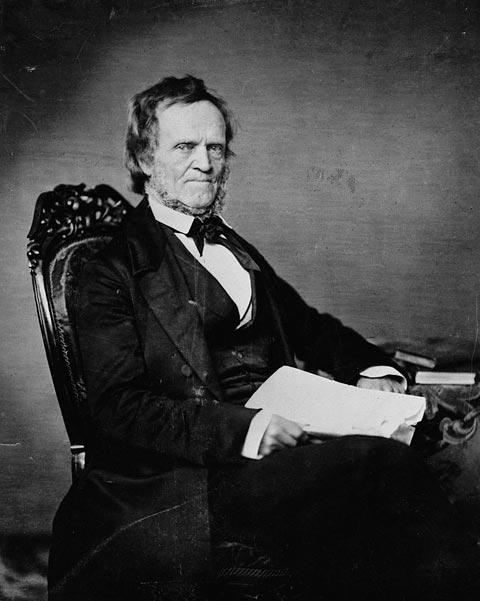
McLeod himself sheds some light on this question in a memorial to Sir Charles Bagot and in an open letter to Sir Allan McNab.[65] Briefly, he asserts that he was the victim not merely of public malice, as instanced above, but of private enmity as well. For one thing, it appears that McLeod was a great deal better known to the Americans than any of the others who were arrested, his position as deputy sheriff for Niagara, U.C., frequently taking him across the line on business. Equally well known were his "anti-patriot" activities during, and after, the rebellion in Upper Canada. Apart from his services on the Canadian side, McLeod, on several occasions, acted gratuitously as an agent to collect information in the United States. On December 8, 1837, he claims to have been at Lewiston, N.Y., and to have learned of an intended invasion of Canada, which intelligence he reported to the lieutenant-governor of Upper Canada. On December 12, 1837, he was in Buffalo reporting Mackenzie's proceedings, and trying to persuade the mayor of that city to suppress them. At Buffalo again, on December 24 of that year, McLeod, after gathering information concerning the movements of the Caroline, had to fly from a mob which considered him a spy. McLeod also states: "I frequently sent my brother Angus McLeod with a similar object (that of gathering news of the patriot activities) to Buffalo." If McLeod's account be true, it sufficiently explains the especial hostility manifested towards him by exiled patriots and their supporters in New York. It also suggests, by mentioning Angus McLeod, the possibility of mistaken identity leading some of the witnesses to swear against Alexander McLeod. Angus, it will be remembered, was the name which appeared on the indictment of the Niagara general sessions; and Philo Smith, one of the principal witnesses for the prosecution, admitted at McLeod's trial that there was a striking family resemblance between the two brothers.[66] Angus, according to Lieutenant-Governor Arthur, was on the expedition, and may well have been taken for his brother in the near darkness.[67]
McLeod himself does not stress that possibility, but goes on to explain the causes of the private enmity which combined with public hostility to persecute him. This enmity arose out of the discharge of his duties as deputy sheriff. Without examination of the complicated details of the situation, it appears that McLeod, shortly after his first arrest of September 22, 1840, became the defendant in a suit brought against him by one Hezekiah Davis. Davis charged McLeod with having sold his, Davis's, property in the execution of a writ taken out by Francis Hincks (later Sir Francis Hincks) and with having pocketed the proceeds after returning the writ marked "nulla bona." McLeod, who seems, to have been entirely innocent of this charge, was on his way from Buffalo, whither he had gone to procure the chief witnesses for his defence, when he was arrested at the Frontier House at Lewiston, N.Y., on November 12, 1840. This inn was kept by J. C. Davis, a brother of Hezekiah Davis and an endorser of the note held by Francis Hincks. In short, McLeod claims that the Davis family and their lawyer, Boulton, took advantage of the resentment against him along the border to serve their own ends. This contention is borne out by the fact that J. C. Davis, his brother-in-law, Philo Smith, and his pot-boy, Charles Parke, appeared as witnesses against McLeod at all his subsequent examinations in New York state, although not one of them testified against him in September.[68] Further corroborative evidence is that Boulton, the lawyer, was later barred from the practice of law in Canada, and that McLeod won the civil suit he was prevented from attending. McLeod's general reputation for honesty is vouched for in a certificate which he obtained from the magistrates of Niagara district, U.C., to support his petition to the legislative assembly.[69]
This collection of evidence supporting the verdict of the jury in Utica, and providing plausible motives for attacks upon McLeod personally, makes it as nearly a certainty as anything can be that McLeod was not on the expedition which destroyed the Caroline. The last question to be considered is: did McLeod ever boast of having taken part in it, thus incriminating himself? In attempting to answer this question, one point may be disposed of at once: McLeod did not, at any time, boast in the United States about his connection with the episode of the Caroline. Not one of the many witnesses brought against him at his various examinations made that charge, as a scrutiny of the proceedings will disclose.[70] The allegation gained currency through its employment by Webster in his speech in defence of the Treaty of Washington, and his rhetorical exaggeration has been repeated by historians ever since. So anxious was McLeod to refute this calumny that he procured sworn statements to the contrary from the American judges who examined him.[71] It is definitely untrue.
All the witnesses who swore to having heard McLeod boasting placed the scene somewhere on the Canadian side of the line, in the vicinity of Chippewa. This fact enables a most damaging criticism to be levelled at the evidence, for over against it we must place the petition, already mentioned, which one hundred and twelve substantial citizens of the Niagara district, U.C., sent to the lieutenant-governor in November, 1840. This petition, which as evidence is preferable in its nature and respectability to that of the witnesses for the prosecution, means that it had been generally known around the district in which McLeod was alleged to have boasted that he was not on the expedition. Surely a well-known figure like McLeod, the deputy sheriff of Niagara district, could not have beep such a fool as to make boasts of the character alleged in such a neighbourhood!
McLeod was first charged with having boasted by a witness examined on December 31, 1837, before an American official investigating the affair of the Caroline; but, at the same time, similar charges were being made against other Canadians who had no share in the expedition.[72] Then, in the testimony placed before the Niagara general sessions which indicted Angus McLeod et al, this McLeod was said to have boasted by a witness who would not give his name. No allegation of boasting was made when McLeod was arrested in September, 1840: but in the inquiry two months later, a good number of witnesses was available to swear to his having boasted up and down the Niagara district over a period of two years. From a legal point of view this testimony was faulty. All the witnesses on this point remembered having seen and heard McLeod uttering his alleged boasts in company, but not one of them could recollect the name of one other person present by whom their testimony might be checked. There was also a very marked similarity in the words McLeod was said to have used in different places, and the witnesses recollected nothing in most cases but one sentence of McLeod's discourse, and that the most damaging. The yarn told by one witness of having seen McLeod in the midst of his boastings, brandishing a bloody sword and an equally bloody pistol, ten days after the Caroline's destruction, would have taxed anyone's credulity. The jury did not place much faith in this testimony: the counsel for the defence, in open court, branded it as deliberate perjury designed to secure McLeod's death, and thus precipitate a war between Great Britain and the United States.[73]
This opinion is concurred in by the magistrates of the Niagara district in that certificate to which reference has already been made. They say in part:
... During Mr. McLeod's imprisonment by the authorities of the United States on the pretence that he was one of the destroyers of the Caroline, we heard allegations against his character, namely that he was a defaulter to the government, had absconded from his creditors, and had vaingloriously boasted that he was one of the party which destroyed the Caroline; we believe these calumnies were without foundation, that they were spread by malicious individuals in order that such slanders might conduce to the conviction and execution of McLeod and consummate their ardent desire - a war between Great Britain and the United States.
These sentiments were re-echoed by the select committee of the legislative assembly, also mentioned above, which considered McLeod's petition for relief.
The evidence adduced, while not conclusive, and drawn partly from ex parte sources, throws strong doubt upon the justice of condemning McLeod, after the fashion of so many books, as a vainglorious drunkard who brought himself and his country into serious trouble by boasting of deeds he never performed.
Footnotes
- [1] Back W. E. Hall, International law, 6th edition (London, 1909), 265; A. P. Newton in Cambridge history of British foreign policy (Cambridge, 1922-23), 11, 240.
- [2] Back A. S. Hershey, Essentials of international public law and organisation, revised edition (New York, 1927), 233.
- [3] Back See United States geological survey, 1901, "Niagara and vicinity."
- [4] Back G. Bryce, History of the Canadian people (London, 1887), 391. The description of Fort Schlosser as an armed stronghold has had great vogue. See W. L. Grant, History of Canada (Toronto, 1922), 203; C. G. D. Roberts. History of Canada (Boston, 1897), 300; J. C. Hopkins, Progress of Canada in the nineteenth century (Edinburgh, 1900), 255.
- [5] Back Public Archives of Canada, Series G, vol. 246, Head to Fox, Jan. 8, 1838.
- [6] Back C. Wittke, History of Canada (New York, 1928), 119, 111.
- [7] Back C. G. Fenwick, International law (New York, 1924), 388.
- [8] Back Public Archives of Canada, Series Q, voL 251, p. 1.
- [9] Back "The trial of Alexander McLeod" (Gould's stenographic reporter, II, Washington, 1841).
- [10] Back F. B. Tracy. The tercentenary history of Canada (Boston, 1909), III, 852.
- [11] Back See narrative of Richard Arnold quoted in J. E. Dent, The story of the Upper Canadian rebellion (Toronto, 1885), II, 214. Also Q, vol. 251, p. 1, C. S. Finlayson to Kingsmill, March 21, 1905. Both these men were survivors of the expedition against the Caroline and their accounts of the Caroline's fate are in perfect agreement. Arnold maintains that the steamer's engine could be seen in the shallow water of the rapids for some years after the event.
- [12] Back G, vol. 246, Head to Fox, Jan. 8,1838, vol. 88, p. 226, Fox to Forsyth, Feb. 6, 1838; vol. 227, Forsyth to Fox, Feb. 13, 1838.
- [13] Back Ibid., vol. 88, Glenelg to Arthur, Aug. 19, 1838.
- [14] Back Ibid., vol. 88, Glenelg to Arthur, Aug. 19, 1838.
- [15] Back Q, vol. 408, part 1, passim.
- [16] Back Ibid., voI. 251" interdepartmental communications, Glenelg to Palmerston, Oct. 24, 1838; p. 227, Palmerston to Glenelg, Nov. 8,1838.
- [17] Back G, voI. 108, Arthur to Fox, Nov. 24, 1840.
- [18] Back Webster, Works, 7th edition (Boston, 1853), V, 121, Forsyth to Fox, Dec. 26,1840
- [19] Back G, vol. 108, Fox to Palmerston, Dec. 27,1840; p. 98, Palmerston to Fox, Feb. 9, 1841.
- [20] Back Webster, Works, VI, 250.
- [21] Back G, vol. 108, Fox to Palmerston, Dec. 27,1840; p. 98, Palmerston to Fox, Feb. 9, 1841.
- [22] Back Webster, Works, VI, 294, Ashburton to Webster, July 28,1842. Lord Ashburton was sent as English commissioner to the United States by Sir Robert Peel's ministry which took office, Sept. 3, 1841. By this change Aberdeen replaced Palmerston as secretary of state for foreign affairs.
- [23] Back Journal of assembly of Upper Canada, 1837-38, 275, 220, 221, resolutions com- mending the action of the militia in destroying the Caroline, and voting sums of money to buy swords for presentation to Colonel McNab and Commander Drew for their part in it.
- [24] Back G, vo!. 108, p. 103, Fox to Palmerston, Jan. 10, 1841.
- [25] Back Ibid., vol. 184a, McLeod to Harrison, Nov. 19, 1840.
- [26] Back Ibid., Draper to Harrison, Dec. 14, 1840.
- [27] Back Ibid., vol. 227, Fox to Arthur, Jan. 3, 1841
- [28] Back Ibid., vol. 184a, McLeod to Harrison, Dec. 28, 1840.
- [29] Back Ibid., Carnpbell to Draper, Jan. 21, 1841.
- [30] Back The Albion (New York, Feb. 13, 1841) printed an open letter from McLeod's
- counsel detailing the events at Lockport.
- [31] Back Webster, Works, VI, 252, Webster to Fox, April 24, 1841
- [32] Back G, vo!. 227, Webster to Crittenden, April 15, 1841.
- [33] Back Ibid., Fox to Arthur, April 20, 1841.
- [34] Back Webster, Works, V, 134.
- [35] Back In his letter of April 24 to Fox Webster said in part: "The undersigned hardly needs to assure Mr. Fox that a tribunal so eminently distinguished for ability and learning as the Supreme Court of the State of New York may be safely relied upon for the just and impartial administration of the law in this as well as in other cases."
- [36] Back G, vol. 227, Fox to Palmerston, April 28, 1841, and July 27, 1841.
- [37] Back Ibid., Palmerston to Fox, Aug, 18, 1841.
- [38] Back Ibid., Fox to Aberdeen, Sept. 23, 1841.
- [39] Back Ibid., Webster to Fox, Sept. 20, 1841.
- [40] Back Ibid., Aberdeen to Fox, Sept. 18, 1841.
- [41] Back Utica was the town in central New York to which the venue of the trial had been transferred from Lockport.
- [42] Back G, vol. 402, Jackson to Stan1ey, Oct. 11, 1841.
- [43] Back Ibid., vol. 227, p. 603, Fox to Jackson, Oct. 25, 1841.
- [44] Back Ibid., p. 613, Fox to Aberdeen, Oct. 12, 1841.
- [45] Back Ibid., p. 596, Fox to Jackson, Oct. 11, 1841; p. 603, same to same, Oct. 25, 1841.
- [46] Back For charges made against Webster in the senate see his speech in defence of the Treaty of Washington (Webster, Works, V, 78).
- [47] Back Public Archives of Canada, Series C, voI. 615, pp. 248, 251, Stanley to Bagot, Aug. 2, 1842.
- [48] Back R. V. HarIow, The growth of the United States (New York, 1925),376.
- [49] Back Gould's stenographic reporter, 11. McLeod's alibi was to the effect that he left Chippewa about 7 p.m. on Dec. 29 and drove to Stamford (a village about six miles from Chippewa) in a wagon with a certain William Press. Arrived there, he spent the night with a family named Morison with whom he was intimate. The following morning, having heard the report of the Caroline's destruction, he rode back to Chippewa, and, after meeting several people on the road, got there about 11 a.m.
- [50] Back These witnesses had five previous opportunities to testify, viz., before Niagara general sessions, Jan. 1838; before Judge Stevens, Erie county court, Feb. 2, 1838; before Justice William Bradner, Manchester, Sept. 24, 1840; before Justice J. Bell, Lockport, Nov. 14, 1840; and before Judge L. F. Bowen, Lockport, Dec. 19, 1840.
- [51] Back G, vol. 108, p. 37, Arthur to Fox, Jan. 12, 1841.
- [52] Back Ibid., vol. 184a.
- [53] Back It will be recalled that the reform government under the leadership of Baldwin-Lafontaine had resigned in 1844. It was replaced in the autumn of that year by a Tory government led by Draper and Viger. McLeod's petition was presented in the first session of the new assembly, so that the leader of the government, W. H. Draper, and the speaker, Sir Allan McNab, had both been intimately acquainted with the case.
- [54] Back Parliamentary papers, 1844-45, IV, appendix ZZ.
- [55] Back G, vol. 246, Arthur to Brady, Oct. 26, 1838.
- [56] Back Quoted in T. Saint Pierre, The Americans and Canada in 1837-38 (Montreal, 1897), 32.
- [57] Back G, vol. 227, Fox to Arthur, Jan. 3, 1841.
- [58] Back Q, vol. 431, part 1, Buffalo Journal, Dec. 30, 1840.
- [59] Back G, vol. 88, p. 483.
- [60] Back Q. vol. 408, part i, p. 16. Arthur to Glenelg, Sept. 18, 1838.
- [61] Back G, vol. 246, Arthur to Fox, April 18, 1838.
- [62] Back Q, vol. 408, part 1, Arthur to Glenelg, Sept. 18, 1838.
- [63] Back Public Archives of Canada, pamphlet no. 1555, "Letter from Alexander McLeod to Sir AlIan Napier MacNab", Jan. 4, 1845.
- [64] Back G, vol. 458, p. 264, Bagot to Stanley, April 19, 1842. It is perhaps significant that no further arrests of this nature took place after Ashburton had virtually apologized for the incident of the Caroline, on July 28, 1842.
- [65] Back Ibid., p. 296; McLeod to Bagot, May 2, 1842. Pamphlet no. 1555, McLeod to MacNab, Jan. 4, 1845.
- [66] Back Q, vol. 431, part 2, p. 468, see testimony given before Judge Bowen, Dec. 19, 1840.
- [67] Back 5ee note #56.
- [68] Back J. C. Davis, Philo Smith, and Charles Parke had previously lived in Canada. At the time of the Caroline's destruction, Davis was the proprietor of an inn at Chippewa, U.C., at which McLeod stayed on the afternoon of Dec. 29, 1837, and in which he was alleged to have boasted on the morning of Dec. 30.
- [69] Back Printed in Parliamentary papers, 1844-45, IV, appendix ZZ.
- [70] Back The references in order of the dates are: Jan., 1838, G, vo!. 88, p. 483; Feb. 2, 1838, Public Archives of Canada, Series S (Sundries Upper Canada); Sept. 24, 1840, Parliamentary papers, 1844-45, IV, appendix ZZ; Nov. 14, 1840, G, vo!. 184a; Dec. 19, 1840, Q, vo!. 431, part 2.
- [71] Back Parliamentary papers, 1844-45, IV, appendix ZZ.
- [72] Back S (Sundries Upper Canada), deposition of Norman Barnum sworn to before N. K. Hall, Dec. 31, 1837.
- [73] Back Gould's stenographic reporter, II.