
The Caroline Affair 1837-1838
By H. A. Musham [ See note. ]
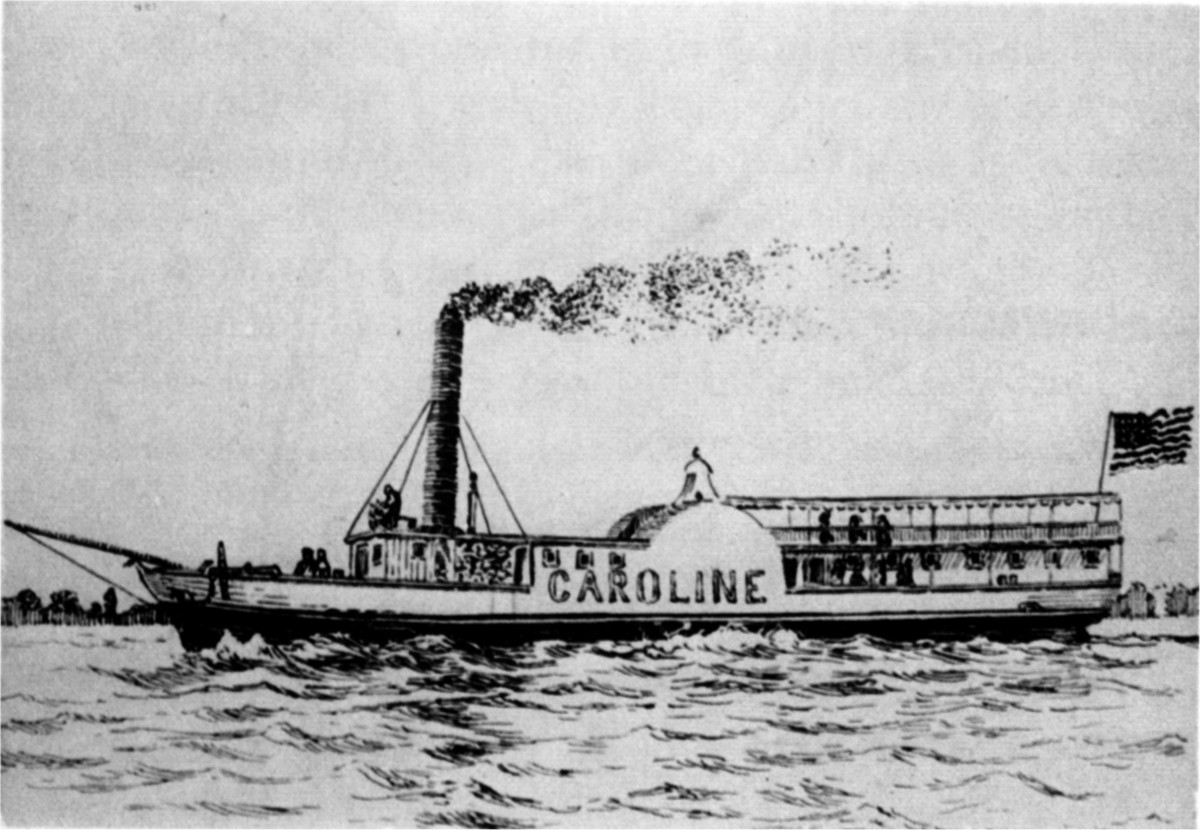
The Caroline was a small steamboat – in fact a very small steamboat, – but one that attained a prominence out of all proportion to its size, and one whose destruction became an international incident which almost plunged the United States and Great Britain into war. Caroline was built at New York by Commodore Vanderbilt in the early eighteen twenties, used there for a time, and then sold to a party of gentlemen in North Carolina for $6,000.00. They operated her for a while on Albemarle Sound and then sold her back up north. She was returned to New York, 1 and in 1834 was taken up the Hudson and ran for a short time as a ferry between Albany and Troy. After this she was dismantled, the side wheels being removed and the superstructure taken down, and was then towed through the Erie and Oswego Canals and taken to Ogdensburg. The hull was built of live oak, and now being in bad condition, was rebuilt there, from the light water-line up, and the wheels and deck works refitted. She was again operated as a ferry, this time across the St. Lawrence to Prescott. Evidently she was not successful in this service and she was moved on once more, this time via the Welland Canal to Lake Erie and to Buffalo where she appeared in June of that year and was hailed as a steamboat curiosity. There she was put into service between Buffalo and Port Robinson on the Welland Canal by way of the Niagara and Chippewa Rivers under Captain James Ballentine. Smuggling is said to have been one of her activities. 2 On 1 December 1837, she was sold by her owner John B. Mason to William Wells of Buffalo for $800.00, and laid up in the ship canal for minor repairs.
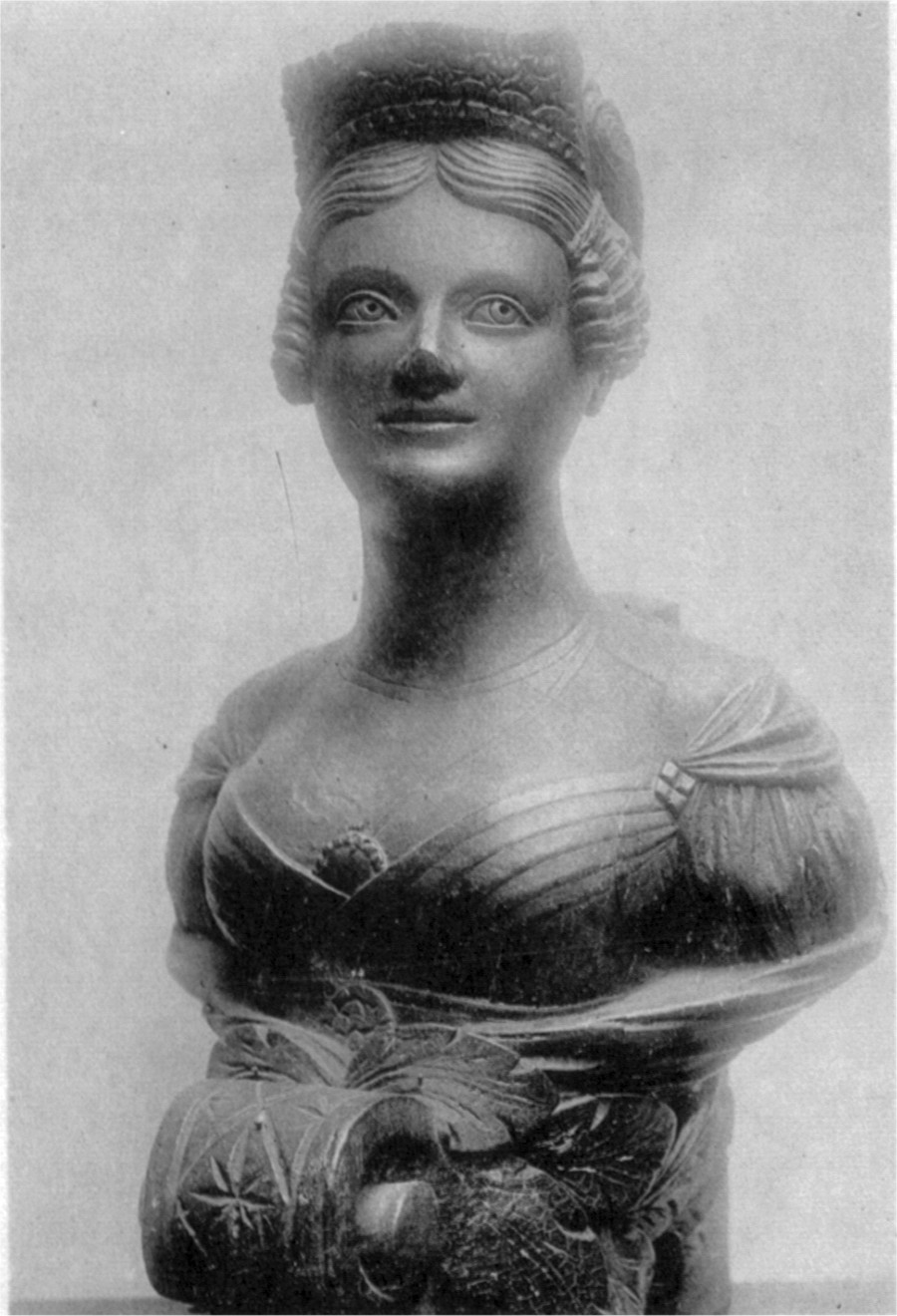
Her enrollment at the Port of Buffalo gives her a length of 71 feet, a breadth of 20.5 feet and a tonnage of 45, 95/100. She was a single decker with a cabin on the main deck. Her engine was of the square low pressure type. She had a clipper bow with a short bowsprit, and carried a tall smoke-stack, but no masts. The stem carried a figure-head (Plate 37) 3 19 inches high, a well carved and altogether pleasing head and bust of a plump and dainty lady, wearing a coronet above her ringlets, presumably representing Queen Caroline, 4 consort of George IV.
The season of 1837 had closed quietly but not without signs of the storm coming in the Canadas. 5 The trouble which had been brewing since before the War of 1812, grew out of the maladministration of their governments, and the factiousness of their peoples. Nominally each province was governed on a representative basis, 6 but actually their affairs were in the close grip of small entrenched groups 7 which dominated the governors sent out by the Crown, and in their own interests.
French Canadians predominated in Lower Canada, while in Upper Canada, the population was made up of immigrants from England, Scotland and Ireland with a large proportion coming from the United States. Most of them were dissatisfied with the oppressions visited upon them by the Loyalist ruling minority, as were the French Canadians. The distress caused by the hard times aggravated their discontent and their leaders, despairing of securing justice from their governments, united in 1837, in a movement to rebel and win their independence as a nation with a view to possible annexation to the United States. The first outbreaks took place in the lower province in October. British troops were quickly moved by Sir John Colborne 8 to the localities involved and by the middle of December, the rebellion there appeared to have been crushed. ‘The Americans of the northern frontier, with few exceptions, strongly sympathized with the rebels. To restrain them, President Van Buren issued a neutrality proclamation on 21 November, calling upon them to obey the laws of the country and warning them that should they fall into the hands of the Canadian Governments, they would receive no aid from that of the United States. To all of this they gave but little heed.
In the upper province the rebellion had been more extensively organized by William Lyon Mackenzie, the leader of the reform movement there. ‘Taking advantage of the absence of the British regulars in the lower province, he proclaimed the independence of Upper Canada and attempted to seize Toronto on 5 December, with a small force of rebels, but failed because of a confusion of orders. Another rising at Oakland, thirty miles southwest of Hamilton, was put down by a militia detachment under Colonel Allan McNab. A few rebels were captured in these two affairs. Mackenzie and others fled to the States. The rebellions to all outward appearances were now over.
Mackenzie reached Buffalo on 11 December and was welcomed with open arms. The following evening he was given an ovation at a large public meeting. The war for Canadian independence, better known as the Patriot War was initiated then and there. Arms, ammunition and other supplies were asked for and arrangements made to receive them. Volunteers were called for and a few of the more enthusiastic enrolled in the Patriot Army. Other meetings followed and an advisory body known as the Committee of Thirteen 9 from the number of its members was appointed. A provisional government for the Republic of Upper Canada was organized. Rensselaer Van Rensselaer, ex-cadet of the United States Military Academy, who aspired to be another Sam Houston, and who had been one of the first to join up, was appointed Major General and Commander-in-Chief of the Military Forces. An elaborate plan of campaign was drawn up for the invasion of Upper Canada with Toronto as the main objective. Navy Island, 10 on the Canadian side of the Niagara River three miles above the falls, was chosen as temporary headquarters and occupied on 15 December. There Mackenzie issued a proclamation establishing a provisional government for the State of Upper Canada, citing grievances and calling upon Canadians to rise and win their independence.
The Buffalo authorities protested these actions but the people paid no attention to them. The movement was now gaining strength. Meetings were held in other cities and towns along the frontier from St. Albans to Port Huron at which money, munitions and supplies were freely given. The principal lack of the Navy Island forces was of arms. To fill it the local armory was robbed of 200 muskets on 12 December, 130 of which were recovered the next day at Black Rock while being taken to Navy Island. Recruiting was actively carried on and about 400 men joined up. Commissions were passed out freely, an unduly large portion being for general and field officers.
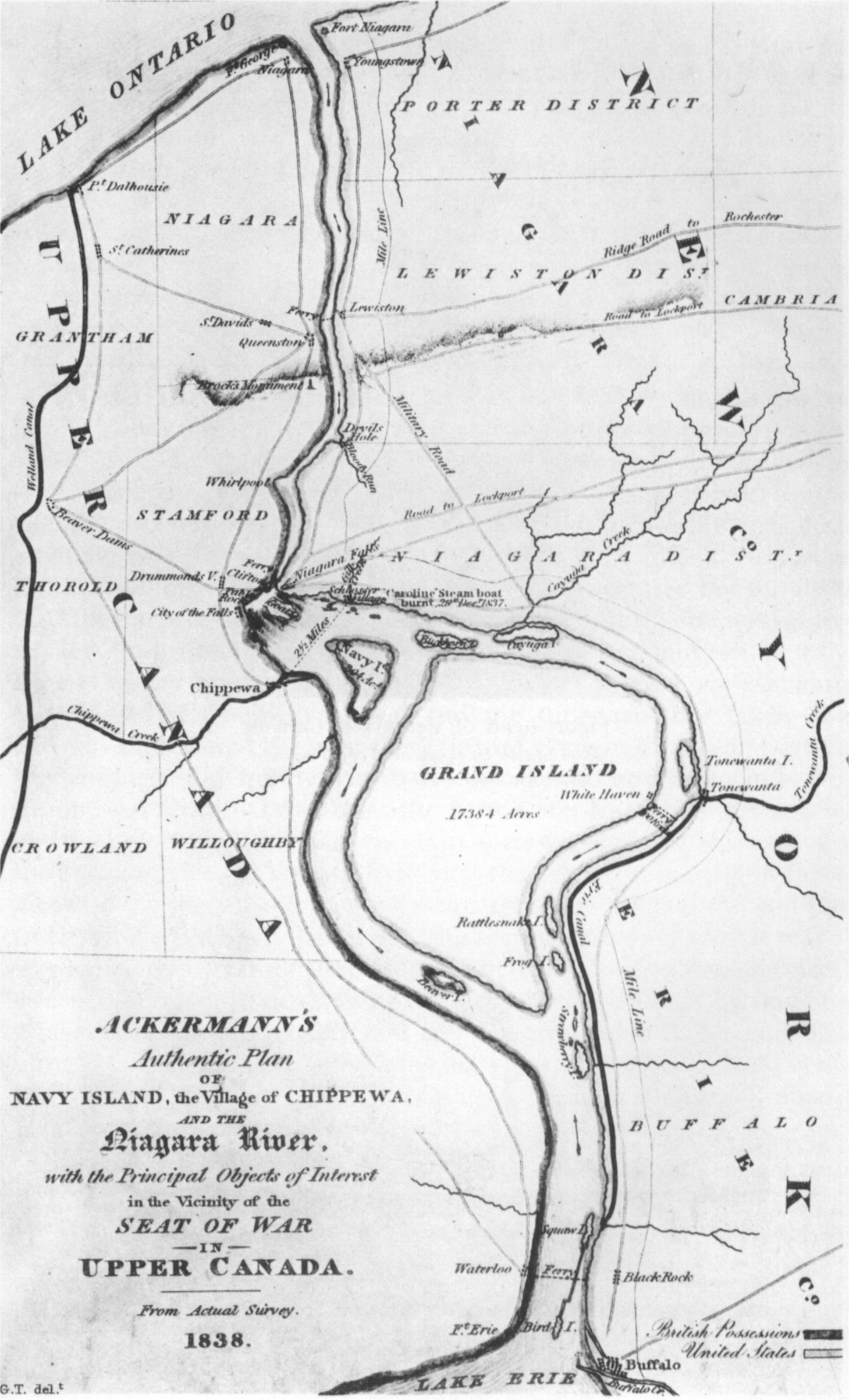
These operations were very disturbing to the Loyalists of Upper Canada who had become very nervous over the possible invasion of the province by this force. To protect it, Lieutenant-Governor Sir Francis Bond Head 11 ordered a militia force of white men and Indians to Chippewa on the main Canadian shore just below Navy Island, placed Colonel McNab in command and re-enforced it until it had a strength of about 2,500 men. McNab on assuming command wrote to the public authorities at Buffalo urging that they prevent the furnishing of supplies to the forces on the island, stating that if this were done the whole affair could be closed without bloodshed, but they were unable to do it. There was considerable firing between the two forces, the Patriots especially taking pot shots at the militia sentries on the Canadian shore.
The pressing need of the Patriot force now was reliable river transportation, which only a shallow draft steamboat could furnish. Caroline, lying icebound in the ship canal at Buffalo, was suitable for such service, and Wells, her owner, was looking for business. On Christmas Eve, one Alexander McLeod, Deputy Sheriff for the District of Niagara on the Canadian side, whose duties called for him to cross the river frequently, heard in Buffalo that Caroline was fitting out to run down to Chippewa. The next day he heard the same thing at the Pavilion Hotel at Niagara Falls. Crossing over to Chippewa, he lost no time in telling the news to McNab. Wells had been approached by the Patriots with a view to hiring Caroline and went to Navy Island on the twenty-sixth, where he saw General Van Rensselaer, Dr. Chapin and a Mr. Flagg, the latter two, ardent patriots. They asked him to put the boat into their service. They told him he could make money in it. He didn’t say yes and he didn’t say no, but nevertheless applied to the Collector of the Port of Buffalo Creek for a clearance to carry passengers and freight between Buffalo and Schlosser 12 and intermediate points, and was given one. The Collector told him he could carry anything he liked, including guns. There was talk by some of the Patriots of an indemnity bond, but he did not ask for one, nor was one given him. Caroline was cut out of the ice on 28 December, at little expense to him or anybody that he knew of. A good many helped in the work. 13 McNab was worried about Caroline and on the morning of the twenty-eighth sent Captain Graham, one of his officers, and McLeod out in a boat rowed by eight sailors to locate her. They did not find her as she was still at Buffalo. She left Buffalo on the morning of the twenty-ninth, with not more than a half dozen passengers. Her freight consisted of one cask of heavy articles and some others, for the transportation of which Wells was paid $10.00. Gilman Appleby, a lake sailor, was captain and Wells was one of the engine-room force. Caroline stopped at Black Rock on the way down but took on no freight. 14 There she hoisted the American flag. As she left a volley of musketry was fired at her from the Canadian shore which did no injury. She continued on down to Navy Island unmolested, tied up to the scows moored there for a dock and landed her passengers and freight. She then crossed over to Schlosser, and that afternoon two trips were made to the island. Some muskets and an artillery piece were taken over, along with a number of spectators at twenty-five cents a head. 15
These proceedings were nervously observed from Chippewa by McNab and Commander Andrew Drew, R.N., his naval aide, through field glasses. They discussed the possibility of stopping her further activities by seizing her. On McNab’s orders, Drew reconnoitred the island and the landing at Schlosser that afternoon in a small boat, accompanied by one man and reported that she could be cut out. McNab became excited and ordered him to do it. A watch was posted to keep her under observation. At 5:00 P.M., it reported her to be at the island.
Caroline returned to Schlosser at 6:00 p.m. There she was made fast to the dock in Gill Creek with chains. During the evening 23 men, unable to find accommodations in the nearby tavern, came on board, asked for and were given sleeping quarters. At 9:00 P.M., a two-man watch was set. About midnight some of the crew returning from Niagara Falls, waked Wells and told him their bunks were occupied. He turned the strangers out of them. On board then was a total of 33 men, 10 of whom belonged to the crew. All were unarmed. 16
At 11:00 P.M., after the moon had set, Drew set out for Caroline with 45, volunteers in seven boats. Believing her to be still at Navy Island, he went there first, but not finding her there he passed around the island, saw her lights across the river and set out for her. 17 About midnight, Wells went on deck and one of the watch told him a boat was approaching. He ordered him to look after it to see who was in it and then went below. A short time later the watch waked him and reported that four or five boats filled with armed men were approaching. Appleby was also informed.
The alarm was given but before the sleeping men could reach the deck, Drew’s party boarded her at both bow and stern, crying: ‘hurrah for Victoria,’ and ‘made war upon the defenseless crew and passengers with muskets, swords and cutlasses, under a fiery cry of – damn them, give them no quarters, kill every man; fire! fire!’ They made no resistance and abandoned the boat, their only effort being to escape the slaughter. 18 The fracas lasted but two minutes.
Drew intended to take Caroline to Chippewa, but believing he could not tow her across with the boats, sent Richard Arnold, one of the party, below to light the boiler to raise steam. As Arnold reported it would take too long a time to do it, Drew decided to burn the vessel. Clothes from the ladies cabin were strewn about the cabins. A jar of oil found on board was poured over them and all around the boat. She was released from her chains with some trouble by Edward Zealand, another of the party, and towed out into the stream about twenty yards. There she was touched off and abandoned to the current. There were two casualties in the party, Lieutenant Shepard McCormick, R.N., being desperately wounded and John Arnold, quite severely. 19 The boats returned to Chippewa, safely guided by a big beacon fire set by McNab, and were enthusiastically received, the cheering being heard at Schlosser. But there on the dock with his brains scattered about, lay Amos Durfee 20 of Buffalo, one of those who had been on board the Caroline. He had been shot in the back of the head, the ball coming out through the forehead. 21
The current took the blazing Caroline downstream for a short distance, where she grounded on a bed of rushes. It released her after a time and carried her on, but she grounded again this time some distance above the falls. There the upper works burned off, the flames lighting up stream and shore and there she sank. She did not go over the falls. 22
McNab elated at the success of the expedition immediately dashed off the following report to the Honorable Jonas Jones, A.D.C. to Governor Head: 23
Headquarters, Chippewa, Dec 30th, 1837
Saturday Morning, 3’ o’clock.
Sir: I have the honor to report for the information of his excellency the Lieutenant Governor, that having received positive information that the pirates and rebels had purchased a steamboat called the Caroline, to facilitate the intended invasion of this country, and being confirmed in my information yesterday by the boat (which sailed under British colors) appearing at the island, I determined upon cutting her out; and having sent Captain Drew of the Royal Navy, he in a most gallant manner, with a crew of volunteers (whose names I shall hereafter mention) performed this dangerous service, which was handsomely effected.
In consequence of the swift current it was found impossible to get the vessel over to this place, and it was therefore necessary to set her on fire. Her colors are in my possession. I have the honor to be sir, your ob’t humble servant.
A. N. McNab, Col. Com’ing
P.S. We have two or three wounded – and the pirates 24 about the same number killed.
Captain Appleby hastened to Buffalo and told his story to H. W. Rogers, Assistant District Attorney of Erie County and acting for the United States. He stated twelve men were believed to be either murdered or drowned and that Caroline had gone over the falls. 25 Another story was spread that some wounded Americans were on the blazing craft when it made the plunge. Durfee’s corpse was taken to Buffalo and displayed in an open coffin on the piazza of the city hall. The crowds filed by, paid their respects and freely expressed their indignation. His funeral was made a public affair which a large crowd attended. The wildest rumors were rife. The Patriots were to be driven from Navy Island and the country was to be invaded. The northern frontier seethed. On 9 January, the grand jury at Lockport indicted McNab and his companions for the murder of Durfee.
The Loyalist elements in the Canadas were rapturous over the news. Governor Head approved McNab’s action, commended and thanked Captain Drew and his men, stating he would lose no time in reporting their conduct to her Majesty’s Government. 26
The Patriot cause at this time was not making much headway. Th cutting out of Caroline was the very last thing that McNab should have ordered done. Her destruction and the killing of Durfee made the situation worse. It put new life into a dying cause, gave it what it lacked heretofore, an effective slogan: ‘Remember the Caroline,’ and rallied the American people to its support. What had been a thwarted rebellion now became an international affair. For this blunder, McNab was alone responsible. The old antipathy to the British now came out in full force and all over the states. The cry arose for war with them and their expulsion from the continent. The news reached Washington on 4 January 1838. President Van Buren immediately ordered Major-General Scott to the Niagara frontier to bring the situation under control. The next day he issued another neutrality proclamation, this time warning violators of arrest and punishment. It had about the same effect as that of 21 November.
The operations along the Niagara frontier were supplemented by a rising in the London district which accomplished nothing. In the meantime the Patriots along the Detroit River were keeping Brigadier-General Hugh Brady, in command of the Northwestern Department of the army at Detroit, busy trying to circumvent them. Hearing they had designs on the guns at Fort Gratiot, then ungarrisoned, he sent a detachment of troops there in General Macomb to guard them until they could be removed to safekeeping. The Patriots made an attack on Malden on 8 January, which got as far as Bois Blanc Island close to it, from which they were driven by a force of Canadian militia. General Gratiot, Little Erie, both American and Alliance, Canadian, played minor parts in this operation.
At Navy Island the situation was far from quiet. There was considerable musketry and cannon fire across the river between the Patriots and McNab’s militiamen, heard at times as far as Buffalo and it made the people nervous. McNab was daily expected to attack the island but did nothing. The Patriots still held to their plan to cross the river, defeat McNab’s force and march on to Toronto. A landing was to be made near or at Chippewa from yawls and flats to be towed across the stream by a steamboat. This they did not now have but hoped to get. The owners of Barcelona – about twice as large as Caroline – were interested. They cut her out of the ice at Buffalo and took her down the river to be offered to the Patriots. General Scott reached Buffalo on 12 January. Determined to prevent another Caroline incident and to curb the activities of the Patriots, he sent an agent to the owners and hired Barcelona for official use while the Patriots were trying to find sureties to pay for her loss or any damages incurred while in their service. Scott outbid them by $500.00. The situation on the island was now becoming desperate. Food was running short, the weather had turned bitter cold and the shelter was most inadequate. Scott succeeded in convincing the Patriots at Buffalo of the hopelessness of their situation. He hastened to the island and likewise convinced Van Rensselaer. But Van Rensselaer kept his force under arms on the thirteenth from sunset to midnight in readiness to embark for the attack to be made on Chippewa should Barcelona show up. The decision to evacuate the island was made by the Committee of Thirteen on the thirteenth and he agreed to it. The next day the troops were ferried across to nearby Grand Island, marched across it to the landing on its eastern shore where they were taken over to the mainland. There they gave up their arms and cannon except such as they were able to conceal. ‘These were later moved by wagons to friendly farmers along the south shore of Lake Erie, who hid them for use in future operations.
McNab occupied the island on the fifteenth, the day on which most of the Patriot force boarded Barcelona, with some of their equipment, for Buffalo. The British had determined to destroy Barcelona as they had Caroline and this to prevent the Patriots from making an attack on Canada at some other point. Captain Drew had placed three armed schooners in American waters above the head of Grand Island, and supported them by batteries on the Canadian shore. He intended to sink Barcelona as she cleared it on her way upstream. Informed of this, Scott placed batteries below Black Rock to cover her passage, and informed the commander of the schooners on the fifteenth, by letter, that he was there with the Governor of New York and troops to enforce the neutrality of the United States and that unless the Patriots should attack first – in which case they would interfere – they would be obliged to consider a discharge of shot or shell from or into American waters from the schooners as an act seriously compromising the neutrality of the two nations. The next morning the same warning was repeated and explained to a captain of the British army who had visited the General on other business. He immediately went over to the schooners. About that time Barcelona was seen coming up the river. It was a tense situation out of which could come either war or peace. Better judgment prevailed on the British side and Barcelona was allowed to pass without molestation. 27
Scott now turned his efforts to quieting the people and succeeded to a certain extent by the use of persuasion, he having no troops at hand other than the few he had picked up on his way to Buffalo.28 At this time, no American military post along the frontier was garrisoned, nor were there any armed public vessels on the lakes except the revenue cutter Erie of 60 tons. 29 Scott used Barcelona while moving up and down Lake Erie. He understood fully that the steamboats were the key to the situation. Without them the operations of the Patriots and their supporters, and the British efforts to suppress them, were impossible. Scott warned their owners that he would seize their boats if they sold or hired them to the Patriots or let them use them.
The Navy Island Patriots were supposed to have disbanded, but this was far from being the case. Fredonia, a small place three miles inland from Dunkirk, had been chosen as the rendezvous point for a force which was to assist in another assault on Upper Canada from Detroit and they were seen making their way long the shore of the lake to it. Their headquarters at Buffalo had succeeded in hiring the steamboat New England to move them on to Detroit. On hearing of it, Scott seized her for government service and put Lieutenant Stephen Champlin of the Navy in command. He also took over Robert Fulton. On 21 January, Robert Fulton, under Lieutenant Homans of the Navy, left Buffalo with a detachment of regulars in command of Colonel W. J. Worth, to disarm the Patriots. She reached Dunkirk the next morning. There the troops disembarked and marched to Fredonia where 900 Patriots were found. They surrendered to Worth who seized 390 stand of arms and moved them safely to Robert Fulton, which proceeded on up the lake with the troops, arriving at Detroit.on 27 January. The weather was bad and there was considerable ice in the lake. Fear was expressed for the safety of the vessels in the government service. To facilitate navigation, orders were issued to put the lighthouses into service. 30
Outwardly the frontier was quiet, but under cover the Patriots were preparing for another assault on Upper Canada which was set for Washington’s Birthday. Three attempts at invasion were to be made. ‘The first of these, which was to take Kingston, started on time but was a complete fiasco because of the incompetence of General Van Rensselaer. His force of 500, which marched from French Creek, crossed the arm of the river on the ice to Hickory Island and refused to continue on to the main Canadian shore. The second attempt at invasion was made on 23 February, when a force of about 400 Patriots, mainly from Cleveland, crossed the Detroit River on the ice to Fighting Island 31 on the Canadian side. They had depended on securing the muskets, cannon and other supplies of the Navy Island force, which were for the most part seized by Colonel Worth at Fredonia. They were practically unarmed and were easily driven from the island by British troops attacking across the river on the ice. The steamboat Little Erie was used by the Patriots in this operation as a supply ship. ‘These attacks were to be supported by an invasion from Vermont, but this attack like that on Kingston was also a fiasco. The Patriots were caught between British and American forces and allowed to return to Vermont. Another attack was made early in March from Sandusky Bay. The lake was frozen over with ice fifteen inches thick. About one thousand Patriots crossed on it to Pelee Island in the last days of February and were driven off on 3 March by a force of British troops under Colonel Maitland.
After all these failures, the Patriots subsided for a time and the frontier quieted down. On 10 March, Congress after much debate, passed a new neutrality law. ‘This gave the President the power to use the military and naval forces and the militia to enforce it. Federal officers and others empowered by the President were authorized to seize or detain any vessel, arms, munitions of war provided or prepared for any military expedition of foreign prince or state, or of any colony, district, of people adjacent to the United States. There had been no use of armed vessels by the Patriots in these operations and none by the British other than their employment of the schooners in the Barcelona affair. The British Government however was alive to the situation and informed Sir John Colborne, in command of the military forces in the Canadas, that it thought it expedient to provide for a small fleet on the St. Lawrence and the Great Lakes, consisting chiefly of a few armed steamboats adapted to that navigation. It did not intend that any extensive preparations should be made for a naval force, but that only due precaution should be taken for securing the means of carrying on any necessary operations on those waters with the aid of small vessels to be procured in Canada. Captain Sandom, R.N., was ordered to Canada to take charge of these naval operations. 32 Accordingly Traveller and Experiment were acquired by the government, the former from John Hamilton for £9,000, after the season opened, and the latter from James Lockhart for £4,500, on 21 June. 33
The troubles in Canada, coming as they did in the first year of the young Queen’s reign, shocked the British people deeply. The rebellion had to be put down and peace restored to the provinces. Sir George Arthur, formerly governor of the penal colony of Van Dieman’s Land and successor to Lieutenant-Governor Head 34 reached Toronto in the early spring. Sterner measures were to be adopted. 35
The failures of the Patriots’ attacks brought down the vengeance of the Loyalists on their supporters in Canada. Thousands of them fled to the States where in a short time they were in desperate straits. ‘To locate and aid them, the Canadian Refugee Association, a secret society, was formed on 19 March, at Lockport, New York. It did succor the refugees to a certain extent, but its main purpose was to further the cause of the Patriots in every way possible. ‘This could be best done by creating incidents that would embroil the country in war with Great Britain. The most vulnerable section of the frontier was that along the St. Lawrence, where, among the Thousand Islands, a thousand refugees were reported to be hiding. Here raids across the river and among the islands became the business of the day. The leader of many of these activities was Bill Johnson, 36 the Patriot Admiral of the Lakes, and bitter enemy of the British and the Loyalist elements.
The extent of the society’s plans are not known, but it had designs on the steamboats that plied Lake Ontario and the river, which were, with the exception of Traveller and Experiment, free of British naval craft. The first steamer to fall victim to its machinations was Sir Robert Peel. John B. Armstrong, her master, had spent the preceding winter in Watertown, New York, where the local Patriots suspected him of being a British spy. To even the score with him and at the same time retaliate for Caroline, the Association planned the destruction of his ship. It further hoped that the act would create the incident that would bring on war with Great Britain.
About 1:00 A.M. on the twenty-ninth of May, Sir Robert Peel, carrying about 19 cabin passengers and 40 in the steerage, Armstrong in command, stopped at McDonnel’s wharf on the south side of Wells Island, on her regular westward run to Oswego, to wood up. Threats of violence had been made against her. A cabin passenger had been given warning of an impending attack but had disregarded it. One Ripley, in charge of the wood at the wharf, told Armstrong that he had seen a long boat filled with men pass by two or three times that night and that on the first appearance of the steamer, he heard the remark: ‘here she comes.’ He suggested that he should not stay too long. Armstrong laughed and brushed the warning aside, saying he could take care of the Patriots as long as they did not come by hundreds. The steamer was kept under observation as she lay at the wharf by some men in a small boat out in the stream. At 3:00 A.M., she was boarded by a party of 2 men led by Commodore Johnson made up as Indians, and armed with pistols, muskets with bayonets fixed and pikes, crying: ‘remember the Caroline.’ ‘The crew and the passengers so rudely roused from their slumbers, were quickly driven off the boat and on to the wharf. Little time was given to them to dress properly or gather their baggage. Some were in their night clothes, a few of them ladies, and the early morning was cold. 37 One of the victims was Major Frasher, half pay British officer and Customs House officer at Brockville. He had intimated earlier in strong terms, ‘that should the damn Patriots attack the steamer they would receive a warm reception, etc.’ He was so frightened when the boat was attacked, that in his haste to reach the wharf he could not find his pantaloons in the dark and appropriated a pair of red drawers belonging to a boy. Reaching the wharf he appeared among the passengers with his red drawers reaching only down to his knees, a ludicrous sight. 38
The raiders went under such aliases as Tecumseh, Sir William Wallace, Judge Lynch, Captain Crockett, Nelson, Bolivar and Admiral Benbow. They systematically plundered the steamer. Toward morning they took her out into the stream and set her on fire. She burned down to the water’s edge, turned over on one side and sank, one paddle-wheel remaining above the water in a horizontal position. The passengers and crew took refuge in the woodman’s shanty and were picked up by Oneida, Captain Smith, which called at the wharf towards daybreak on her regular trip down the river. She put about and returned to Kingston with them. The passengers saved scarcely an article. A Mr. Holditch of Port Robertson lost $6,000.00, most of which was recovered later by the authorities. Sir Robert Peel was a total loss. 39
The news raised great excitement and indignation throughout the Canadas but along the American side and throughout the States it was looked upon as retaliation for Caroline. The Canadian shores were put on the alert. Rumors were rife in Kingston that an attempt was to be made to destroy either Oneida or Telegraph. Oneida avoided trouble by passing Brockville, Loyalist center, on the evening of Friday, 1 June, without stopping, but Telegraph put in there about 10:00 P.M. that same night with a vessel in tow, on her way up the river. She rang her bell twice as she approached. On the wharf was a party of the Queen’s militia along with several other people. Her stay was short and just after she left, she was hailed. Captain Childs stopped her and held her in the stream a short distance from the wharf. He answered that anybody that wished to come on board should put out in a small boat as he could not come back. Just then fifteen to twenty musket shots were fired at Telegraph, four of which hit her and one of which, an ounce bullet, barely missed the chambermaid standing near the stove in the ladies cabin. Childs dropped the tow and made off up stream under a full head of steam. The firing was stopped by the people on the wharf. The captain in command of the volunteer company on duty there went after Telegraph in Kingston, and on overtaking her explained to Captain Childs, when he learned that no harm had been done, that the men who had fired the shots – a sentry party – had misapprehended their orders, which were to fire two shots on the approach of any suspicious boat. Two of the men were later put under arrest. At Kingston, however, Colonel Bonnycastle in command of the Queen’s troops, told Childs that he must expect to be fired into as long as the Americans acted as they did, and added by way of taunt, that the next outrage from our side would be the signal for him to cross the line in a hostile attitude – that the Canadas could take the state without aid from England. 40 All of which did little to allay the serious situation.
The Earl of Durham, who had been appointed Governor-General and Lord High Commissioner with full powers to investigate the grievances in the provinces and to report on a remedy, arrived at Quebec on 28 May. On being informed of the burning of Sir Robert Peel he authorized the offer of £1,000 for information leading to the conviction of any participants.
Governor Marcy of New York also posted a $500.00 reward for Johnson, $250.00 for lesser leaders and $100.00 for any of the others. Johnson was roundly condemned and abused by the Canadian and American presses. To set them straight as to what had been done and why it had been done he issued his own proclamation. 41
To all whom it may concern.
I, William Johnson, a natural born citizen of Upper Canada, certify that I hold a commission as commander-in-chief of the naval forces and flotilla. I commanded the expedition that captured the steamer Sir Robert Peel. The men under my command in that expedition were nearly all natural born English subjects – the exceptions were volunteers for the expedition. My headquarters was on an island in the St. Lawrence, without the jurisdiction of the United States, at a place named by me, Fort Wallace. I am well acquainted with the boundary line, and know which of the islands belong to the United States; and in the selection of the island I wish to be positive and not locate within the jurisdiction of the United States, and had reference to the decision of the commissioners under the 6th article of the Treaty of Ghent, done at Utica, in the state of New York, 13th June, 1822. I know the number of the island, and by that decision it was British territory. I yet hold possession of that station, and we also occupy a station some twenty or more miles from the boundary line of the United States, in what was his majesty’s dominions until it was occupied by us. I act under orders. The object of my movement is the independence of the Canadas. I am not at war with the commerce or property of the citizens of the United States.
Signed this tenth day of June, in the year of our Lord one thousand eight hundred and thirty eight.
WILLIAM JOHNSON.
Several arrests were made all charged with having taken part in the affair. One, a William Anderson, was indicted for arson on six counts and tried in the circuit court and acquitted. With the people feeling as they did it was impossible to convict a Patriot of any such offense. Bill Johnson continued to raid, burn and loot on the Canadian side of the river for some weeks. ‘The Thousand Islands were searched by both American and British military authorities. His retreat on Abel’s Island was discovered on 4 July. In the attempt to arrest the gang, all but two of the eight men found in it escaped, he among them. 42
Both incidents caused much alarm and uneasiness in Lake Ontario shipping. The steamboat United States was warned at Rochester, Oswego and Sacketts Harbor not to stop at Kingston. Owners demanded armed guards for their boats. To secure Canadian shipping from further attacks,
Durham approved Colborne’s recommendation of 8 June that Captain Sandom be authorized to fit out a small armed vessel to cruise among the Thousand Islands and hire additional steamers if he should need them for the river and Lake Ontario. He also requested Vice Admiral Sir Charles Paget, commander of the fleet at Quebec, to permit officers and men to volunteer for service under him. Experiment, already purchased, was armed for service on the river. Four days later the Federal Government informed the British Minister at Washington that it intended to use on Lakes Erie and Ontario two unarmed steamers commanded by naval officers and carrying fifty soldiers each. 43
At this time there were flare-ups of Patriot activity on the Niagara and Detroit fronts. That along the Niagara, sponsored also by the Canadian Refugee Association, consisted of a raid into the Short Hills district by a small party which crossed the River from Grand Island on the steamer Red Jacket. It was dispersed and rounded up by British and Canadian troops. Thirty-two prisoners were captured and taken in Experiment to Toronto for trial. That along the Detroit front was the work of another secret society, the Sons of Liberty, recently organized. Upper Canada was to be invaded on 4 July. Windsor was to be taken and an advance east made in connection with a general rising. The lack of arms was to be supplied by robbing the United States Arsenal at Dearborn. Nothing happened as a Patriot named Baker upset the plans by going off on a looting expedition to the Black River in a small sloop.
On 28 June, the party crossed the St. Clair River near Newport, 40 miles from Detroit, and robbed some country stores. They beat off an attack by some Canadian militiamen and Indians and held their ground. The British authorities sent reinforcements forward in Thames. The Collector of the Port of Detroit heard of the expedition and started for the scene of action with a small force in General Gratiot. On sighting the Gratiot, the raiders ran their sloop aground. Brisk firing broke out from the Canadian shore and they abandoned her and took to the woods. ‘Two or three cannon were found in her hold along with fifteen barrels of flour and a few Canadian prisoners. One of the gang was captured then and five others were picked up later by Governor Marcy. The raid was an indication of trouble to come for General Brady, who took extra precautions to guard the arsenal. As the Patriots could get no arms, there was no invasion.
After the Sir Robert Peel and Telegraph incidents, the frontier quieted down somewhat, but the situation remained grave. At this time there were about 3,000 British regulars in Upper Canada scattered in detachments from Kingston to Sandwich opposite Detroit. Additional troops on the way and a line of barracks and posts along the line was being planned. 44 On the American side, Major General Alexander Macomb and all available regulars were ordered to the frontier. On 5 July Congress voted an increase of 6,650 men for the regular army. In the course of the next few months, Macomb had 2,000 men under his command and raiding across the lakes became more and more difficult. The situation appeared to be under control.
Note: [back] Adapted from a paper by H.A. Musham, American Neptune, Vol, VI, 1947. H.A. Musham was a naval architect and historian of Great Lakes ships and shipping, living in Chicago. He was writing a maritime history of the Great Lakes and this article was a result of some of his research over a good many years in the mid-twentieth century.
Footnotes