
Prince Edward County
Local militia, soldiers and the army
A Proud Militia Record
Although seeking peaceful pursuits, the people of Picton and Prince Edward have never been found wanting, when need arose for them to rally to arms in protection of their homes and those rights for which the British Empire has always stood. In the beginning the County was largely settled by the United Empire Loyalists, those intrepid men and women who remained true to the Union Jack, and refused to come under the flag of insurgency and rebellion, leaving their comfortable homes in the United States, to hew out for themselves new homes in the virgin forests of this county.
With such a background of history, is it any wonder that, when the Mother Country has called them, they have again forsaken those things which have been dear to them, that they may be in the vanguard of those who have answered the call to arms, to support the ‘Motherland, and to stand for freedom against oppression.
The County has a military history of which its people may well be proud. In the last great conflict (this was written prior to WWII, so means "Great War", now often referred to as the First World War) over eight hundred officers and men from this historic county offered themselves on the fields of battle, and of that number about one hundred and fifty failed to return to their homeland, their bodies lying in foreign soil. Their memories will be forever green in the annals of the county’s history.
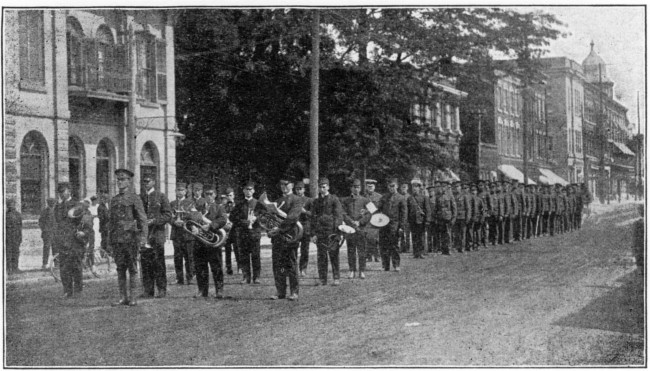
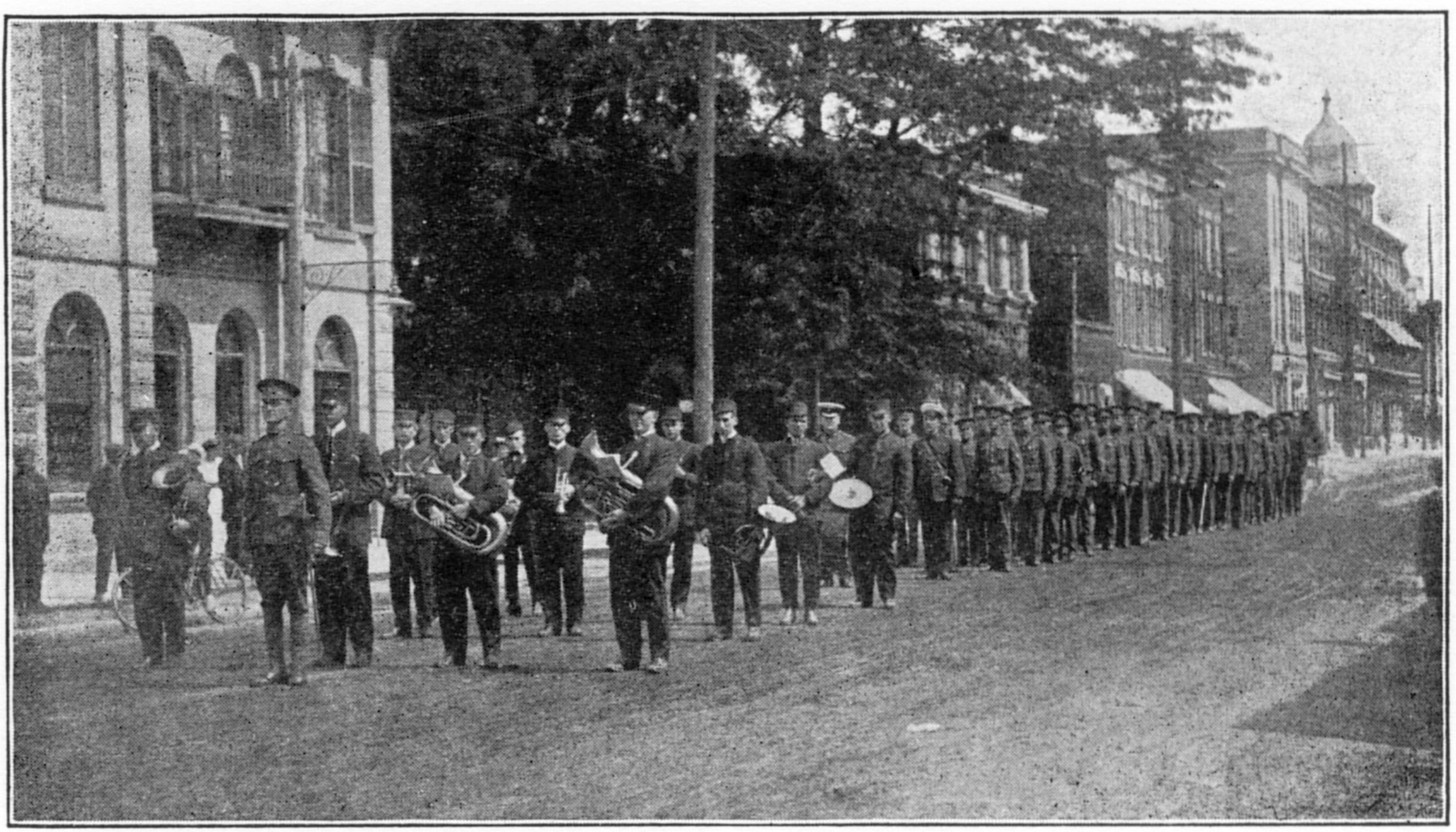
From the date of the first settlement here, which largely was made by discharged officers and men of the British forces, the county was practically under military rule until 1788, at which time a Proclamation of Lord Dorchester, for a few years disbanded the Militia.
However, in 1792, when Governor Simcoe came to Upper Canada, he began the necessary steps to rehabilitate the militia. In that year, the local militia began training at Grassy Point, opposite Deseronto, where training camps continued apparently until 1800, when the annual camp was moved to Hallowell Village, now the Town of Picton, and an effort was made to keep the establishment up to strength from that time.
The War of 1812 gave the local militia the first taste of active war experience and the records show that the county responded very nobly at that time. Following is a list of the officers who were attached to local forces from 1800 until the close of the War. It is to be noted that the Officer Commanding in 1800 was Col. Archibald McDonnell, and as far as can be ascertained, he was the original Commanding Officer of a Prince Edward Militia Unit.
| Col. Archibald McDonnell, Jan. 2, 1800. | Ensign Wm. Blakely, June 4, 1811. |
| Lt.-Col. Daniel Wright, June 2, 1801. | Lieut. James Cumming, June 4, 1812. |
| Major Daniel Young, Dec. 24, 1813. | Lieut. Thos. Howard, March 24, 1813. |
| Capt. James Wright, June 1, 1804. | Lieut. Benjamin Way, Dec. 24, 1813. |
| Capt. Owen Richards, June 1, 1804. | Lieut. Samuel Blakely, March 24, 1814. |
| Capt. John Stinson, July 14, 1807. | Lieut. F. Fergusin, March 24, 1814. |
| Capt. C. Vanalstine, July 14, 1807. | Lieut. Robert Young, March 24, 1814. |
| Capt. James Cotter, June 4, 1811. | Ensign Dan B. Dorland, Feb. 24, 1813. |
| Capt. John Allen, June 4, 1811. | Ensign Daniel Daverne, Feb. 24, 1813. |
| Capt. James Young, June 4, 1812. | Ensign Simon Washburn, Feb. 24, 1813. |
| Capt. Henry McDonnell, March 24, 1813. | Ensign Henry Dingman, Feb. 24, 1813. |
| Capt. David Segar, March 24, 1813. | Ensign Wm. Waldbridge, Mar. 24, 1813. |
| Capt. Peter D. Conger, Dec. 24, 1813. | Ensign Richard Gardner, Dec. 24, 1813. |
| Capt. Simeon Washburn, Dec. 24, 1813. | Ensign Guy H. Young, March 24, 1814. |
| Lieut. Donald McIntosh, July 14, 1807. | Ensign Jacob Howell, March 24, 1814. |
| Lieut. Hildebrant Valoe, Jan. 2, 1809. | Ensign Joshua Hicks, Mar. 24, 1814. |
| Lieut. William Wright, June 4, 1811. | Ensign. Caleb Platt, Dec. 24, 1813. |
| Lieut. Gilliam Demerish, June 4, 1811. | Adjutant William Blakely, Jan. 2, 1809. |
| Lieut. Stephen Conger, June 4, 1811. | Qr. Master B. Ferguson, June 4, 1811. |
In the MacKenzie Rebellion of 1837 this County stood loyal to the flag. She sent two companies of infantry and one of cavalry, besides several detachments. One company saw service on the Detroit border and another was attached to a Toronto Regiment, where they made a fine showing.
In 1863 the various military units throughout the County were amalgamated into the 16th Regiment, which was placed under the command of Lieut.-Col. Walter Ross. At that time there were eight companies in the regiment.
The Fenian Raids of 1866, too, found the County ready to answer the call, and several men and officers served their country well at that time.
Again during the Boer War, also referred to as the the South African War, the clarion call came to the County, and although no concerted movement was made, two detachments went out from the county. Among those who saw service at that time, appear the names of Fred Croft, Alfred Wall, Jack Guest. Following is a list of the officers who were in charge of the militia here from its definite organization as the 16th Regiment in 1863 until the close of the Great War.
| Lt.-Col. Walter Ross, 1863-1883. | Lt.-Col. H. E. Putman, 1905-1910. |
| Lt.-Col. Thomas Bog, 1883-1895. | Lt.-Col. A. A. Ferguson, 1910-1913. |
| Lt.-Col. Alex McDonnell, 1895-1901. | Lt.-Col. M. K. Adams, 1913-1919. |
| Lt.-Col. A. Lighthall, 1901-1905. |
Local Men Quickly Answered the Call
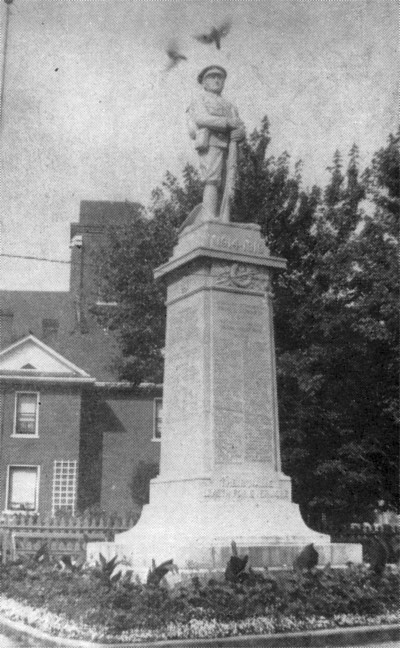
Then came the Great War – a chapter in the military history of this County, of which the county may well be proud during all the years that come. Without a moment’s hesitation, her sons offered themselves in service for the Mother Country, and their record overseas is one which adds lustre to the County’s annals for all time to come.
When on August 4, 1914, word reached Picton that Great Britain was at war, Col M. K. Adams, who was then officer commanding the 16th Regiment, immediately wired the offer of his services and those of his men, to Ottawa. This offer was most gratefully accepted, and inside of two weeks, forty men had enlisted. When the First Contingent left Picton, sixteen days after the declaration of war, there were forty-one men who had enlisted. These men saw service at the first battle of Ypres, and there they played a noble part in stopping the drive for Calais, and several of them fell in that memorable battle.
The second contingent left Picton on Nov. 3, 1914, going across in May of the following year, after intensive training. The third contingent was recruited during the winter of 1914 and 1915, and was incorporated in the 39th Battalion mobilized at Belleville.
Then the 59th Battalion was recruited here during the summer of 1915, and went overseas early in 1916, being mobilized at Kingston.
During the summer and fall of 1915, the 80th Battalion drew several from this county, and D Company of this battalion spent the winter in quarters here in the Armouries. In the same year the 155th was formed with Col. M. K. Adams as O.C. More County men signed up with this battalion than with any other.
The First Canadian Forestry Battalion was organized, with Col. B. R. Hepburn (see short biography) as second in command. The organization was completed in March of 1916, and the county contributed well to this group.
From Milford, in the county, Dr James Howard Walmsley, after qualifying at Queen's University in medicine, left 6 January 1916 for Europe having joined Queen's University Regiment No. 7. After more than two years at the No. 7 Canadian General Hospital, he was injured in a bombing raid and returned to the county.
Early in the fall of the same year the 235th Battalion was recruited at Picton, and again the County responded nobly. The battalion was mobilized for overseas at Ottawa in March of 1917. Also in 1916 the 254th Battalion was organized and drew most of its men from Prince Edward and Hastings, leaving Belleville for overseas in May, 1917.
In June, 1917, it was found necessary to enforce conscription in Canada, and this move drew quite a number more from Prince Edward, although the number in no way equalled those who had voluntarily offered their services. These were mobilized into the 1st Depot Battalion at Kingston and were thrown into active service early in 1918.
Besides these men who offered their services in definite infantry battalions there were also a large number who enlisted in other branches of the service including Field and Heavy Artillery, Army Service Corps, Army Medical Corps, Signal Corps, Engineering Corps, Royal Flying Corps, Royal Navy Air Service, Royal Canadian Navy Volunteer Reserve, and other miscellaneous units.
More Than 800 Served
The total of men and officers from this county who participated in the Great War was over 800, and on the Roll of Honour of those who gave their lives appear the names of some 150 of Prince Edward’s manhood. Truly a patriotic record which glows with the idealism of those who offered their services.
Following the Great. War, the 16th Regiment became a part of the Hastings and Prince Edward Regiment, one company being attached to this county at first. The first O.C. of the local C Company in Picton, was Major Ernest A. Hudgin (1894-1954), who was succeeded by Major (now Lt.-Col.) E. A. Adams and in turn by Major Gordon T. Walmsley (1898-1967). Major Sherman Young is present O.C. of D Company, which was transferred to this county five years ago (1930).
| Officers who have commanded H. and P.E. Regiment | |
|---|---|
| Col A. E. Bywater, V.D. | Lt.-Col. A. V. Yates, V.D. |
| Lt.-Col. Darius Green, V.D. | Lt.-Col. E. A. Adams, V.D. |
| Lt.-Col. H. J. Smith, V.D. | Lt.-Col. B. C. Donnan, E.D. |
Note: the Volunteer Officer's Decoration (V.D) was awarded to volunteer officers for at least twenty years of meritorious service. In September 1930, it was superseded by the Efficiency Decoration (E.D.), and in Canada by the Canadian Forces' Decoration in 1951,
Prince Edward Regiment names
The Hastings and Prince Edward Regiment, often known as the "Hasty P's", was formally created 12 March 1920 as part of the re-organization after the Great War. The chronology can be summarized :
6 February 1863, originated in Picton, Ontario as the 16th Battalion Volunteer Militia (Infantry) Canada
30 November 1866, redesignated as the 16th Prince Edward Battalion of Infantry
8 May 1900, redesignated as the 16th Prince Edward Regiment
12 March 1920, amalgamated with the 49th Regiment Hastings Rifles to form The Hastings and Prince Edward Regiment
7 November 1940 as the 2nd (Reserve) Battalion, The Hastings and Prince Edward Regiment
1 November 1945, redesignated as The Hastings and Prince Edward Regiment
1 September 1954, amalgamated with the 9th Anti-Tank Regiment (Self Propelled), RCA, the 34th Anti-Tank Battery (Self Propelled), RCA, and The Midland Regiment, retaining its designation as The Hastings and Prince Edward Regiment
The above was in adapted from Picton's 100 years, Forces Publication A-DH-267-003, with some additions and minor corrections.