
A Tale of two BANSHEES
by Capt. Gerry Ouderkirk with the Editor
Ship of the Month No. 199, The Scanner, vol XXV no. 2, 1991; with kind permission of the Toronto Marine Historical Society
Today, any loss of life in a marine accident, especially on the Great Lakes, is considered to be a matter of extreme gravity. There was a time, however, when human life was not valued nearly so highly, and when the occasional (and, unfortunately, frequent) loss of life was considered to be something that went hand-in-hand with the operation of ships.
The 1861 navigation season brought the loss of 116 lives in accidents on the lakes. The worst individual loss occurred during November, when Lake Huron claimed 33 souls, being all of the passengers and crew of the steamer KEYSTONE STATE. More obscure, however, was the loss of a single life, an unfortunate passenger aboard a small steam propellor which was lost off Timber Island, on Lake Ontario. [1]
The ill-starred steamer was aptly named BANSHEE. That is the name which, in Ireland and the Western Highlands of Scotland, is given to a female fairy-elf, or spirit, which by its shrieks and wailings foretells a family of the impending death of one of its members. This seems a strangely unpleasant name to give to a passenger steamer, but in fact there were two vessels bearing this rather odd name, both built at approximately the same time and in the same area. Accordingly, it is not surprising that substantial confusion exists as to which of the vessels was intended whenever the name BANSHEE was mentioned in early marine reports.
The first BANSHEE was a small propellor built in 1852, and it was this ship that was lost in 1861. The second BANSHEE, a sidewheeler operated by the Royal Mail Line, was built in 1854 and lasted until she was dismantled in 1876. This second BANSHEE was a much larger vessel.
According to Canadian Coastal & Inland Steam Vessels 1809-1930, by John M. Mills, the propellor BANSHEE was 119 feet in length and 18 feet in breadth of hull, 166 tons, and was built in 1852 at Portsmouth (Kingston), Ontario. Interestingly, however, we have been unable to discover any accounts or mention of her in any of the available 1852 or 1853 newspapers. Steamboat advertising in the public press was very common at that time, and one would think that her owners would have taken pains to advertise the steamer's route and schedule to attract the patronage of the travelling public.
The first advertisement for BANSHEE that we have found is one that appeared on the front page of “The Globe", Toronto, on Monday, April 9, 1855. The steamers ST. NICHOLAS, Capt. Williams, and BANSHEE, Capt. Malcolmson, were owned by Nixon & Swales, of City Wharf, Hamilton. The two ships operated between Hamilton and Kingston and, by the autumn of 1855, they were joined by the steamer CITY OF HAMILTON, Capt. Everett, in a new line of independent freight boats. [2]
ST. NICHOLAS was built at Quebec in 1847 and was broken up in 1861. CITY OF HAMILTON was constructed at Bath, Ontario, in 1850, and was renamed (b) CITY OF THE BAY in 1856, reverting to her original name in 1862 and holding that name until she was abandoned in 1875.. In 1854, Capt. John Trowell, of Kingston, was master of the schooner EMBLEM, of Hamilton, but he transferred to command the propellor BANSHEE later that season. (EMBLEM had been built in 1851 by Melancthon Simpson at Bronte, Ontario. On her second trip from Toronto in 1855, she was rammed by the Great Western steamboat AMERICA off Long Point on Lake Erie, and five of her crew drowned. [3] She later was rebuilt and ended her career as the Picton schooner OLIVIA.)
The "List of Canadian Vessels" published by the Toronto "Globe" on Monday, August 4, 1856, shows BANSHEE, commanded by Capt. Malcolmson, as 150 tons, built at Bath and owned by Nixon & Swales. She was valued at $14,000. The Same statistics were published the following year, but there was an ownership change, the ship now listed as owned by M. V. Browne, a prominent Hamilton wharfinger and shipowner. [4] J. B. Mansfield, in his History of the Great Lakes, lists BANSHEE as built in 1854 at Portsmouth, but this information would appear to refer to the second BANSHEE. Mansfield gave BANSHEE's tonnage as 400, but this apparently also was a reference to the sidewheel BANSHEE, whose tonnage usually was given as 294, or 402 "old tons".
In respect of the tonnage reported for old steamboats, readers would do well to remember the words of the late marine historian, C.H.J. Snider, who remarked that "It should be said that tonnage discrepancies which may be noted need not worry anyone. Even in the same register, tonnage measurements for the same vessel often differ... Tonnage is a subject too deep for landsmen and over the hip-boot tops of many sailors. It should be approached with prayer and fasting, a sense of humour, and the knowledge that a ton is not a ton, but a unit about as definite as 'a heap, a lot, some, any, or plenty'... an arbitrary divisor of one product of certain measurements loosely related to the length, depth and width of a vessel's hull." [5]
BANSHEE was offered for sale in the Toronto "Globe" of January 14th, 1857, the advertisement describing her as "at Hamilton, with a new engine this year by Shepard, of Buffalo". There is no documentation available as to how long Browne & Co. actually owned the steamer.
BANSHEE suffered serious damage on Thursday, October 13, 1859, when she ran on a rock at Whiskey Island, a few miles below Gananoque, in the St. Lawrence River. There was no loss of life, but the propellor went high and dry on the rocks, with her back broken. She had been laden with goods consigned to Upper Canada. Captain Andrew Dunlop, who began his career in 1854 aboard the Royal Mail Line propellor LORD ELGIN, was purser in BANSHEE at the time of her stranding. (He later went on to command the Royal Mail Line steamers CHAMPION, BAVARIAN, ALGERIAN, SPARTAN and CORINTHIAN.) [6]
In 1860, BANSHEE (I) was listed in the "Board of Lake Underwriters: Lake Vessel Register" as 190 tons, built in Kingston in 1852, owned by Higginbotham, with Toronto as her port of hail. BANSHEE was valued at $6,400 and was classed B-2.
It is not known to which BANSHEE the "Daily British Whig" was referring when on July 21, 1860, it reported the grounding of three steamers in Lake St. Peter on Wednesday night, the 18th. The steamer COLUMBIA, downbound for Quebec from Montreal, was the first to go ashore. The upbound steamer QUEBEC went to her assistance and touched bottom, but got off without damage. COLUMBIA was got off in six hours, not much damaged. BANSHEE, reportedly, then went aground, where she remained, taking on water. These strandings took place because a raft of logs had carried away the lighthouse. Two days later, the "Whig" proclaimed that the BANSHEE stranding report was untrue, and that she had arrived at Kingston "quite sound" at about 7 o'clock on Saturday evening, the 21st. [7]
The "false" stranding report could have referred to either BANSHEE, for the propellor still bore this name when she was sold on September 20, 1860, “under a warrant of distress emanating from the Police Court". The purchaser was a Mr. Starnes, of Bath, Ontario, who paid $3,000 for her. BANSHEE was lying in the canal at Bartley & Gilbert's foundry at the time of this sale. [8] She was resold by Starnes, presumably the same year. The Mills list (Supplement #2, 1983) gives a rename in 1860, with BANSHEE (I) going under the name HERO for the season, but reverting to BANSHEE in 1861. According to Mills, she ran on Lake Huron as HERO. If, in fact, this rename ever actually occurred, it must have happened late in the 1860 season, for we can find no newspaper advertisements for her under the name HERO.
BANSHEE (I) cleared the Welland Canal, downbound, on Tuesday, August 20th, 1861, and sank the following night in a gale on Lake Ontario. Captain McCrea, an experienced seaman, was at her helm when she went down in the vicinity of Timber Island, off Point Traverse, Prince Edward County. BANSHEE's machinery reportedly failed and, becoming unmanageable, she foundered.
She had been bound from Port Stanley and Port Dalhousie for Montreal with a cargo of 6,000 bushels of wheat, 250 barrels of flour and 300 kegs of butter.
BANSHEE's upperworks washed off before she was abandoned by her crew. John Nagle, a printer heading home for Montreal, was drowned. Ten were saved in BANSHEE's small boat, and seven more climbed aboard a piece of wreckage and eventually washed up safely on Timber Island. The steamer RANGER passed BANSHEE on Thursday, at which time the latter was sunk in 18 feet of water. Unfortunately, at the time, the seas were running too high for RANGER to attempt to get any of the survivors off Timber Island.
A great feeling of apprehension was created in Toronto when the first report of the wreck arrived. The report was understood as meaning that the larger sidewheeler BANSHEE (II), of the Royal Mail Line, had been lost, and as this boat had departed Toronto on Wednesday afternoon (August 21) for Montreal with upwards of sixty passengers on board, the numerous friends of those persons were exceedingly anxious regarding their safety. The sidewheel BANSHEE, however, passed down the upper St. Lawrence at her usual hour on Thursday morning, the news of this relieving the fears of those in Toronto.
The "Whig" reported that the sunken BANSHEE (I) was in a good position to be raised. It also reported that the purser, Mr. Scott, had saved the books and cash under his care. Later to be a captain, John H. Scott went on to command the steamers COLONIST, ST. LAWRENCE, CITY OF LONDON and SCOTIA, and for many years he was skipper of the famous propellor PERSIA.
Despite the preliminary optimistic report in the "Whig", however, the sunken BANSHEE never was raised. At the time of her loss, she had been owned by Mr. Charles Rose (reported elsewhere as John Rowe), of St. Thomas, Ontario, and by Captain Howard, of Quebec, who was commander of the steamer MAGNET in 1861. Both the cargo (valued at $6,000) and the BANSHEE herself (valued at a conservative $2,000) were insured.
Our late T.M.H.S. member, Willis Metcalfe, wrote: "On Sunday, October 15th, 1967, Mr. Dennis Kent and members of the Quinte Aqua Divers, Belleville, found the wreck of the propellor BANSHEE, which was lost one mile off Pt. Traverse. The remains of the wooden ship were in some 24 feet of water on the Timber Island Bar. Over the winter months, the location was lost, but on July 30th (1968), after nearly two months of searching by Q.A.D., it was refound and pinpointed." Later exploration proved that the remains which they had found and called the BANSHEE actually appeared to be two vessels, one on top of the other. Part of the wreckage appeared to be that of a propellor, and it was in the correct general area for her remains, but it has yet to be determined whether it actually is BANSHEE and, if so, what the identity of the other wreck might be. [9]
The second BANSHEE was a wooden-hulled sidewheeler, 175.0 feet in length, 25.0 feet in the beam and 9.1 feet in depth, and 294 tons. She was built at Portsmouth, Ontario, in 1854-1855 by George Nelson Ault. She was powered by a vertical beam engine, with a cylinder of 40 inches diameter and a stroke of 11 feet, which had been built by Ward's Eagle Foundry, Montreal. She was fitted with very large paddlewheels of the radial (non-feathering) type, which were 30 feet in diameter.
The "Kingston Daily News" on June 21st, 1854, announced the launch of a new brigantine from the Marine Railway Ship-yard at Kingston, this likely being the ORKNEY LASS. There was another, larger vessel on the stocks in the same yard, partially planked. She was a clipper-modelled lake bark, probably the CATARAQUI, owned by Robert Gaskin. At Portsmouth, Mr. Ault had in frame a first-class, fore-and-aft clipper schooner of about 300 tons. (The only schooner credited to Ault in 1854 was the JAMES LESLIE, built at Colborne, Ontario.)
During the 1854 annual "Spring Walk", the editor of the "Whig" reported that at Hatter's Bay “or Portsmouth", as some people absurdly name it, in Mr. Ault's Ship Yard, Mr. James Morton has a good-sized propellor (the WILLIE NICKLE) ready for launching. Mr. George Ault has built the vessel, and her engines have been refitted at the Kingston Foundry. She looks a very handy boat and among the satisfactory commercial doings of the Kingston Millionaire, will be found both useful and profitable. The CHARLEVOIX steam tug, also hauled out at this yard, is being repaired, and will be ready directly.
"Mr. William Bowen, the St. Lawrence Wharfinger, has recently laid down the keel in this yard, of a full sized River Steamer, for himself and the other stockholders of the steamer ST. LAWRENCE (built at Chateauguay, Quebec, in 1848). Many of her timbers are already out, and she will be actively put together during the summer and launched in the fall. She is to be a first class vessel, with all the modern improvements, and the lines of her model evince a capacity for great speed, if due power be placed within her. Next spring, she will be a Mail River steamer between Kingston and Montreal. Mr. George Ault, her builder, is famed for the beauty of his craft, as shown in the MAY FLOWER (sic), the handsomest modelled steamboat on Lake Ontario, and that's saying no small things."
The "Whig", of Friday, December 8th, 1854, announced the Thursday, November 30th, launch of a new steamer "of a beautiful model", launched at Ault's Ship Yard, Portsmouth, and christened BANSHEE. A Mr. Perry, described as "an enterprising young gentleman", immediately laid the keel for another freight and package steamer on the ways on which BANSHEE had been built. Launched in 1855, this was BOWMANVILLE, given in the "Globe" 1857 list as 250 tons, Capt. Perry, built in 1855 at Hatter's Bay and owned by Charles Percy (probably a typographical error for "Perry"). She was valued at $30,000.
We do not wish to delay getting on with the story of BANSHEE, but we would be remiss if we did not say a bit more about the BOWMANVILLE. She was a very large steamer for her day, and indeed she was too large to fit into the locks of the existing Welland Canal. She ran the route from Montreal to Toronto, Hamilton and St. Catharines. Our records show that she was 176.4 x 27.3 x 14.0, 759: Gross and 521 Net. In 1861; she made a special trip from Toronto and Hamilton to Quebec City with excursionists to see the steamer GREAT EASTERN. Sold foreign, she left the lakes on August 11, 1863, for Havana and reportedly foundered en route.
Ault had built the steamer MAYFLOWER in 1848 at Bath, the schooner SARAH in 1852 at Portsmouth, ELIZA QUINLAN at Kingston in 1852, and JAMES LESLIE in 1854 at Colborne. He is then credited with BANSHEE in 1854; the schooner NEWCASTLE at Kingston in 1856; a rebuild of the barkentine GARRYOWEN in 1856 from the bottom of the schooner STORK; the schooner QUEEN OF THE LAKES at Portsmouth in 1858, and the schooner HEMLOCK at Portsmouth in 1864. There is little doubt that Ault was involved in the construction of other vessels as well, but records on the subject are very scarce.
Now back to BANSHEE! Her engine, although built in Montreal as previously mentioned, was supplied by the Kingston Foundry. It was not in her when she was launched, although some of her other machinery was in place. Immediately after the launch, BANSHEE was towed down to Bowen's Wharf, at Kingston, where her construction was completed and the engine installed. She was intended for the River Mail Line, to take the place of the steamer ST. LAWRENCE in 1855, in consort with the splendid new iron-hulled steamer KINGSTON, being built at Montreal by Dunbar & Bartley for the Hon. John Hamilton. The ST. LAWRENCE had sunk in 1852 and had been rebuilt later the same year. Bowen & Company also owned the schooner BAY OF QUINTE. [10]
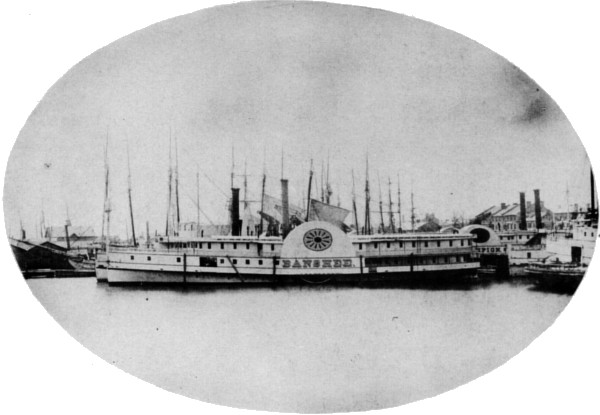
As far as we are aware, there is no known photograph of the first BANSHEE, but we do have an excellent photo of the second BANSHEE, the sidewheeler. It was taken in 1856 at Bowen's Wharf, Kingston, and is reproduced on our photopage. The earliest known photograph of a Great Lakes ship is a daguerreotype of the steamer SOUTHERN MICHIGAN, which was taken in 1853 and is preserved at the Dossin Great Lakes Museum. Photography was scarcely a decade old (in useful form) when Mr. H. K. Sheldon advertised in the "Kingston Daily News": "Views of buildings, machinery, vessels and landscapes, etc. I am prepared to execute in any style of the art." Specimens of his work were exhibited at his Daguerre Gallery at Kingston. It is highly probable that he was the photographer who took this view of the BANSHEE, as well as an equally good view of the sidewheeler KINGSTON. The BANSHEE photo is particularly interesting because of the myriad of other ships which appear in it, [11]
BANSHEE (II) was a handsome steamer, with a pleasing sheer to her hull. She had a curved stem and a counter stern. The cabin on the main deck extended out to the sides of the ship forward of the paddleboxes, enclosing the freight deck area. Aft of the wheels, the cabin was recessed and there was a promenade around the stern. We have no knowledge of any of BANSHEE's interior cabin arrangements, but undoubtedly the purser's and chief steward's offices were located on this deck, aft of the freight area. The ladies' cabin may well have been aft on the main deck.
On the upper deck was the cabin which contained the main passenger quarters, including lounges and staterooms. There was an open promenade all the way around the cabin on this deck, except for the area on each side which was obstructed by the paddleboxes, and a large, open observation area was located forward. Light for the interior of the deckhouse was admitted via a clerestory which ran for almost the entire length of the hurricane deck above. In typical fashion of the day, there probably was no special dining room; tables would be set at mealtimes down the centre of the passenger cabin, between the rows of staterooms.
Far forward on the hurricane deck was placed a small octagonal (or “birdcage") pilothouse, with a domed roof topped by a decorative finial. There were two tall, thin and virtually unraked smokestacks which were set athwartship, just forward of the paddleboxes, and the engine's walking beam was situated between the funnels. As a result of the large diameter of the radial wheels, the paddleboxes were very large indeed, and they rose high above the hurricane deck. There was only one mast, which rose immediately abaft the pilothouse, and the photo of BANSHEE strangely shows no evidence of lifeboats, either on the hurricane deck (where one would expect them) or anywhere else.
The steamer was painted white all over, with some dark shade of trim at deck levels, on fenders and strakes, and at the rails. The ship's name was displayed in large, ornamented letters down the sides of the paddleboxes at the level of the main deck, and as was the custom on the lakes for many years, a period was placed after the name. The paddleboxes themselves were relatively plain, although a decoration in roughly the form of a sunburst was placed with its centre approximately at the level of the hurricane deck.
Perhaps a word of explanation is due in regard to the Kingston BANSHEE photograph. Readers will note that two smokestacks seem to be visible, one shorter and darker, and set to the left of the other. In point of fact, the shorter, darker funnel is one of a pair of 'thwartship stacks that belongs to the steamer moored behind, or inboard of BANSHEE, and the bow of this ship can be seen just forward of BANSHEE's stem. (Unfortunately, we do not know the identity of this steamer.)
BANSHEE's portside funnel is the tall stack visible just forward of her paddlebox and, careful observation will reveal, this definitely is BANSHEE's funnel, as it is set between the camera and the port side of the hurricane deck clerestory. (Only one of the two stacks on each steamer is visible because the view is a dead broadside, taken from amidships.) BANSHEE's walking beam is the one set farthest to the right in the photo, so that its after end is set directly over the centre of BANSHEE's port wheel.
There are numerous discrepancies between the appearance of BANSHEE in the Kingston photograph and a drawing of the steamer which accompanied a history of her on Page 27 of Early American Steamers - Volume III, published in 1964 by Erik Heyl, of Buffalo. Heyl's profile drawing, which supposedly was based on a pen-and-ink sketch "at Toronto Public Library", showed BANSHEE with very little cabin on the upper deck aft of the paddleboxes, with prominent lifeboats set on the hurricane deck aft and, most interestingly, with arch truss frames to provide hog-bracing for the hull. All of this seems very strange indeed, and although cabin arrangements might change from time to time, it is not likely that arch trusses could either be removed or retrofitted. As well, their use was limited almost exclusively to wooden-hulled propellors, and sidewheelers usually carried hog-chains instead. Under the circumstances, we have no alternative but to believe what we see in the actual photograph, as opposed to a sketch of unknown origin or credentials.
BANSHEE appears to have fitted out in the spring of 1855 and operated successfully for the Bowen interests. However, during the evening of Saturday, July 28, 1855, BANSHEE sank in the Lachine Rapids after striking a rock. Her captain managed to run her ashore on Nun Island, where she settled. No lives were lost and the steamer subsequently was raised, the damage being estimated at $500. Mr. McGillivary, the "mail conductor" from BANSHEE, and three men took the mail from the wreck in a jolly boat to Montreal, but it was reported that they nearly were lost between the piers of the Victoria Bridge. Fortunately, they escaped their predicament and landed safely. [12]
The “List. of Canadian Vessels" in the "Globe" of August 4, 1856, listed BANSHEE as commanded by Capt. Howard. She was shown as being of 300 tons, built in 1855 at Hatter's Bay, owned by Capt. Bowen, and valued at $40,000. Her registry at Kingston gave her master as Thomas Howard, who formerly had sailed the steamer ST. LAWRENCE. The registry records also described the ship as being of 294 tons, 173 feet and 5/10 in length, 24 feet and 6/10 in breadth (of hull, not over the guards), and 9 feet and 3/10 in depth: She was carvel-built, with a square stern, and had a single mast and no bowsprit. Her engineroom was measured as 48 feet (in length), and 108 tons.
The registry listed BANSHEE's subscribing owners as William Bowen, Thomas Howard, Mr. Smith, John: Walker, John S. Hoist, Alex. Miller, John Breden, Alex. Summerville and Edward Garwood, executor to the estate of the late Henry Gildersleeve, of Kingston. We should note that the person listed as “Alex. Miller" was, in fact, Alexander Milloy, a native Scot who was a member of the Hon. John Hamilton's Montreal shipping agency for twenty-one years. Milloy owned a small share of BANSHEE, but his first major entrepreneurial step was his purchase of the steamer MAGNET in 1859. In 1861, Milloy became secretary-treasurer of the Canadian Navigation Company when it took over Hamilton's Royal Mail Line. [13]
In 1856, BANSHEE operated under charter to the Royal Mail Line, which operated passenger and freight service from Montreal to the head of Lake Ontario. The line then was run in two divisions. The steamers ARABIAN, MAGNET, KINGSTON and PASSPORT ran from Hamilton to Ogdensburg, via Toronto, Kingston and Brockville. (At the latter port, three steamer lines connected with the Grand Trunk Railroad for Montreal and Quebec.) The second division of the Royal Mail Line was comprised of BANSHEE, NEW ERA, OTTAWA and ST. LAWRENCE, which operated from Montreal to Kingston and the Bay of Quinte. Passengers transferring between the two lines did so at Kingston. [14]
BANSHEE and the other ships of the “river division" of the Royal Mail Line were scheduled to leave Montreal's Canal Basin every day of the week, except Sunday, at 9:00 a.m., and then proceeded up the canal to Lachine, from whence they sailed following the arrival of the noon train from Montreal. Arrival at Kingston was the following morning. There were no Sunday sailings of the line from Montreal.
Commencing in 1857, the two Royal Mail Line divisions were amalgamated into the "Through Line", thus doing away with the need for passengers to change ships at Kingston. The "Through Line" advertised that service was provided from Montreal to Hamilton, with stops at Prescott, Ogdensburg, Brockville, Kingston, Cobourg, Port Hope, Darlington and Toronto. Originally, the Hamilton terminus of the line was at Browne's Wharf, East Flamboro, across the Bay from downtown Hamilton. Passengers were conveyed from the Great Western Railway dock, in Hamilton, across to Browne's Wharf by the ferry VICTORIA.
Joseph Doyle, forwarding and shipping agent for Capt. Bowen, and long associated with the St. Lawrence Wharf at Kingston, leased the Atlantic Wharf at that port for a period of ten years, commencing in 1859. The lease on the St. Lawrence Wharf had been held by Capt. Bowen, who at the time owned BANSHEE and CHAMPION (the latter steamer being partially visible, astern of BANSHEE, in the 1856 Kingston photograph). Most of the old warehouses on this wharf were removed in 1859 and new “fire-proof" warehouses were constructed. The wharf itself was lengthened and widened. George Anderson, Capt. Bowen's book-keeper, assumed the duties of wharfinger for the season.
Lake Ontario played havoc with the sidewheeler BANSHEE on Saturday, October 8th, 1859 (only a few days before the other BANSHEE ran aground on Whiskey Rock). Captain Howard steamed his ship out of Kingston for Toronto at 5 o'clock on Saturday afternoon, but BANSHEE had a tempestuous trip, encountering strong southwesterly head winds and rough seas. BANSHEE was heavily laden with freight and had on board about 140 passengers. When she was within seven miles of Cobourg, it was discovered that she was short of fuel and would not likely make it to port, as she was making very little headway and, at times, the waves were breaking completely over her.
Capt. Howard wisely turned his ship and ran with the wind and seas back to a village near Kingston, where he “wooded her up" (took on wood fuel) and again headed out into the lake. For lengthy periods, the ship made no more than three miles an hour, and once she even was borne backward in her course by the force of the waves. She hauled into the shelter of Toronto Harbour at. 11 o'clock on Monday morning, 44 hours after her initial departure from Kingston. [15]
A typical freight cargo delivered at Toronto in October, 1859, was consigned as follows: S. Gregory, 2 bundles of mail bags; C. Reading, 1 case cocos, 1 case brandy, 2 gr. casks gin: C. Moore 4 Co., 40 barrels herring; J.C. Griffith & Co., 15 baskets champagne, 3 gr. casks spirits, 1 hogshead sherry, 2 cases bitters, 1 case show cards; Cowan & Co., 17 boxes glass; Commissariat Office, 2 bales; Sessions, Carpenter & Co., 10 cases boots and shoes; G. Ewart & Co., 1 pipe wine; Shaw, Turnbull & Co., 1 case; J. Baker, 3 cases; P. Hendershalt, Streetsville, 3 hogsheads earthenware, 1 barrel; McCoppen & Co., Welland, 2 cases; J. M. Cooper, fort Bebineson, 1. case; R. Davis & Co., 3 barrels ale, 5 boxes; J. Flemming, 4 baskets, 10 bags; Heinfeld, 50 boxes, 1 bed; J. Flyn, 89 empties. [16]
In the spring of 1860, the "Whig" announced that PASSPORT, KINGSTON, BANSHEE, NEW ERA, CHAMPION and JENNY LIND would form a line between Kingston and Quebec. The Hon. John Hamilton, who was the Royal Mail Line's chief manager at Kingston, owned PASSPORT, KINGSTON and CHAMPION, and chartered the other steamers for the season. The boats departed Kingston in the night, after the arvival of the express train from Toronto, and reached Prescott or Ogdensburg in sufficient time to take on the eastbound passengers from the Lake Ontario Express Line. The ships would arrive at Montreal early in the afternoon, and proceed down to Quebec the following day.
William Bowen was the agent for the line at Toronto, and Alexander Milloy was the Montreal agent. John Hamilton, in addition, chartered the steamers NEW YORK and NORTHERNER, which had formed the American Express Line in 1859, and these vessels now were run between Lewiston, Toronto, Cape Vincent, Kingston and Ogdensburg, connecting at Prescott with the Mail Line. As well, the company acquired the steamer WALTER SHANLEY, which ran twice a day between Kingston and Cape Vincent, her ferry run connecting with the Grand Trunk Railroad and also with the Rome & Cape Vincent Railroad. The Grand Trunk, in turn, chartered all of these ships from the Mail Line for a period of three years.
Capt. Howard relinquished command of BANSHEE in 1860 to take over the iron-hulled steamer MAGNET, which had been purchased by Alexander Milloy that spring. Her upperworks were totally rebuilt and her machinery was overhauled and improved before she was placed in service. MAGNET connected with the Mail Line ships at Quebec, and departed twice a week for Riviere du Loup, Cacouna and the Saguenay River. The command of BANSHEE passed to Capt. Duncan Sinclair, formerly of the MAYFLOWER. He was described as "a very smart, active officer, and a good seaman to boot". [17]
In 1861, the Royal Mail Line, whose official name actually was the Canadian Inland Steam Navigation Company Ltd., underwent a corporate reorganization, and became simply the Canadian Navigation Company.
On Friday and Saturday, September 27 and 28, 1861, another violent storm hit Lake Ontario, and it was reported that a more severe storm had not been experienced on the lake for 25 years. The wind blew with hurricane force from the northeast, and the seas ran high. At the always-dangerous eastern end of the lake, the storm was particularly severe and inflicted considerable damage upon shipping.
When some fifty miles out of Kingston, on Saturday morning, BANSHEE, which was bound for Toronto with mail and passengers, fractured her shaft whilst labouring in the waves. She put back with great difficulty, only having the use of one wheel, and eventually reached Kingston safely, from which port on Sunday her mail and passengers were dispatched to Toronto aboard PASSPORT. A new shaft was ordered for BANSHEE and repairs were effected at Kingston.
While the steamer had been creeping back to Kingston in the storm, she had met the steamer GEORGE MOFFAT, of Messrs Holcomb & Henderson's freight line, under Capt. Collins, which had been bound from Port Stanley to Montreal. The MOFFAT fractured her propeller shaft and, late on Saturday afternoon, drifted ashore below Long Point, Ontario. The seas broke over her with great violence, stove in her bulwarks and sprang her timbers. She was loaded with flour and dried peas, and the latter swelled when they became wet, and burst the deck of the MOFFAT. Capt. Sinclair of BANSHEE had communicated with Capt. Collins at noon but, being in distress himself, was unable to render any assistance. When BANSHEE arrived at Kingston, however, he reported the plight of the MOFFAT, and the steam tug HERCULES was dispatched to her aid. The tug arrived a quarter of an hour after the MOFFAT finally went ashore, but the waves were running so high that no attempt could be made to haul her off. The crew of the MOFFAT reached shore safely, but their steamer became a total loss.
(It is notable that, in the same storm, the steamer OSHAWA, Capt. Riddell, was driven ashore at South Bend, thirty miles west of Kingston, on Friday night whilst en route from Port Dalhousie to Montreal with flour; her crew got ashore safely but their ship was abandoned to the underwriters. Capt. Robert Gaskin's schooner ST. GEORGE was reported ashore near "The Ducks", and on the U.S. side of the lake, the steamer BAY STATE, Capt. Morley, of the American Express Line, was detained two days in the Genesee River, not daring to venture out. Two propellors were reported ashore on the south side. Said the "Leader": "It is creditable to the staunch steamer ZIMMERMAN that her trips were regularly made throughout the week, not withstanding the severity of the weather. If anything further were necessary, this fact is about sufficient to establish her as a thorough and reliable sea-going Vessel." [18]
Two years later, on August 20, 1863 (otherwise reported as during the night of August 21-22), ZIMMERMAN burned at Niagara with the loss of two lives. Less than two weeks later, on Tuesday, September lst, BANSHEE was downbound in the St. Lawrence, ten miles below Kingston, under the command of Capt. H.E. Swales, when she fractured her shaft and damaged one of her wheels. The incident caused damage of $4,430 to BANSHEE, of which only $1,250 was recoverable from the insurers. All of BANSHEE's passengers were transferred to "the American steamer from Ogdensburg", and BANSHEE was towed back to Kingston that evening.
Her owners were extremely anxious to have BANSHEE operational for Kingston's Exhibition Week, and consequently they arranged to have brought up from Montreal a paddleshaft which had been intended for their new steamer GRECIAN, which was under construction there. The new shaft was quickly fitted in BANSHEE, her other damage repaired, and she was back in service on September 20th.
Just a few days later, on September 23, 1863, BANSHEE was forced to lay over at Toronto due to heavy weather. Again, in November, she was forced to take shelter, this time at South Bay. It is interesting to note that Capt. John Trowell, who had sailed in the propellor BANSHEE (I) in 1855, was mate on BANSHEE (II) in 1863. [19]
At daybreak on Saturday, August 6th, 1864, BANSHEE collided with the steamer EMPRESS, (a) NEW BRA, in thick fo¢, ten miles west of “The Ducks", off Point Traverse in Lake Ontario. Bound for Kingston, BANSHEE sustained damage to her stem, but she was able to continue her voyage. EMPRESS, bound from Kingston to Rochester at the time, was struck abaft the paddlebox on the port side, a fifteen-foot hole being punched into her superstructure, but she also was able to proceed to Kingston for repairs.
The "Buffalo Daily Courier" of April 4, 1865, carried the announcement that the steamer BANSHEE had been sold to U.S. interests, her destination said to be New York, and there is some indication that the potential purchasers may have been Warren, Johnson & Co., importing stationers, wholesale paper dealers, book manufacturers and printers, of Buffalo. This sale, however, does not appear to have materialized. BANSHEE remained idle that spring, her name not appearing on the charter list of the Canadian Navigation Company. She did not fit out until June 27, 1865, when she was chartered (presumably by Bowen, who still had owned her in 1864) to Aeneas Mackay, of Hamilton, for service between Toronto and Hamilton under the command of Capt. T. Harbottle.
BANSHEE was back under charter to the Canadian Navigation Company in 1866. An advertisement by Alex. Milloy, agent, dated May lst, 1866, indicated that the company's “Royal Mail Through Line" from Montreal served Beauharnois, Cornwall, Prescott, Brockville, Gananoque, Kingston, Cobourg, Port Hope, Darlington, Toronto and Hamilton "direct without transshipment". "This magnificent line" was composed of the first class steamships GRECIAN, Capt. Hamilton; SPARTAN, Capt. Howard; PASSPORT, Capt. Kelley; MAGNET, Capt. Fairgrieve; KINGSTON, Capt. Dunlop; CHAMPION, Capt. Sinclair, all of which were listed as "new" iron vessels, and the "rebuilt" steamer BANSHEE, for which no master was shown. [20] We have no details concerning the alleged rebuilding of BANSHEE.
The Canadian Navigation Company actually purchased BANSHEE outright in 1867. The "Kingston Daily News" of March 25th, 1868, stated: "The Canadian Navigation Company (Royal Mail} will have in operation the SPARTAN, GRECIAN, CORINTHIAN, MAGNET, KINGSTON and PASSPORT. The CHAMPION and BANSHEE are held in reéserve." [21]
The Canadian Lake Underwriters' Association list of 1869 records BANSHEE as owned by "The Inland Navigation Company" (sic) of Montreal, and gave her value as $17,000 with the ship classed Bl, with the remark "Not Fit for Heavy Weather". The Lake Vessels and Barges list of 1871 shows BANSHEE but gives no owner for her. The C.L.U.A. list of 1873 gives the same detail for BANSHEE as in 1869, but her value had been dropped to $14,000 and her classification to B2, with the remark that she had been surveyed in 1871.
It would appear that BANSHEE continued to operate in her usual service (when needed) until 1874, but age was catching up with her. Her registry records indicate that she was sold, after many intervening changes, to the Canadian Navigation Company on January 13, 1874, but we are not convinced that this was not simply a late recording of the 1867 sale. In any event, she was sold in 1874 to the St. Lawrence Towing Company, of Kingston. Heyl recorded the name of the purchaser as the St. Lawrence Towboat Company, but the Canadian Lake Underwriters' Association list of 1874 shows "Towing". The C.L.U.A. list also showed the value of the vessel as $14,000 and classified her as C, with a notation that she had been surveyed in March of 1874.
The new owner cut BANSHEE down to a tug, but she operated for them for only a few years, usually towing vessels through the dangerous Coteau Lake section of the St. Lawrence River. The St. Lawrence Towing Company in 1875 became the St. Lawrence Steam Navigation Company Ltd., Quebec. It is believed that BANSHEE, a victim of old age (for a heavily-used wooden hull) was broken up in 1876, although her register was not closed officially until January 21st, 1883, thus causing confusion as to when the old steamer actually reached the end of her career.
It is interesting to note that the Canadian Navigation Company was absorbed into the Richelieu and Ontario Navigation Company Ltd., Montreal, in 1875, just after BANSHEE had been sold out of the fleet, and the St. Lawrence Steam Navigation Company Ltd., was also absorbed into the R & O, although not until 1886, after BANSHEE was long gone from the scene.
Footnotes:
Note by the Editor of "The Scanner", Jay N. Bascom
We extend sincere thanks to Capt. Gerry Ouderkirk for his generosity in researching the history of the two steamers named BANSHEE, and for preparing the first draft of this feature for us. In turn, Gerry wishes to acknowledge the assistance rendered by Ray Mifflin, of Hamilton, by Jack Messmer, of Buffalo, and by Bill McNeil and John Mills, both of Toronto.
Your Editor added material here and there, exercised his editorial "blue pencil" where necessary, and came up with the final manuscript. We hope that Gerry approves of the result. Ye Ed. acknowledges the notes of the T.M.H.S. Secretary, John H. Bascom, concerning the two BANSHEEs, and also the unpublished manuscript, Hamilton Harbour 1826-1901, by T.M.H.S. member Ivan S. Brookes, of Hamilton.
We gratefully acknowledge the assistance of Ronald F. Beaupre, of Port Elgin, who provided for our use the 1856 Kingston photograph of BANSHEE (II), which comes from the collection of the National Archives of Canada.
Other Notes: (added by Naval Marine Archive)