
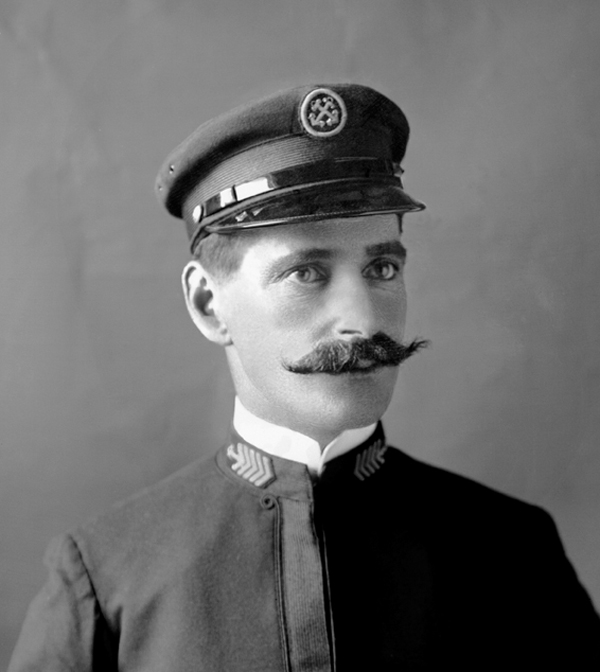
Captain Charley (Charlie) Barr
Charles Barr, b. Gourock, Scotland 11 July 1864, d. Southampton, 24 January 1911
Background
This page is in part adapted from several articles in the 1940 volume of The Rudder, authored by L. Francis Herreshoff. Note the spelling of Captain Barr's commonly used 'familiar' name; while most writers used 'Charlie', Mr Herreshoff uses 'Charley'.
The following sailing yachts are mentioned: Atlantic, Avenger, Britannia, Caluna, Clara, Colonia, Columbia, Corona, Germania, Ingomar, Meteor, Mineola, Minerva, Navahoe, Reliance, Satanita, Sea Call, Shamrock II, Valkyrie II, Vanitie, Wasp, Westward -- and steam yachts Erl King, Narada, and Tuscarora.
Content
It so happened that about the year 1909 there was a slight financial panic or temporary depression in the stock market, and so several of our racing yachts did not go into commission that spring. One of these was the crack sloop, Avenger of fifty-two feet waterline, a yacht on which I had raced the two previous seasons. Very suddenly, however, the owner of the Avenger decided to put her in commission just before the New York Yacht Club cruise, and if he could not sell her on the cruise he would lay her up directly afterward.
That summer, strange to say, Capt. Charley Barr was unemployed, so the Avenger’s owner made a contract with him to put her in commission, hire a crew, and sail her on the cruise as well as in the Astor and King’s Cup races. I lived quite near where the Avenger was fitted out and, as I showed a familiarity with her parts when she was being rigged, plus an unbounded enthusiasm for the Avenger as a whole, Capt. Barr invited me to accompany him in the few days before the cruise. So we went to Newport. No doubt Capt. Barr had invited me along principally because he wanted someone to talk to in the evenings, and thought I would be an appreciative listener, in which assumption he was quite right. The next several evenings were spent by Capt. Barr in relating in great detail some of the famous races he had participated in. He had a most remarkable memory. He could tell just what sails his competitors had carried in the races, who was on board each yacht, just what tactical mistakes he or they made in each leg of the race, although the race being described may have been ten or fifteen years before.
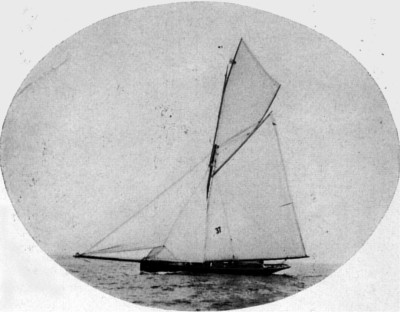
Those evenings on board the Avenger with Capt. Barr were about the pleasantest of my whole life. If it were a pleasant warm evening we sat in the cockpit and had the whole fleet of yachts at Newport as our subject of conversation. Each yacht of any consequence (either steam or sail) was described one after another in the most interesting way that could be imagined. The abilities of her designer and builder were reviewed, the peculiarities of her original owner related, and then a general review of her life was narrated, including her outstanding cruises and races, for Capt. Barr seemed to have the whole history of each yacht stored away in the archives of his memory.
Brenton Cove (a part of Newport Harbor), where we were anchored some of these evenings, was in those days a most romantic place. The few yachts which were anchored there were large fine ones such as the steam yacht Tuscarora, Erl King, and Narada, and some of the large schooner yachts. At the head of the cove, surmounting a large grey rock or crag, stood the fine residence of E. D. Morgan, which had been designed by Stanford White with a great deal of care and was intended to be a copy of one of the strongholds of the Knights of Malta. On our southeast side we occasionally got a glimpse of the feudal walls of Commodore James’ large residence, or at least we could see the weather-vane on its watchtower through the trees back of Beacon Hill. Off to the westward lay Fort Adams, which in those days seemed full of life from the sunrise gun until the poor soldiers’ work ceased with the sunset gun, for all the morning was spent in exercises and all the afternoon in reviewing the troops as each company passed in review, and the cavalry manoeuvred to the sound of bugles while the parade grounds were surrounded by the bright coloured parasols of the Newport belles.
The evenings were the pleasantest times of all in Brenton Cove, for as the wind went down at sunset the whole expanse of Narragansett Bay seemed spread out to the northward, and its many islands gave distance to the scene. The lights of the many lighthouses and of the larger naval craft in the outer harbour came into being one after another, and the quiet scene was only interrupted by the occasional passing of a ferry boat or the shrill whistle of a distant steam launch at the government landing. This was the setting in which many of Capt. Barr’s stories were started, and as darkness came on and the dew began to form on the deck we went below and sat in the main saloon under the subdued light of a bulkhead lamp, while above the main skylight one could occasionally see the sail cover over the mainsail as the flicker of the riding light lit up one side, then the other, as the lantern swung back and forth.
These talks of Capt. Barr were monologues, sometimes of three or four hours’ duration, told in a pleasant and quiet way, and I was as much held spellbound as the Wedding Guest was under the eye of the Ancient. Mariner, Not only were these talks monologues because I was spellbound, but as the story went along each question was automatically answered and the whole description was so clear that the scene seemed distinctly before me, with each yacht in her place working up to the final climax at the finishing mark.
Capt. Barr was in some ways unique among yacht captains. He seemed perfectly content to stay aboard ship all the time excepting for the morning marketing and getting the latest newspaper. He was always neatly dressed and seemed to get up that way very early in the morning. He planned a complete day’s work for each of the crew, and although all hands were busy all of the time, the yacht at all times was ready to receive the owner or guests, and could have been gotten under way at a moment’s notice. Which is in great contrast to most yacht captains of that time, who only dressed up to go ashore to spend the evening in some gin mill, or to boast on some pierhead till the small hours of the morning. Capt. Bart’s crews seemed quick, willing and contented. Their principal ambition seemed to be to please their captain, so that everything went off like clockwork and the meals were good and on time. Yes, Capt. Barr loved to be aboard ship, but best of all he liked being under way and sailing, and when everything was straightened out and he sat at the helm with his eye on the luff of the topsail he was the picture of contentment. I must say I never saw an owner who began to get the pleasure out of sailing or racing that Capt. Barr did. He seemed never to be under tension in a race, and could steer the yacht by instinct while carrying on a conversation or perhaps telling some funny incident of past yachting.
When so inclined, he could be most entertaining and agreeable to the owner and guests, which certainly is not so of most skippers, particularly the amateurs who seem to take racing so seriously that they cannot bear to have anyone speak when they are steering. However Capt. Barr did not speak to any of the crew when under way except in giving an order. When he was on one of the larger yachts with first and second mates, quartermasters, etc., he was a strict disciplinarian, and after his crew had been trained the procedure of carrying out an order was about as follows. He had trained his first mate (who for several years was Chris Christiansen) to keep one eye on him, and when Capt. Barr wished to give an order he simply crooked his forefinger slightly, whereupon the mate came close to him. Then Capt. Barr would say very quietly but distinctly something about as follows: “Mr. Christiansen, after rounding the next mark I would like the spinnaker set to starboard. I would like the jib topsail replaced with the ballooner.”
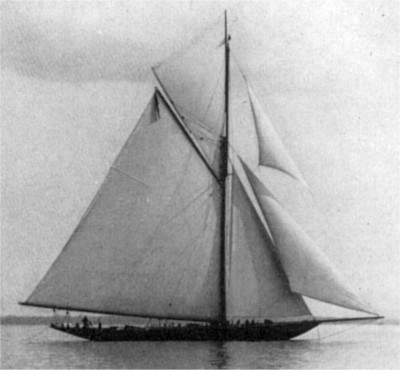
The mate would then pace slowly up and down the deck, watching the marker they were approaching until he estimated the time and distance right to commence action, when he would roar out, ‘Take in the yib topsail. Raus mit the spinnaker pole to starboard. Stand by for a yibe.” Before this moment everything was quiet, the crew of some twenty men all lying prone in a neat row with their heads near the weather waterways. The second mate crouched in the leeward fore rigging watching the headsails, and the only sound to be heard was the swish and hiss of the waves under the leeward bow, and a low moan of the wind in the rigging. But now the yacht’s deck suddenly changed to a scene of intense activity as each man scrambled to his station and stood crouched, ready for action, some at the sheets, others at the upper and lower backstays, while the spinnaker pole was being run out and the men on the bowsprit had muzzled the jib topsail.
Now the mate nods his head at the mastheadsman, and this agile fellow runs up the mast hoops like a monkey climbing a ladder and stands on the fore spreaders in anticipation of changing the main topmast staysail. Now the mark buoy is almost abeam, and the yacht swings like a gigantic turntable as Capt. Barr crouches to leeward of the wheel and pulls the spokes toward him hand over hand. The yacht now rights herself, and the wind, which had seemed quite strong, suddenly becomes very light as the yacht, which before was heading into it at some seven or eight miles an hour, now goes with it, making the difference of some fourteen miles an hour to the wind’s apparent velocity. But in the meantime there is the clicking of many winches and the chorus of many orders as the second mate and the two quartermasters call out in broken English strange words that are instantly understood and obeyed. Some of the orders are, “Stand by the after spinnaker guy”, “Overhaul the leeward backstays,” and the whole yacht seems to quiver from the stamping forward and aft of several two hundred pound Swedes, when crisp and clear the first mate calls out, “Yesus, don’t younce de yacht.”
The spinnaker and balloon jib are now broken out almost simultaneously and the balloon main topmast staysail is going aloft. Soon everything quiets down again and the only movement is a few hands coiling down sheets and halliards. Capt. Barr has now moved back of the wheel and stands with his eye on the telltale pennant at the peak of the club topsail. He seems perfectly cool and quiet, and no one would have guessed his eye had seen anything but the mark buoy, the compass and the luff of the topsail. And furthermore anyone would have thought the manoeuvre had been perfectly performed, would have thought the crew had performed miracles of sail changing in almost seconds. But now Capt. Barr crooks his forefinger again and the mate approaches him, saying, "Yes, sit", and Capt. Barr says, “Mr. Christiansen, that was done very well, but the next time I would like to see the club sheet slacked simultaneously with the foresheet.” “Aye, aye, sir’, says the mate as he moves to the weather main rigging with one eye on the luff of the spinnaker.
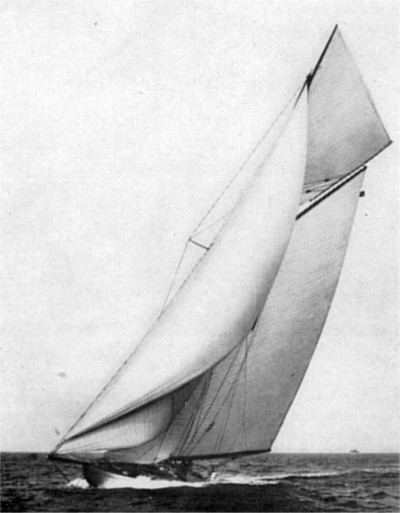
Now the men are all sitting up on deck, ranging aft from the forecastle hatch to the weather backstays, when silently the jib topsail is handed up, stretched aft, and the men kneel in a straight row, each bending over and pulling a piece of stopping thread from the mop-like hank attached to his waist a little aft of starboard. Each man rolls the sail up to its luff rope, ties a few stops, and almost before you know it the jib topsail again disappears forward.
Now eight bells is struck, and there is a slight movement at the fore hatch. The second steward is passing up great thick sandwiches and a bottle of beer for each man. What a pleasant sight it is to see this row of big Swedes and Norwegians each with a sandwich in one hand and a bottle in the other! If the jib topsail had been stopped up rapidly, the sandwiches and beer were now being stowed away even more rapidly. Many of Capt. Barr’s crew were large handsome fair-haired sailors of middle age with Viking-like moustaches, and many of them had sailed under him for several years and were perfectly trained. After being trained, these Nordic crews that Capt. Barr specialized in were very quick workers. Each man was a machine that could understand and execute orders without stopping to think what he was doing, so that the yacht had one head or brain (the captain), several mouthpieces (the mates), and twenty or so bunches of sinew, muscle and leather which acted instantly at each order.
The yacht is now rolling slowly back and forth as the spinnaker pole, rises and settles, and the great billowing spinnaker and balloon sails pull alternately on one side and the other. The contrasts and shades of colors through the sails are always changing so that the yacht seems a great iridescent being of opalescent color—the heavy mainsail of grayish white, the club topsail of creamy yellow, the spinnaker and balloon jib of transparent pinkish tan; and now and then a shadow from a spar or sail reflecting the blue of the sky and sea in a light violet shade. The Oregon pine spars of rich amber and gold, the teak rail cap, the snow-white decks and uniforms of the crew, the polished bronze, all seem alive and moving as they sparkle in the reflection of the sun. Beyond our triple wake of spindrift which narrows in the distance, where the sea has turned from transparent green to azure blue, there follow two other gigantic nautili decked in creamy rainbow hues. This is but a glimpse of yachting at the turn of the century in the time of Charley Barr, when yachting was at its zenith, but, alas, now all gone and only a memory like the squarerigger, for the large steel schooner is gone, the crews which manned them are gone, and the captains who could manage them are gone.
Charley Barr spent his boyhood on or near the Clyde in Scotland. His older half-brother was the famous racing skipper John Barr, who was captain of the cup challenger Thistle. So from his earliest youth Charley was in a world of yacht racing, and as a very young boy went on Scotch yachts as a spare hand. He first came to this country in the little cutter Clara of only nine feet beam. He was cook and cabin boy on the Clara and I presume about nineteen years of age. This crossing of the Clara was in 1886, and they must have had some pleasant steady weather, for Capt. Barr used to say about the trip, "We were on one tack for so long that the grass grew on her topsides", which of course means that she was heeled over one way long enough for her to get foul above the waterline.
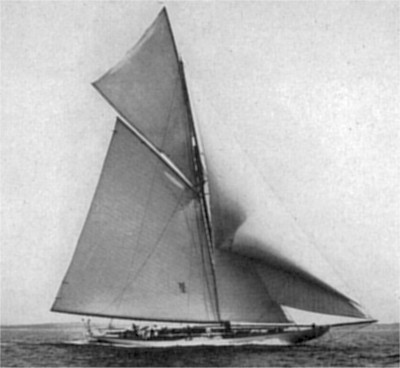
The American owner of Clara was Charles H. Tweed, and when he had a new yacht designed and built by William Fife, Jr., in 1888 Mr. Tweed sent Charley Barr, who in the meantime had studied navigation, to bring her across. The new yacht’s name was Minerva, and she with Capt. Charley Barr at her helm, won so consistently during the next two years that it might well be said Charley Barr's reputation as a racing skipper was at once made in the Minerva, but Minerva was a beautifully modeled yacht so perhaps each helped to make the other famous.
Capt. Barr’s next command was the forty-six-footer Wasp, a similar yacht to the Gloriana which he succeeded in generally beating. His next yacht was the steel eighty-four foot waterline sloop Navahoe which he sailed to England in 1893 and raced against the large single stickers Britannia, Valkyrie II, Satanita and Caluna. Although Navahoe’s season in England was not very successful, still she did succeed in winning back the Brenton Reef Cup which Genesta had wrested from us in 1885. Capt. Barr used to say this race for the Brenton Reef Cup was the greatest of his life, and it is probable that it was one of the greatest and most exciting yacht races ever run. It was a match race with Britannia, the starting line off The Needles at the Isle of Wight, and the race to and around the breakwater at Cherbourg and return. On the first leg across the English Channel there was a strong breeze and quite a sea. Both yachts housed their topmasts soon after the start, and in the first two hours they had covered twenty-five miles, which is remarkable sailing in a seaway. Navahoe reached the breakwater at Cherbourg slightly ahead of Britannia, but in this short weather leg both yachts encountered some very hard squalls that nearly knocked them flat, and Britannia worked ahead, leading Navahoe home across the Channel but seldom getting more than a hundred yards ahead of her. At the finish of this long hard race, after the time allowance was corrected, Britannia was declared the winner by two and a half seconds, but the mark boat had shifted due to stress of weather, making the finish line on an angle. The regatta committee of the Royal Yacht Squadron, taking this into consideration, finally awarded the race to Navahoe, so we can guess it was a remarkably close finish.
I wish the reader could have heard Capt. Barr tell the story of that race, for it certainly was something to listen to, and it would have given him a very high regard for yachting of some fifty-odd years ago.
A few days later Navahoe had a try for the Cape May Challenge Cup which Genesta had also taken away from us in 1885. This time over the same course Britannia beat Navahoe nearly an hour, but this was due mostly to a fluke in a three hour calm when Britannia got a breeze that took her about three miles ahead of Navahoe. In her racing in England in 1893 Navahoe won six races out of eighteen starts, which was a very good record considering the three or four fine yachts generally racing against her.
Capt. Barr’s next command I think was Vigilant, when in 1895 she served as a trial horse against the new defender, Defender. Charley Barr made Vigilant perform very well, which caused some ill feeling and protests, and probably somewhat. embarrassed my father who had designed both yachts, and it seems remarkable today that anyone could have made Vigilant keep up with Defender, for the latter was not only a great improvement in model but was of very scientific construction, her topsides, deck and even deck beams being of aluminum, a then (1895) quite new metal for yacht construction.
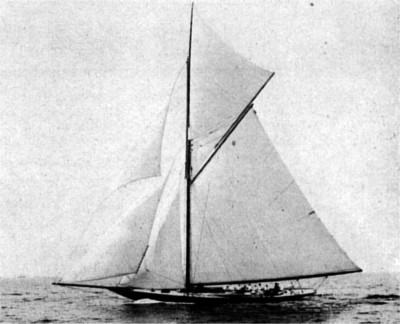
For the next two or three years Capt. Barr sailed the large schooner Colonia with great success. The Colonia had been built in 1893 as a sloop to defend the cup but was beaten by Vigilant. After she was re-rigged as a schooner she was used many years, most of them under the name of Corona.
When the cup defender Columbia came out in 1899 Charley Barr was selected as her captain, and this time the new yacht had no trouble in beating her trial boat, the previous defender, Defender. One of the principal owners of Columbia was J. P. Morgan, for whom Charley Barr had the greatest possible respect, so that when J. P. asked Charley to sail Columbia in 1901 again he was glad to do it. But in the meantime, in the year 1900 if my memory serves me correctly, he was captain of one of a one-design class of seventy footers, perhaps the Mineola owned by August Belmont. This was our largest one-design class of sloops and had practically the same sail area as a modern J boat.
In 1901 J. P. Morgan asked Capt. Barr to sail Columbia again, which he did so successfully and skilfully that she beat the new cup boat Constitution quite regularly, and so Columbia was again chosen to defend the cup. Capt. Barr used to chuckle when telling about that season’s racing, and would say, “Mr. Morgan and I defended the cup that year for a few thousand dollars, while before that it had sometimes cost some two hundred thousand, and since then much more. You see I had laid Columbia up carefully in 1899 and when she was put in commission again she was in good shape, and as it turned out we could not buy many new sails that year, for the Constitution had taken all that the Herreshoff Manufacturing Company could make, so that season’s racing cost very little.” But to this I must add that Capt. Barr was so used to Columbia that he could handle her like a knockabout, and knew just what he could do with her under all conditions. He has often been spoken of as a reckless daring captain who took great chances, but I do not agree with this statement. I admit he was aggressive, but believe he knew just what he was doing and seldom caused fouls or collisions. He could handle Columbia like a top and scared the after guard of Constitution most to death.
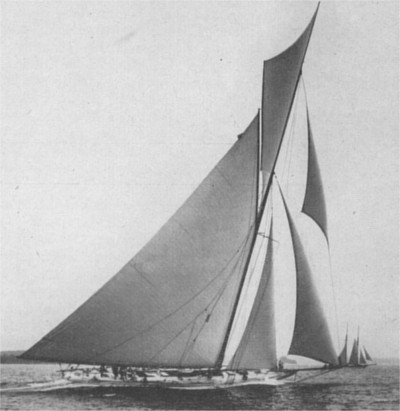
However Columbia had a hard time beating Shamrock II that year, for Shamrock II, designed by George Watson, was one of the best designed yachts that ever challenged for the cup. In some of the races Columbia only beat her a few seconds, boat for boat, although she did have some time allowance which allowed her to win by a minute or two, but it is very likely that in the hands of anyone other than Capt. Barr the Columbia would have been beaten by this Shamrock II.
Somewhere around the time we have been telling about Charley Barr married the daughter of a nautical instrument maker of Southampton, England, and I believe she was a woman of good education and refinement, which no doubt had a beneficial effect on his career,
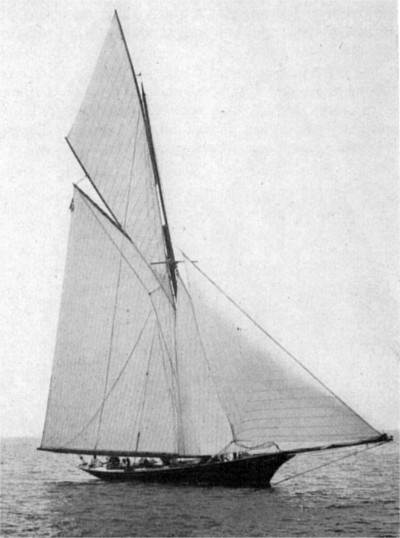
One of the next large yachts he was to command was the famous Reliance, the cup defender of 1903. By this time Capt. Barr was an experienced and extremely capable man, and he needed to be to handle Reliance, for not only was she the largest single sticker ever built, but she probably had lighter spars and rigging per square foot of sail area than any yacht built before or since. Under Capt. Barr’s superb management she went through the season without an accident, and I (at least) thoroughly believe no one else could have accomplished that feat, for Reliance certainly was an extreme racing freak. Nevertheless, in spite of her size Capt. Barr generally sailed her in and out of harbours without taking a tow, and often brought her up to her mooring buoy at Newport as one would a knockabout. And I might mention that, although Reliance was only approximately ninety feet on the waterline, still the length from the forward end of the bowsprit to the after end of her boom was 102 feet, length of the main boom was about 116 feet, and she drew nearly twenty feet of water.
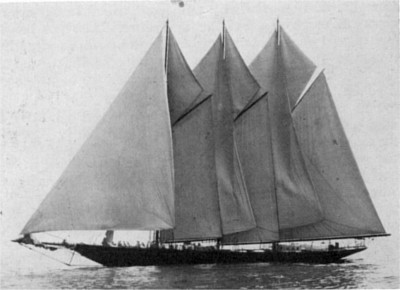
The next few years were extremely busy ones for Capt. Barr, for in 1904 he took the steel schooner Ingomar to Europe and raced her in English and German waters, winning, I believe, nineteen firsts out of twenty- two starts. In 1905 he took temporary command of the three masted schooner Atlantic to sail her in the ocean race called the German Emperor’s Ocean Race, which started from Sandy Hook and finished at the Lizard in England. Atlantic made the crossing in twelve days and four hours which I believe is still the record for sailing yachts.
There are some strange stories told about Capt. Barr on this race, and one of them is that soon after the start he drove the owner into his stateroom and kept him there throughout the race, but Capt. Barr’s version of that incident was about as follows:
“One night there came up a good beam breeze and I determined to see what the Atlantic could do on a reach, and when I had everything drawing well the owner came to me and asked me to shorten sail, to which I said, ‘Sir, you hired me to try and win this race and that is what I am trying to do.’ And after we had won the race he was as pleased as any of us.”
However Capt. Barr said the Atlantic had too little freeboard amidships to drive hard and that, together with her low deck line and high bulwarks, she carried a lot of water on deck. “Yes,” he said, “I had to wear hip boots most of the time at the steering wheel.” Which makes me think he drove Atlantic pretty hard, and ’most anybody would have wanted to take in sail.
During the next few years, or between 1905 and 1908 (if I remember right), he went captain of several boats somewhat smaller than those before mentioned and, strange to say, one of these was an American schooner named Shamrock. I think he was also on one of the seventy footers for at least two years, but you must remember it was nearly forty years ago now that Capt. Barr was telling me these things in the cabin of Avenger. However about that time (or possibly 1906), and I believe the last year that the 70’s raced, Capt. Barr was frequently beaten by another 70 sailed by Harry Maxwell, an amateur skipper, but this should not detract from the captain’s credit, for Mr. Maxwell was one of the best amateurs we ever had and was as much at home at the tiller of a twenty-one footer as at the wheel of a ninety foot steel schooner.
Well, this brought the sketch of Capt. Barr’s life up to the time he was telling me his story, or perhaps a few days before the Astor Cup Race at Newport in 1909. Then one morning a very pleasant young gentleman came alongside in a small steam yacht and requested to be shown over Avenger. For some reason or other Capt. Barr thought I could do the honours, so I showed the gentleman everything aloft and alow from bowsprit cone to clew outhaul, and must have shown it with the enthusiasm that I felt for that fine vessel, for the next morning when Capt. Barr came out with the mail he said, “I have a telegram saying Avenger has been sold to Alexander S. Cochran and that he will take her over with her crew immediately. Did you ever hear of Mr. Cochran?” “No,” said I, but when he came aboard later he turned out to be the gentleman I had shown the yacht to the previous day, and as we got to know him he proved to be a very pleasant man. He invited me to stay aboard the next few days, and the day after this Avenger won the Astor Cup Race.
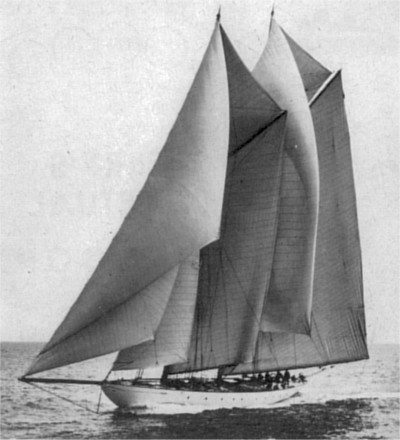
During the next several evenings Capt. Barr continued his stories about racing abroad in the Navahoe and Ingomar, and his crossing in the Atlantic, and Mr. Cochran became very interested. Although neither Capt. Barr nor I realized Mr. Cochran was a wealthy man, he soon signified that he would like to own a yacht that could race in Europe, and the outcome of these stories was that Mr. Cochran ordered a ninety-six foot steel schooner from my father, and when she came out she was named Westward.
The next year, the season of 1910, Westward sailed for England with Mr. Cochran aboard and Charley Barr as captain. Their racing abroad, and particularly in German waters, was so satisfactory that Mr. Cochran’s enthusiasm was raised to the highest pitch, and soon after he came back to this country he ordered from Mr. Gardner a three masted schooner to be an improvement on Atlantic, with no expense spared. This yacht, Sea Call, was plated with Monel metal over steel frames, and although planned to last longer than the conventional steel schooner, was unfortunately condemned and broken up before she really had a chance to show what she could do. While I will not go into the details of why Sea Call was broken up, I will bewail the fact that she never had a real sail and will simply state that she was similar to Atlantic in size and shape but had higher freeboard and thus should have been perhaps the fastest schooner ever designed. Although Sea Call was an extremely expensive yacht, still Mr. Cochran’s enthusiasm for yachting was so great that he alone, without a syndicate of owners, had the trial cup boat Vanitie built that same year, making unquestionably the greatest outlay any single person had ever made on sailboats in one year. The two yachts together would unquestionably cost over a million dollars today.
The winter after Westward raced abroad Capt. Barr spent in England where Westward was laid up and, although a comparatively young man, he died of a sudden heart attack at Southampton in his forty-sixth year, having crowded a most remarkable career into a comparatively few years. If Capt. Barr had lived and sailed Vanitie and Sea Call (provided she had stood up better) the history of yachting might have been somewhat affected. However the large sailing yacht has probably gone forever. Undoubtedly we shall never again have men like Capt. Barr, and the reason is simply because both here and in England the yachts now must have amateur helmsmen in the races. Thus our present yacht captains are little more than ship keepers.
I should mention that during Capt. Barr’s era there were several other famous and capable captains, particularly in England where they had Wringe, Sycamore, Cranfield, Bevis, Parker and several other notable helmsmen. You see, in England they had more large yachts than we did, the season was longer, and they raced more days during the season, often every day of the week, and I believe the yacht captain was on the whole more respected, and therefore capable men were more apt to adopt that profession. Although I may risk being accused of prolixity I am now going to give the reader a copy of a letter written by Capt. Barr to my father, and I am not only doing this to show the type of man he was (which usually shows in a letter), but also because it contains several nautical terms properly used.
16th July 1910.
Some time ago Mr. Cochran asked me to write you regarding the “Westward”, but I have not had an opportunity until now.
There is no criticism of the “Westward” to be made. She is a splendid boat, crossed over with some rather rough weather and got no water on deck, and practically on an even keel. She has not shown the least sign of strain, and made no creaking inside, which I think is a rare thing in a boat crossing the Atlantic.
In regard to her speed, she is fast enough in any kind of weather to win from the German schooners, but I have an impression that with her present load she would be rather sluggish compared with the “Queen” in light airs. This of course is only an idea. In a breeze of wind she would make an exhibition of any schooner in America. We have had some very strong winds racing, and she is always easily under control, no danger of getting in irons or even lying over far enough to make it uncomfortable.
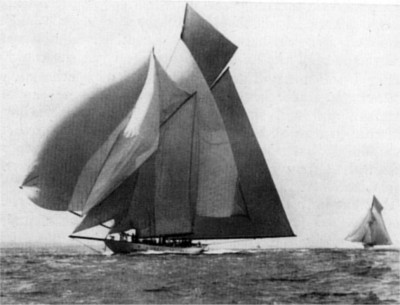
In the race from Kiel to Travemunde we ran with the spinnaker 34 knots in 2 hrs. 58 mins. and had a lead on the “Hamburg”, who was second, of about 3 minutes. We then reached on various courses 28 knots in 2 hrs. 14 minutes. At this stage “Germania” was second, about 2 minutes behind. From this to the finish was a close haul with a short tack at the line, distance 16 miles, time 1 hr. 17 mins. “Germania” was about 2 minutes behind, and had a list of 44 degrees just before she finished. “Meteor” broke her main gaff and did not finish. “Hamburg” was some distance behind. We carried working main topsails, as did the others, and were never in trouble. Distance 78 knots. Time hrs. 6, mins, 29. Strong wind and smooth sea.
“Meteor” and “Germania” on a close reach can do us from 12 to 15 seconds per mile if the wind is strong enough, but on no other point. We have outrun them in all kinds of weather and the same to windward. We have outreached them from close to wide in everything but strong hard winds.
The ballast is the same as when we left with the exception of 1 ton which I took out. I took it out of the bow but later moved 34 tor? from aft forward which brought her trim the same as before. This was before we started racing. It seems to be impossible to get her down to 96 feet unless we take more lead out, and as she has done so well there does not seem to be any need to do it.
In regard to the rig, we have had to make many changes. The anchor fell from the fish hook the first time we hoisted it after arriving here. It made a big dent in the rail and fell overboard, taking the chain with it. We had a way ahead at the time but dropped the sail and stopped the chain before it stopped us. The hook opened in some way, so I had a large plain hook made and rove off a larger fall in larger blocks, and we have had no trouble since.
I had to condemn the manila part of the main halliards as they would not run through the blocks. I put in 2 3/4 in. hemp.
Our anchors are much larger than anything the German schooners carry and they have only four to our five. I do not understand this, as I have had our weights looked up, and am informed that we are only about 50 lbs. overweight on the whole lot. The two iron blocks on the foremast for the M.T. mast staysail halliards did not have room to swing. They got aground on the collar of the forestay, so I replaced them with a single. swivel block on the spring stay. We broke the head sheet tackle blocks because they did not lie clear on deck and had to put wire stops on them. The same with the fore topsail sheet blocks where we had to put in shackles. The flange eye under the main boom for the balloon M.T. staysail sheet broke the first time we used it.
The sails have had very hard usage with strong wind and rain, and although we have slacked them up on every possible occasion have stretched badly. The main luff got above the strut and I had it cut four inches along the foot and the corners cut off on the leach. It was out on the foot and head and very baggy so I had about four inches more taken out in the middle. This was before we started racing. Now it is so large that it has to be cut again off the head six inches at the throat, and a foot off the peak, and the corners of the leach trimmed again. Ratsey has so much work to do that we cannot get it before Cowes and will have to use his sail.
The first cut on the mainsail was like this. (Sketched in body of letter by Capt. Barr.) The lug foresail is out on the head, and in the last race had to be lowered to clear the spring stay. In all the sails, that is foresails and mainsail, we have had the peak cringle taken out and a hole cut in the sail instead. This appears to hold the sail just as well and saves the whole size of the thimble.
The main boom has been in two collisions and is as good as ever. A large tramp steamer struck the end of it with the luff of her bow, hard enough to grind ½ inch off one side as she scraped along. It was in the crutch and fast with the lifts and tackles, which I had no time to let go although we were working at them. It was dark at the time and I fully expected to see it sprung in the morning, but there was not a mark anywhere except on the end.
On the other occasion the old Cary-Smith “Meteor” sailed into us on the port tack, and stuck her bowsprit between the cap shrouds on the mainmast. The bowsprit went instantly and we could not see where it had been, but the stump hit the main boom abaft the wheel and put a dent in it, which does not appear to affect it in any way.
A great many remarks have been made about the lightness of our gear, but all three German schooners have broken down and we have not so far, and even after the “Meteor” (now Nord Stern) ran into us we sailed right on in half a gale of wind and left her wrecked behind us. The only thing which I think is doubtful now is the main lifts. We have had to renew the lift runners two or three times. The mainmast stands up fairly well with a very tight truss stay but not as well as it should. Although we have sailed in very strong winds there has been no sea so far, and it looked rather bad sometimes.
Mr. Cochran is very much pleased, as I have no doubt he has told you, with the boat, and she is undoubtedly a fine boat – far ahead of any of our racing schooners. I am not talking about speed, but about her seaworthiness and comfort.
She has started 9 times, won 8 without time allowance, and 1 with the time allowance. She has 12 cups and the only thing she did not get was the handicap from Eckernforde to Kiel. I think she is the best boat you ever built.
I trust you are feeling better than when we left and remain with best regards,
[signed] Charles Barr
P.S. We got a prize for the best corrected time over the course for all classes the day we lost the handicap cup, which was the day the Nord Stern collided with us.
I will now quote a few lines written in the English magazine Field at the time of his death, as it shows what our English cousins thought of Capt. Barr.
“We think that there can be no question that Charley Barr stood first among the racing skippers of the world. He had great skill, judgment and nerve, he took the keenest and most intelligent interest in the accurate observance of sailing rules, and was himself careful to be obedient to them. In person he was dark, small and slight, with refined features, and he was of modest and unassuming demeanour. In fact, his manner, speech and appearance were that of a townsman of that part of Scotland in which he was born, and unlike that of a seafaring man. Whilst we know of no sailing master who was a stricter disciplinarian than Barr, nor one to be more promptly obeyed, his manner with his officers and crew was quiet and dignified, and the extraordinary amount of shouting that goes on aboard many English vessels was absent in the yachts under his command.”