
The Kaiser's Cup Race 1905
Schooner Atlantic sets record
The schooner Atlantic, under the command of Captain Charlie Barr won the transatlantic race for the Kaiser's Cup from Sandy Hook, New York to the Lizard (England) in 12 days, 4 hours and 1 minute, setting a record that stood for a century. Story continues below this image...
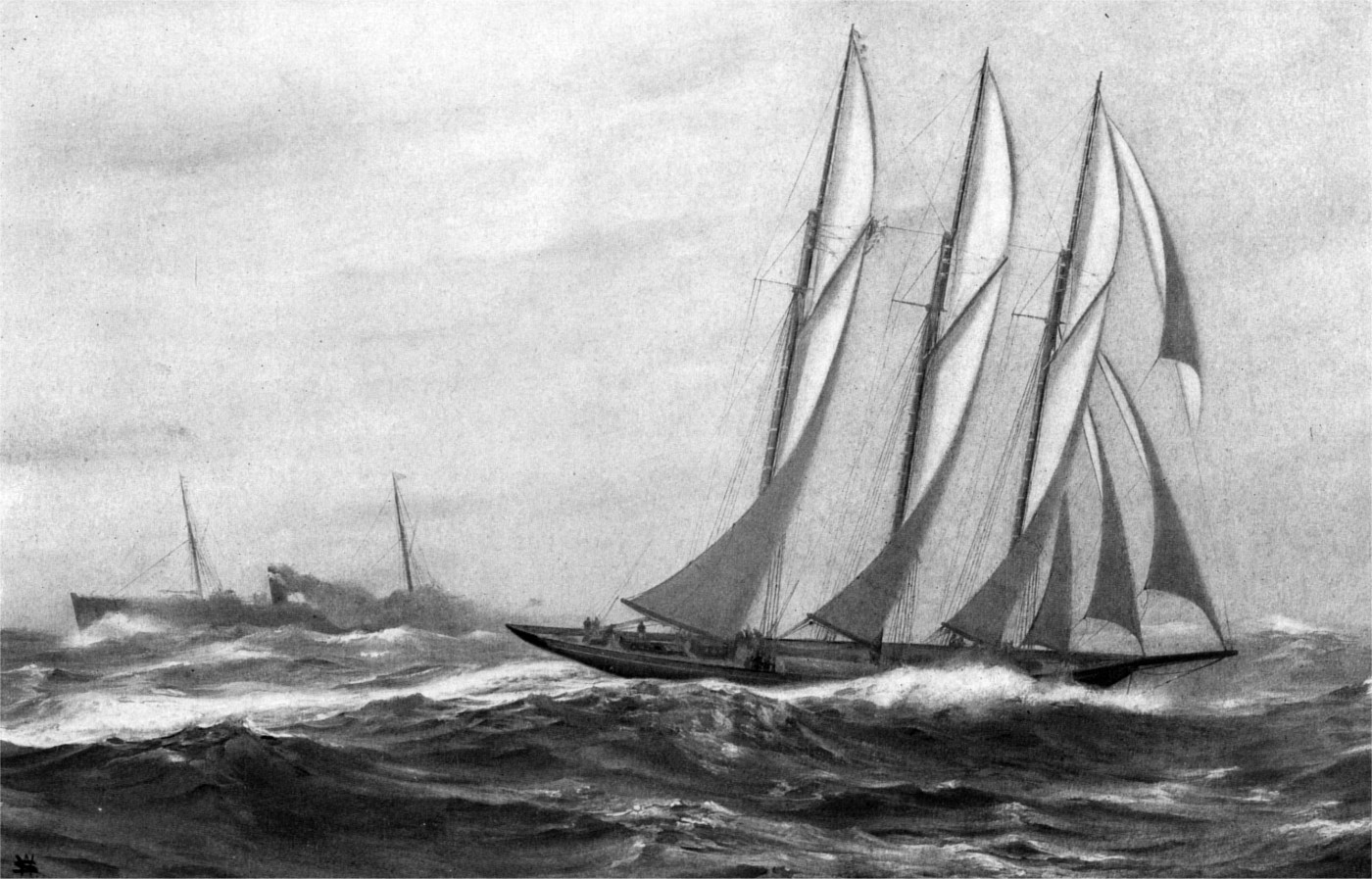
The transatlantic ocean race for the Emperor’s cup
In the history of yachting a special place must be given to the ocean race of nineteen hundred and five for the cup offered by the Emperor of Germany, in which eleven yachts, representing three different nations, were the contestants, for this is the first open race which has ever been sailed across the Atlantic, and the winning yacht has established a record from Sandy Hook to the Lizard which may stand unequalled for years.
In this contest, which was open to yachts of over eighty tons, and sailed without handicap or time allowance, many different rigs were represented; and it is interesting to note that the first three yachts to finish were of different rigs, the winner, Atlantic, being a three-masted, fore-and-aft schooner, the second boat, Hamburg, a two-masted schooner, and the third, Valhalla, a full-rigged ship. It is also interesting to note that these three yachts represent the three nations under whose flag the yachts sailed, for Atlantic, the winner, is American, Hamburg is the sole German entry, and Valhalla sailed under the colours of the Royal Yacht Squadron of England.
The log of each yacht which took part in this great race would furnish material for a story of the sea quite as exciting as any work of fiction, for in spite of the fact that gales and high seas were encountered sails were crowded on and carried till they twist, or the spars gave way, and sail was reduced only when it was absolutely necessary. Then as soon as the gales moderated in the least storm topsails came down and mainsails were hoisted, with the topsails and kites aloft, too, so long as there was a fair chance that they would not be blown to pieces. In many cases, when sails split they were taken in and new ones set in their places, and one hard driver of a skipper, after having burst all the fore-topsails aboard, sent a spare jib aloft to serve until the torn sails could be repaired. Day and night it was constant work for the crews changing sails, tying in or shaking out reefs, or working to replace rigging carried away. On several of the boats it was deemed necessary to lash the men at the wheel, to avoid the danger of their being washed away, and in one case a man was washed off the bowsprit and by lucky chance caught at the fore rigging hauled aboard again. Another was picked up by a sea and thrown against the bulwarks with such force that several of his ribs were “stove in.” Such incidents as these, however, were taken as coming in the ordinary course of events, and it is to the credit of the men who fitted out and sailed the yachts that there was not a single serious accident or mishap to mar the success of the great event. The story of the start has already been told, but it may be well to begin at the very beginning with the complete story of the race.
The start was made from the Sandy Hook Lightship, at 12:15 p. m., on Wednesday, the 17th day of May. As the gun boomed the yawl Ailsa shot over the line with the schooner Hildegarde just to leeward and the three-masted Atlantic a short distance astern, the others all close behind, excepting Utowana and Valhalla, which were obliged to return and recross, and so were some distance astern when they finally got properly started. Ailsa held her lead for a while, but she did not seem to have the speed which she was expected to show, and the big Atlantic, sailed by Charlie Barr of Cup-race fame, soon walked into the lead, while Hildegarde dropped back and the German entry, Hamburg, came up at a rate which promised to make her a formidable rival for first place, and throughout the afternoon she gave Atlantic a hard race, working up till she was in even terms and then dropping back and creeping up again. As the wind increased and the sea became rougher Atlantic took in both her topmast staysails and jib topsail, while Hamburg took in only her jib topsail, and at 6 o’clock the German boat had the lead, which she had increased considerably when darkness shut her out from the view of those on the Atlantic. It was a nasty night with fog, light wind and a little sea, and the next morning brought but little improvement in the conditions. Atlantic with topsails and staysails set held close to Hamburg, while Fleur de Lys and Endymion came up close to the leaders. At noon Atlantic had taken the lead and Fleur de Lys was close astern of Hamburg.
During the afternoon the winds were light, and some of the racers tried carrying spinnakers for a while. A fine, clear moonlight night followed, with a good breeze over the quarter, which sent the boats along at a good speed.
The noon observation of the 18th shows the leading boats to have been just South of 40° N. lat., and somewhere between 70 and 71° W. longitude; but from this point their tracks separate, as Atlantic, Hamburg, Endymion and Ailsa took a Southern route, while Fleur de Lys, Hildegarde and Thistle went up North.
The boats which went South were about on the steamer track, and with the exception of Atlantic were often seen and reported, while those who went North were not heard from so frequently. From the time Atlantic passed Hamburg, on the noon of May 18th, she held a good course, and favored by strong winds and, with the skill and good judgment of her skipper always in evidence, made good runs, each day steadily increasing her lead, so that she saw nothing more of her rivals. This is also true of the boats which went North, as they became separated and saw nothing of one another, but did see icebergs in plenty. Hamburg, Endymion and Ailsa seem to have had the greatest amount of close racing with others, and for most of the race Endymion had some rival in sight, either ahead or astern. At one time after several days at sea there was the remarkable occurrence of Endymion, Valhalla and Ailsa - a cruising schooner, a full-rigged ship and a racing yawl — all within sight of one another.
Friday, May 19th, saw some close racing between Hamburg and Endymion, for during the night the latter boat gained and at daybreak was within sight of the German craft. Endymion was making good speed, carrying spinnaker and balloon jib, while the Hamburg was under only her plain sails; but on sighting the American schooner the Germans also set their light sails, and a very close race followed. The wind and sea increased, so that toward noon both skippers took in their spinnakers and set square sails instead, and under this sail Endymion took the lead, but it was only for a short time, as one end of her square-sail yard was carried away, and while repairs were being made Hamburg regained the lead, passing her at about nine in the evening. As the wind moderated both set their spinnaker and light sails and made a splendid race, driving along at a twelve-knot speed. All night the two were in close company, and in the course of the next forenoon Endymion again got the lead; but in the afternoon the wind hauled more abeam and increased, and Hamburg doing twelve and thirteen knots an hour again took the lead, and at dark Endymion was some distance astern. On Monday, the 22nd, light winds were encountered, and Endymion at noon had made only fifty-nine miles since Sunday, noon, while Hamburg held enough breeze to put her about a hundred miles in the lead, and Ailsa came up from astern, and on Monday, at 9 a.m., Endymion and Ailsa were on practically even terms again, with Valhalla in sight, hull down astern. In the light air Ailsa drew away from Endymion, and on the morning of May 23rd was about seven miles ahead of her and about eleven miles astern of Hamburg.
In the log of each, record is made of sighting an iceberg, Hamburg seeing it at 10 a.m., Ailsa at 10:30, and Endymion at 11 a.m. So that it is evident the three were not far apart.
The noon observations of Endymion and Ailsa for May 24th put the two in very nearly the same position, though no mention is made in the log of either of having sighted the other. The wind and sea were increasing on these days, and while the three yachts saw nothing of one another the log of each is a record of driving hard under shortened sail, with decks awash a good part of the time, and at noon, on Saturday, the 27th, a gale of wind was blowing and such a sea was running that it was impossible to keep Ailsa before it, and after she had broached to twice it was decided to heave her to, and for eight hours she was hove to under storm trysail, while the others were driving off before it. Endymion’s log gives the outlines for a picture which even the dullest imagination can complete. It says: “Heavy seas. Set double-reefed mainsail. Wind strong. 10 a.m. shook one reef out of mainsail. 11:30 carried away raffee. 12 [noon] carried away raffee again. 1:30 set raffee. 6 p.m. carried away fore-topsail, took it in and set a jib topsail as a fore-topsail.” And the preceding day gives much the same record of splitting sails, taking them in, repairing them, and then carrying them until they burst again.
Hamburg was running off with close-reefed mainsail lowered four feet, with square sail set and one reef in the fore sail, before a terribly high sea, and using oil to prevent the seas from breaking aboard. Atlantic, though miles ahead, evidently encountered the same gale, for she was running under square sail and fore trysail only, with two quartermasters lashed to the wheel and decks flooded, when the top of a wave came over the rail in spite of the oil bags which were used to prevent it, and late in the afternoon it became a question of heaving to; but Barr finally decided to keep her going and take chances on the seas getting worse. The gale continued, and on the following morning the wind hauled more abeam, so the square sail was taken in and she was run for a time under only fore trysail and jib. Later, the mainsail was set double-reefed, and she ran under this short sail until afternoon, when the wind moderated, and reefs were shaken out.
These days of strong winds brought Valhalla up among the leaders, and put her in such position that she was able to hold her lead over Endymion in the days of moderate winds as the yachts neared the English coast, and she crossed the finish about two hours ahead of Endymion.
After passing Hamburg on the noon of Thursday, the 18th, Atlantic made fast time under all lower sail, topsails and balloon staysails, and at four in the afternoon set her spinnaker to port. At 7:30 a shift of wind made it necessary to jibe over, and the spinnaker was set to starboard, and all through the clear moonlight night, with spinnaker pulling, she did about ten knots an hour. In a fresh breeze, on Friday morning, the main topsail split and was replaced by a new one, and shortly the spinnaker also split and had to be taken in, the square sail and raffee being set in its place. In the late afternoon the wind hauled more Westerly, and the mainsail was taken in to prevent slatting itself to pieces as the ship rolled. Saturday morning was fine and clear, and the mainsail was set at 9 a.m.; also the staysails and jib topsail. The squaresail and raffee were next taken in and the spinnaker set with also a balloon main topmast staysail. The spinnaker proved a rather unsatisfactory sail for sea work, as the weight of the boom puts a severe strain upon the light sail as the boat rolls, and the square sail and raffee were set instead. A bad Easterly swell was encountered during the afternoon, which made the ship roll so badly that water was often taken aboard forward and the deck washed fore and aft. Toward sunset the breeze died away, but at 8:30 p.m. a bad squall came out of the Southwest, and all light sails, the mainsail and mizzen were lowered away, but in an hour the squall had passed over and soon everything was set again. During Sunday forenoon there was a fine fresh Northwest breeze with a smooth sea, and a speed of over eleven knots was made for several hours. In the afternoon the wind fell light again, and in the evening it was so calm that light sails were all taken in and sheets trimmed to prevent the sails from slatting themselves to pieces.
On Monday morning the light airs continued, and noon of this day marked the smallest day’s run of the voyage, as only one hundred and twelve miles were covered. In such gentle breezes the heavy lower sails would not stand full, so the mainsail: was taken in and a big balloon topmast staysail sent aloft, which did good work. Soon the big balloon jib and the spinnaker were also set, and the schooner must have made a beautiful picture with such a perfect cloud of canvas drawing. Soon, however, the wind increased to such force that the kites had to come down, and working sails took their places. Falling temperature of air and water indicated the presence of ice, and at ten in the evening a large iceberg was passed a mile to leeward.
On the morning of the 23rd, at 5:30 a. m., a much larger iceberg was passed, which was estimated to be a half mile in length and nearly three hundred feet high. The berg was surmounted with two great towers of ice, and with the sun sparkling upon it made a beautiful sight. By this time the topsails were getting badly stretched out of shape, so the main topsail was unbent and a new one sent up in its place, while the mizzen topsail was brought down on deck and recut with a cloth taken off of the leech. Fine weather with a smooth sea prevailed throughout the day, and during the afternoon a speed of fourteen and fifteen knots was attained for hours. All through the night and following forenoon every possible stitch of canvas was crowded on, and at noon the record-breaking day’s run of three hundred and forty-one miles had been made in the 23 hours, 31 minutes and 30 seconds’ time, from noon of May 23 to noon of May 24. This shows an average speed of over fourteen miles an hour for the entire day’s run, and is thirteen miles better than the record of three hundred and twenty-eight miles made by the Dauntless in 1887.
Good sights were obtained both at the beginning and end of this big run, so there can be no doubt as to its accuracy, especially as independent observations were made both by Capt. Barr and Mr. Frederick M. Hoyt, and both agree as to the positions and distance.
During the afternoon the wind increased steadily and the seas got bigger, and it became necessary at 6 o'clock to tie two reefs in the mizzen to make the boat steer. At 9:30 in the evening all hands were called on deck to take in the spanker, and the mizzen trysail was bent ready for hoisting.
Before the Southerly gale, with a heavy sea running, Atlantic was doing over fourteen knots under foresail, mainsail and fore staysail, and at midnight it became necessary to take in the fore and mainsails, and the fore and mizzen trysails were set instead, so that the ship would be in shape for heaving to if it became necessary. She behaved beautifully, however, taking no water on board, and toward morning as the gale showed signs of moderating the mainsail was hoisted again, then the fore-sail set in place of the fore trysail, and soon topsails were sent aloft, although the sea was making up steadily.
In the afternoon the gale began to blow stronger, and the topsails and mizzen trysail were taken in; still she was running off a good average of thirteen knots an hour. Heavier weather was coming, however, and on the morning of the 26th it was blowing a gale from the Southwest, and it became necessary to use oil bags, four being placed along the weather rail. In the afternoon sail was taken in until only fore trysail and square sail remained, and then she drove along at a wild pace before the gale with two men lashed to the wheel, for at times the breaking seas came over the rails and flooded the quarter-deck almost knee deep. Toward night it was evident that if the sea became much worse it would be necessary to heave the vessel to, and the advisability of doing so was discussed ; but Capt. Barr decided to take chances on running her. She made good weather of it through the night, but on Saturday morning the seas were running higher than ever, and as the wind hauled a bit to the South’ard and more abeam it became necessary to brace the square sail well forward, and as this seemed to bury her by the head it was taken in and a jib set, with better results. The mainsail was double-reefed and set at seven in the morning, and under this with fore trysail and jib she did a good twelve knots. By noon the gale began to diminish, and reefs were shaken out, topsails and staysails set again, for even though Barr had been for about four days and nights without sleep he was still driving her and working his crew to get every bit of speed out of the ship.
On the afternoon of Sunday, the 28th, the mizzen was double-reefed and set for the first time in four days, and with topmast staysails aloft she was reeling off thirteen and fourteen knots.
The finish was rapidly drawing near, and the men on board very naturally began to wonder about the other boats, though it did not seem possible that anything could be ahead after the wonderful runs that had been made day after day.
On the morning of Monday, May 29th, the light on Bishop’s Rock was sighted a point off the lee bow, and at 9:36 a.m., Greenwich time, it bore North, making the time of passage from Sandy Hook 11 days, 16 hours and 22 minutes, which beats all previous records.
With only forty-nine miles to the Lizard there was a good possibility of reaching it before 5:15 p. m., which would mean a passage of less than twelve days. The wind kept growing lighter, however, and slow progress was made. At 2:45 an Admiralty tug came alongside and gave the welcome news that no yacht had yet finished, so Atlantic was the winner. Every passing steamer, from the dingy old tramps to the big ocean greyhounds, altered its course to come close alongside and salute by dipping the ensign or by deep blasts of the whistle. At 4:30 the German cruiser Pfeil, marking the finish, was in sight, and an American press boat came alongside with cheers and congratulations.
At 8:30 the Pfeil hoisted Atlantic’s number and signalled, “Congratulate you,” which was answered with “Thanks,” and at 9 hours, 16 minutes, 19 seconds p.m., Greenwich time, Atlantic crossed the line and received the winning gun from the German war vessel.
Hamburg was the next yacht reported at the Scilly Islands, and under working sails, balloon jib and spinnaker she crossed the finish line at 7:22 p. m., on Tuesday, twenty-two hours astern of the big Atlantic. Hamburg made a fine picture as she neared the finish, with the last rays of the setting sun glowing upon her, and she was welcomed with cheers from her countrymen upon the Pfeil and by salutes from all the craft nearby, while the deep-voiced fog signal on the Lizard also sounded its greeting. Hamburg dipped her flag, and the crew lustily returned the cheers as she swept by on her way to Cowes.
The third yacht to finish was the big Valhalla, which we sighted approaching the Lizard on Wednesday afternoon, and toward sundown she neared the Lizard, running at a twelve-knot gait before a freshening breeze with all sail set, including starboard studding sails. She made a grand sight, as she swept over the line, her crew lining the rail and returning the cheers from the sailors on the Pfeil. She was timed at 8.08 p.m., which made her about twenty-five hours behind Hamburg and nearly forty-seven hours astern of Atlantic. Close on the heels of Valhalla came the Endymion, finishing in fourth place, at 9:34 p.m. She had been sighted by Lloyd’s observer. When some twenty miles away darkness had shut her out from view, and she was not seen again until just before nine, when her night signals blazed out before the eyes of the men on lookout at the signal station. It was not expected that she would finish before midnight, and in spite of all efforts the Pfeil was unable to reach her position at the finish from her anchorage in the Cove before Endymion crossed the line, carrying full sail and with spinnaker drawing before the increasing gale. She was timed from the shore, and the excitement caused by her finish had scarcely subsided when another night signal was seen close at hand, and the red and blue lights followed by a single star showed her to be Hildegarde, which had been practically unheard from since the start of the race. Hildegarde was timed from the shore at 10:08 p.m., just two hours astern of Valhalla and only a half hour astern of Endymion, winner of the last of the four prizes offered.
Sunbeam had been reported from the Scilly Islands late in the afternoon, and before midnight her night signal showed through the darkness, and twenty minutes later she crossed South of the lighthouse, being officially timed at 11:40 p. m., on Wednesday, May 31st. Little Fleur de Lys was the next to finish, coming in close behind Sunbeam, and the yawl Ailsa came next, crossing at 4:39 a. m., on Thursday morning, with the three-masted Utowana only a half hour astern of her.
The Thistle was the last of the fore-and-afters to finish, and she crossed at 12:39 p.m., on June 1st. Thus it will be seen that between eight o’clock on the evening of May 31st and noon of June 1st eight of the eleven contestants crossed the finish line, which is really remarkable when the length of the race is considered.
The bark Apache was the last to arrive, and she was so far behind the others that some anxiety was felt regarding her safety.
The prizes will be presented to the owners of the winning yachts by Emperor William himself, at Kiel, during the Kiel Regatta Week, and these trophies will always stand for the most successful event in the history of ocean yacht racing.