
Sailing Vessels of the Great Lakes
Early history
Until 1678 there were no sailing vessels on the Great Lakes. In November, 1678, La Salle and Father Hennepin built a ten-ton schooner near what is now the city of Kingston, Ontario, but were unable to navigate beyond the mouth of the Niagara River, and continued their journey westward by land.
In May, 1679, they launched the Griffin, the first sailing vessel to navigate the upper lakes, and in September she reached Green Bay, Wisconsin. The Griffin laden with furs, was lost on the return trip, just where nobody knows.
In 1759 the English began to build vessels on both Erie and Ontario. Two sloops, the Oswego and the Ontario, were launched at Oswego in 1760, followed a little later by two sixty-tonners, a sloop and a schooner; and in 1763, owing to the withdrawal of the French from Canada, several French-built vessels were added to the English fleet. After the American Revolution the commerce on Lake Ontario rapidly increased, and up to 1800 it exceeded that of all the other lakes put together.
In 1855 the first lock was opened at St. Mary's Falls. Before this there was practically no commerce in Lake Superior; soon after, to all intents and purposes, the navigable waters and shoreline of the Lakes were increased about 30 per cent and the aggregate tonnage of sailing vessels rapidly increased, culminating about 1890.
In that year there were 917 United States schooners on the Lakes, totalling 185,081 tons and valued at $4,238,850; of these, 155 haled from Chicago, 100 from Port Huron, 83 from Detroit, 129 from Milwaukee, 74 from Grand Haven, 64 from Cleveland, and 17 from Buffalo, their average tonnage being 202. This was near the peak, but schooners still carried more than half the freight on the Great Lakes and were a mighty fleet up to 1905, after which they rapidly gave way to the steel steamers and the barges. Today there is not a single sailing freighter on the Lakes.
Some of the earlier vessels were classed as barques and brigs, but after 1875 they were all called schooners; nevertheless, most of them carried some square canvas on their foremasts. They were mostly two- and three-masters, which differed somewhat from ocean-going ships. The two-masters were quite similar to those on the east coast, except that most of them carried a yard on the foremast on which was set a raffee as well as a course. A great many, in fact a majority after 1885, had three masts: the foremast slightly shorter than the mainmast, and the mizzenmast much shorter and stepped well aft, like the mizzen on a ship. On the foremast were usually two yards carrying a course, a topsail and a raffee. There was no spring stay connecting the main- and the mizzenmast heads, but there was a stay running from the maintopmast head to the mizzenmast head. On the Atlantic these vessels would have been called barquentines, not schooners.
A notable barque was the Erastus Corning, built at Tonawanda, New York, in 1867.
In 1862 Captain William Callaway of Milwaukee built the barquentine Hanover and sailed with a cargo of wheat down through the Lakes, the canals, and the St. Lawrence River and across the Atlantic to Liverpool, and from Liverpool proceeded to Germany.
The first European vessel to come to Milwaukee with a cargo was the steamer Cragg, with eight thousand barrels of herring, arriving May 26, 1894. There were a few regular four-masted schooners built on the Lakes, the masts of which were all of the same height and quite similar to the four-masters on the Atlantic coast; one of these was the Alexander B. Moore, built before 1880; she was renamed the Northwest and lost in the Straits of Mackinac in 1898. I cannot find her dimensions, but judging by a photograph of the vessel in dry dock, she must have been close to fifteen hundred tons. [ Pease see our ships database entry here for the Alexander B. Moore, later renamed the Northwest. Note that she was built as a three-master, later converted to four masts. Ed. ]
The first vessel to anchor in Milwaukee Bay was H M. Sloop Felicity, in November, 1779. The first merchantman to enter the harbour was the Chicago Packet, in 1823; and the first brig and barque built at Milwaukee were the C.J. Helfenstein and the Utica in 1846.
A five-master, the David Dowes, was built at Toledo, Ohio, in 1881. She was a typical laker and never left fresh water, being too long to go through the Welland Canal locks of that time.
For years the only United States man-of-war on the Great Lakes was the Michigan, a wooden side-wheel gunboat. She was moored in the river off Detroit in 1891 and was still afloat in 1925; she came to Milwaukee in 1845.
The last laker was the schooner Lucia A. Simpson, built at Manitowac, Wisconsin, in 1875; she registered 227 tons and was 127 feet long, 28 feet beam, and 8 feet 7 inches deep. She plied the Lakes until 1930.
The Schooner Moonlight
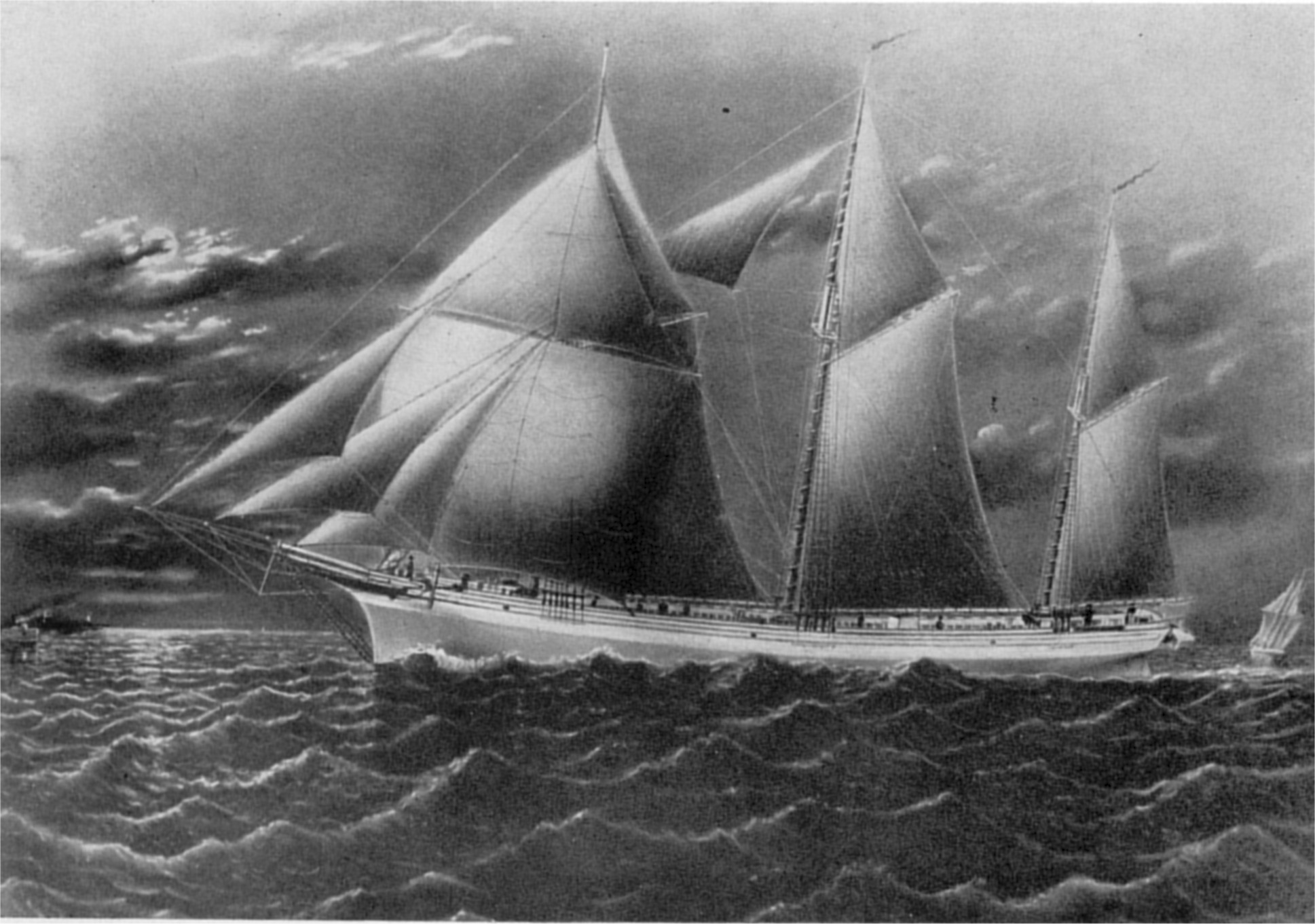
The Schooner Moonlight was built in 1874 by Wolf, Davidson Company of Milwaukee, Wisconsin, for David Vance and Company. She was 205 feet 9 inches long and had a breadth of 33 feet 6 inches and a depth of 14 feet 2 inches. Her gross tonnage was 777.01 and her net tonnage 738.16. She had a half-moon figurehead and a square stern.
The Moonlight was enrolled at the Port of Milwaukee until May 21, 1886. During that time she raced the schooner ‘Porter, one of the fastest schooners on the Lakes. The race began at Mackinaw and was to have finished at Milwaukee. The Porter, however, was dismasted while only eight and one half miles northeast of Milwaukee. This race took place on June 4, 1880. Captain Denis Sullivan was in command of the Moonlight and Captain Orville Green of the Porter. In 1890 the Moonlight also raced the Annie M. Peterson, a similar schooner of seven hundred tons, commonly known as the "Race-horse of the Great Lakes," from Cleveland to Milwaukee and won by a narrow margin.
The Moonlight was not enrolled between the years 1886 and 1889. In 1889 she was transferred to Cleveland, Ohio. At the time of her change in port she was commanded by Captain J. H. Coleman. The date of transfer of command is not available, but it is known that shortly after 1895 the Moonlight was made into a barge. She was lost in a northeast gale on Lake Superior on September 13, 1903.
Schooners of the Moonlight type were the fastest sailing ships on the Great Lakes up to the time of the modern sailing yachts. They were comparatively fine forward and carried a great deal of canvas for their size. This type was suitable, of course, only for inland waters, where they would encounter relatively short seas as compared with ocean waters. There was a good deal of competition in the early nineties in the lumber trade, and only the fastest and most ably handled vessels could hope to earn their way.
In 1880 the Moonlight accomplished the previously unheard-of feat of making eleven round trips between Milwaukee and Buffalo during the season. (The Lakes are closed to navigation for about four and a half months each year — from around the third week in November until the ice breaks up in the spring.)
Among the schooners built by the Wolf, Davidson Company at Milwaukee were the Resumption, Waukoma, Hanover, Penokee, Itasea, and many others.
Captain Denis Sullivan
Captain Denis Sullivan, master of the Moonlight, was born in Ireland in 1851 and came to this country at a very early age, when his family settled in Canada.
In his youth he took to sailing on the Great Lakes, and became a master mariner at the age of twenty-one. On reaching his majority he was put in command of the Moonlight and sailed this vessel for several years. Later he went into the steamship business at Chicago, where he became president of the Gartland Steamship Company, Chicago Navigation Company, and other steamship companies.
Some notable sailing vessels of the Great Lakes were:
Barque Erastus Corning, built at Buffalo in 1867.
Schooner Moonlight
Schooner John B. Merrill
Schooner Alice B. Norris.
The three-master Zack Chandler, said in her day to be the fastest on the Lakes, made the trip, with full cargo, from Chicago to Buffalo in four days. This was in 1884(?). The average round trip was two weeks, including loading and unloading, which in those days was all done by manual labour.
One of the last schooners to sail the Great Lakes regularly was the Lucia A. Simpson. She plied the Lakes until 1930. Another was the John Kilderhouse.
The last sizable schooner built at Milwaukee was the James Mowatt. She came from the yard of Wolf and Davidson in 1884 and registered 523 tons.
The Annie M. Peterson, 700 tons, built in 1874, 200 feet long and 33 feet wide, was lost on Lake Superior with all hands in 1914.
In the great storm of November 16, 1869, ninety-seven vessels were lost on the Lakes, including eight barques, four brigs, and fifty-six schooners, which gives an indication of the extent of Lake sailing shipping of that date. Again in September, 1872, another gale occurred in which forty-seven schooners were lost.
This article is adapted from B.B. Crowninshield's book titled Fore-and-Afters, Houghton Mifflin, 1940.