
Bowdoin Bradlee Crowninshield, 13 October 1867 - 12 August 1948
Naval architect
B. B. Crowninshield is often remembered as a designer of racing and cruising sailboats from the late 19th and early 20th century. He had a strong influence on the development of the Gloucester fishing schooner and for two one-design classes - the Dark Harbor 17 1/2 (LWL), of which over two hundred were built between 1909 and the mid-1930’s, and the Dark Harbor 12 1/2 (LWL), a cabin-less version built beginning in 1915. He is perhaps less well known as the designer of much larger commercial ships, many large schooners including, including the six-masted William L Douglas and the unique seven-masted schooner Thomas W. Lawson.
Crowninshield was born in New York to a wealthy family with strong seafaring roots. Cleopatra's Barge, said to be the first yacht in the United States, belonged to one of his ancestors. The family moved to Boston in 1868 and then to Marblehead in 1874, where young Crowninshield started sailing and racing, quickly achieving recognition for his skill, especially in “tuning up” a racing boat to her best speed potential.
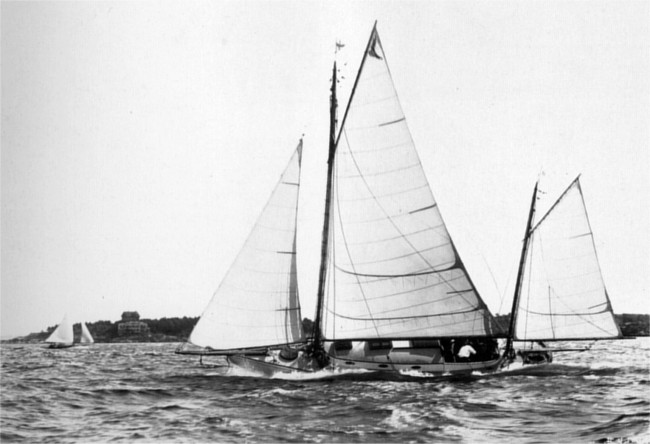
After entering MIT in 1885, Crowninshield transferred to Harvard the next year and graduated in 1890. He spent some time in the western states, but returned to work at John R. Purdon’s yacht design firm in 1896 and opened his own office, originally in partnership with Frank Tandy, in 1897 in Boston. He saw success with his earliest racing designs, especially Mongoose, a 21-foot knockabout whose good reputation resulted in a steady stream of orders. From 1917 to 1926 he was President and General Manager of the Crowninshield Shipbuilding Company of Fall River, Massachusetts. He resumed his work in naval architecture in 1926 and was appointed Inspector of Hull Building for the United States Navy in 1943.
Crowninshield was one of the earliest designers to vigorously pursue the hull characteristics that fully separated the yacht hull form from its working-class ancestors. While cargo carriers, fishing vessels, and the yachts that evolved from them tended to have short ends, deep forefoots, long straight keels, heavy displacement, and V-shaped sections, Crowninshield’s style generally tended toward long ends, dramatically cutaway underbodies, short finlike keels with all outside ballast, quite light displacement but with fully developed bilge turns.
While there was nothing unseaworthy about the type, there is no question that the boats were optimized for inshore racing and cruising, with an emphasis on speed in smooth water and in light air. In those days of engineless coastal cruising, this “ghosting” ability contributed to both safety and convenience. In stronger winds it was a fast, wet, and exciting ride — more comfortable offshore voyaging and living aboard developed decades later.
While yachts have always borrowed ideas from working vessels, Crowninshield was instrumental in passing some important concepts in the other direction. Prior to 1900, the Gloucester fishing schooners were of the clipper model, meaning that they sought the speed they needed to get to market by opting for shallow, beamy centreboard models (partly dictated by the shallow water of Gloucester Harbor) with a large sail area. This was exactly the wrong combination for the severe offshore weather they frequently encountered; they easily capsized and were hard to control, and there was great loss of life.
Crowninshield, his contemporary Thomas McManus, and others realized that while they weren't good work boats, the deep, narrow, outside-ballasted yachts of the day would not capsize, and no matter how much they might punish their crews, they could maintain control and reach high speeds in heavy weather. Application of these yacht-based ideas to schooner design produced vessels now known as the Gloucester schooner type.
Like a yacht, the Gloucester schooners had a cutaway forward and a deep, abbreviated fin-like keel and a raked rudder post. Unlike the inshore yachts, they were very V-shaped forward for driving through heavy seas, and they were heavy so as to accommodate the catch they were bringing home. Crowninshield also introduced a straight line to the bottom of the keel making it safer and easier to haul out or dry thme dockside on a falling tide.
It would have been easy to design a more comfortable offshore vessel, but probably not one that would get to and from the distant Grand Banks and other fishing grounds with such a combination of safety and speed. Gloucester Harbor was dredged to permit the new type’s deeper draft, and it became the accepted norm. Crowninshield produced seventeen designs for fishing schooners, from which thirty vessels were built. The Crowninshield schooners had a particular exuberance to their lines which still contributes to their appeal.
Later designers such as William Hand and John G. Alden, both of whom began their careers in the Crowninshield office, recognized that the Gloucester form was easily adaptable to the newly popular sport of offshore yacht racing, and a whole generation of successful small schooner yachts resulted. Thus Crowninshield was involved in passing yacht ideas to commercial use, and then back again, in an example of vigorous and healthy evolution in design.
Few Crowninshield boats survive. The commercial sailing vessels ended when inboard engines changed their economic environment, changes in handicapping rules made the racing boats similarly obsolete, and a new emphasis on offshore comfort combined with the influence of auxiliary power created very different cruising boats. The schooner Martha was still sailing on the West Coast in 2019, the yawl Quill II reported in Maine in 2024, and maybe several Dark Harbor 17 1/2-foot class and Dark Harbor 12 1/2-foot class, probably in Maine.
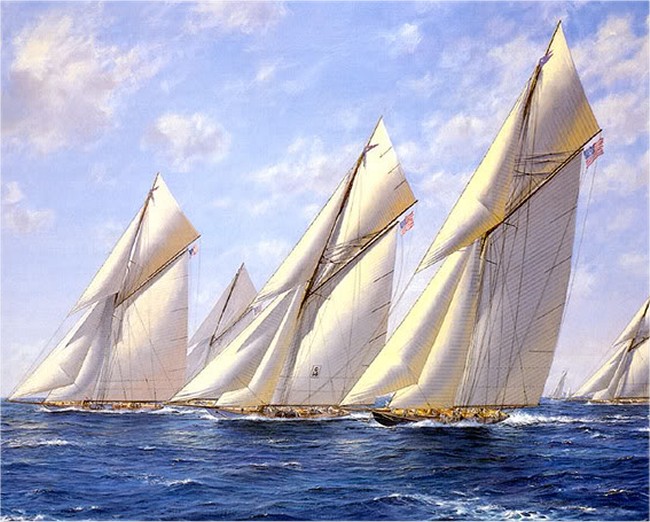
While many of the Crowninshield boats were very carefully constructed, the engineering of lightweight hulls was not well understood at the time. The resulting flexibility accelerated the aging process, and this was undoubtedly exacerbated by the frequent, well-meaning replacement of the old gaff rigs with jib-headed sail plans generating new and unanticipated stresses on the hulls. However, enough boats have survived, on paper, in art, in words and in memory to undeniably confirm that few have ever drawn a prettier boat in the old-style, long-ended form than B. B. Crowninshield.
Crowninshield also designed a small number of other vessels - Thomas Lawson commissioned him to design Independence, built at the George Lawley & Son shipyard and knocked out of trials as a possible America’s Cup defender in 1901; and also the worlds only seven masted sailing vessel - the Thomas W. Lawson in 1902 -- lost at the end of her first transatlantic voyage in 1907.
Among possible surviving Crowninshield boats are the yawl Quill II, the Dark Harbor 17 1/2-foot (LWL) class, and the Dark Harbor 12 1/2-foot (LWL) class, all located in Maine.