
Eric Riordan
John Eric Benson Riordan, 5 December 1906 - 23 December 1948,
Eric Riordan and his family moved from St Catherines to Montreal when he was two years old. He attended McGill University and then studied at the Ecole des Beaux Arts taking charcoal drawing. In 1932 he went to Paris where he continued his art studies painting at the Grande Chaumière and the the Académie Jullian.
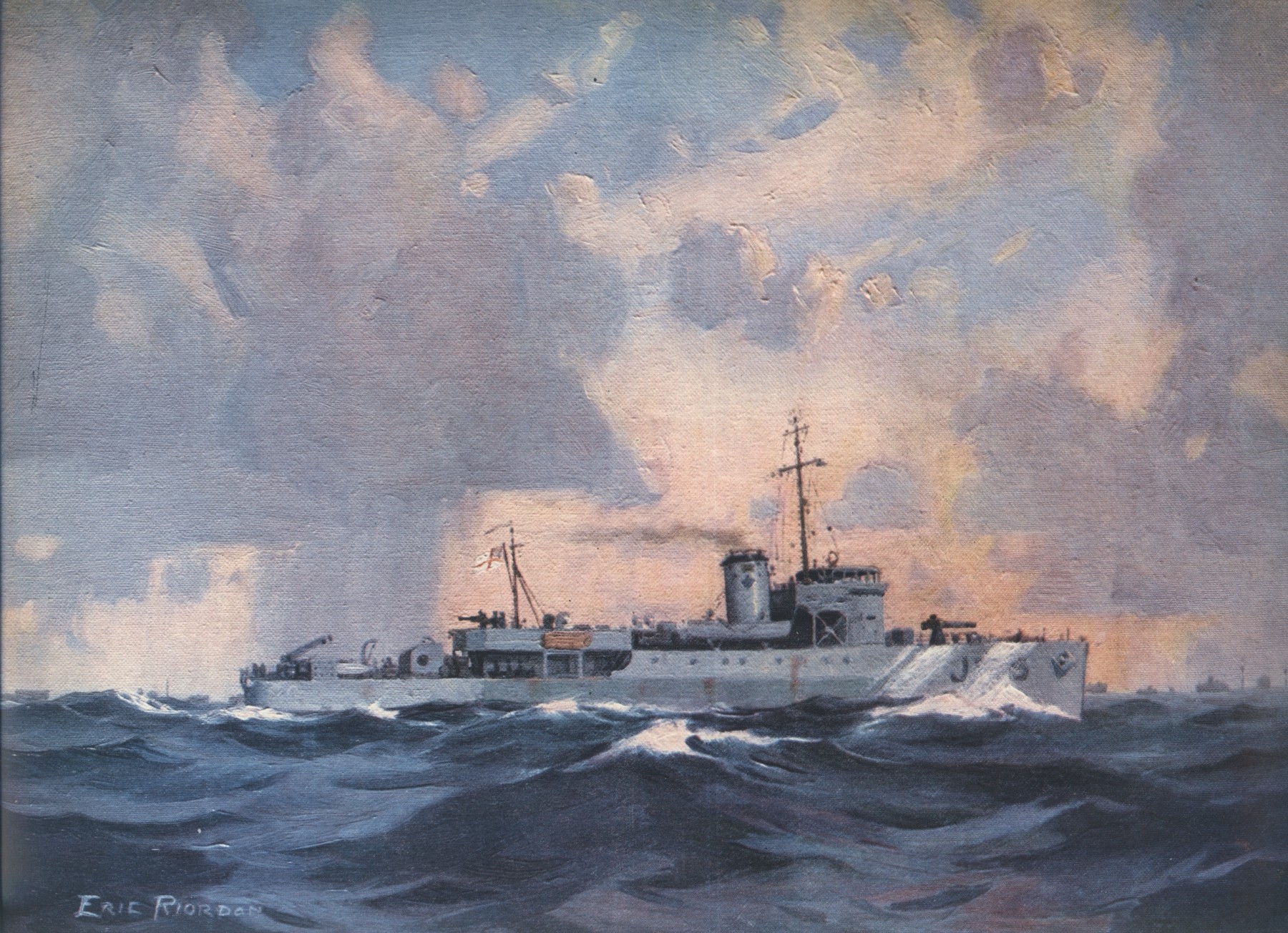
In 1940 he joined the Royal Canadian Naval Volunteer Reserve (RCNVR) and became a lieutenant. He served on a corvette as second in command for anti-submarine and convoy duty during the Battle of the Atlantic, and at war’s end was a lieutenant commander. In spare moments he painted over thirty miniatures of the ships and the sea portraying the Canadian Navy during the war. [1]
Both prints shown here are in our collections. They both show Bangor-class minesweepers but are undated and their identification, Jxxx has been painted over with "bow spray" by the artist -- a common practice during the Second World War time period.
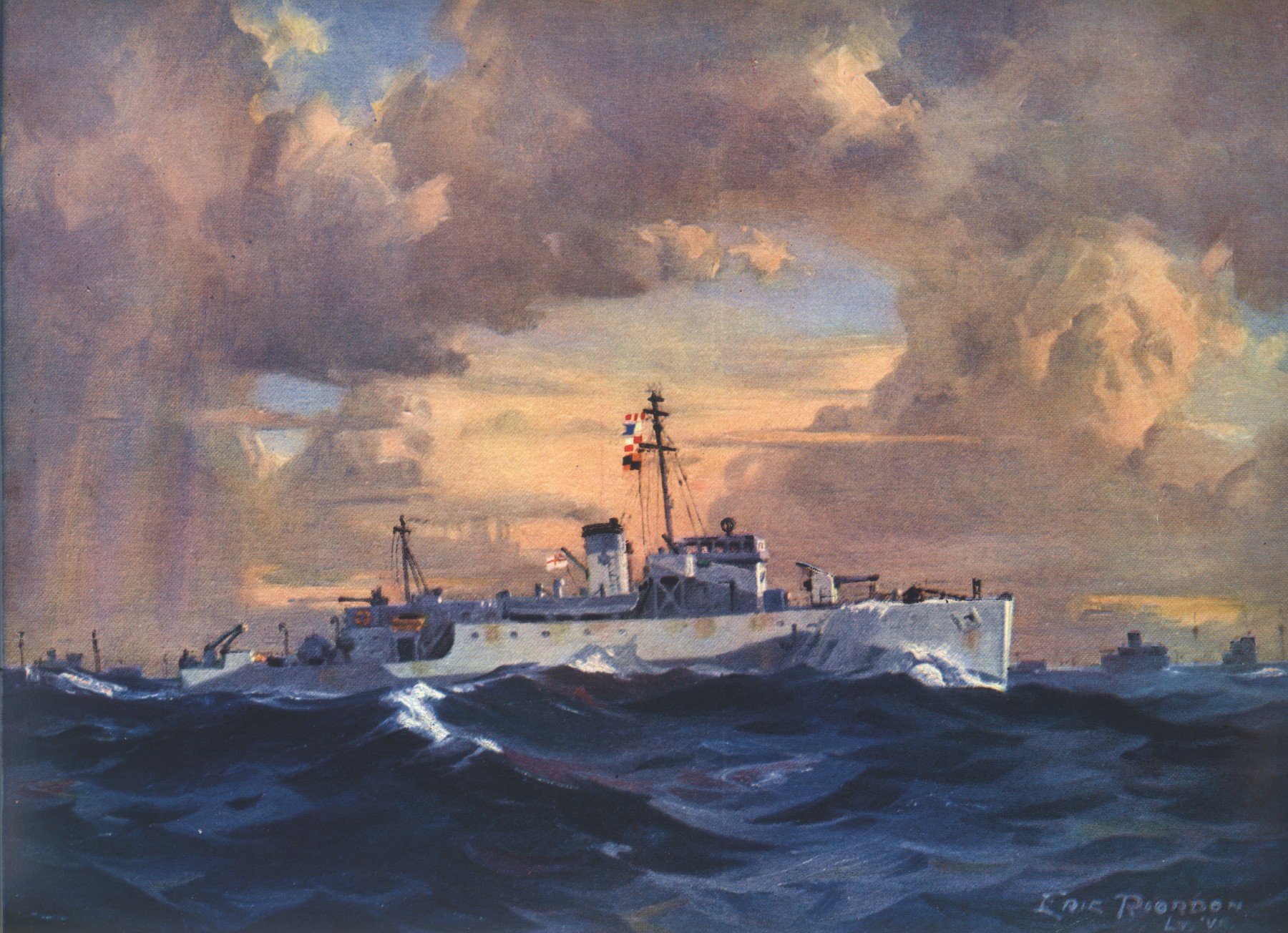
The Bangor-class minesweepers were built in large numbers – well over one hundred – and had many variants. Note that the foredeck gun, while both of those shown in these prints were probably "12 pounders" (sometimes known as "3 inchers" although exact manufacturers and dimensions varied), either had a gunshield or not.
Note the length of the upper and stern decks aft of the coamings. Many of these ships were built with steam reciprocating engines (Illustration 1), a few were built with diesel engines, resulting in the overal length of the ship being reduced by some twenty feet. [2]
Also note the signal flown in Illustration 2. The top pendant is 'code and answering' indicating that the signal uses the 'international' rather than 'naval' code flags, followed by Alpha, Uniform, Lima (AUL) meaning "All is well."
We continue our research into Eric Riordan's artwork.
A detailed description of Eric Riordan's life and artwork, can be found here, particularly for WWII convoys.