
One Hundred Years of Service
Toronto Telegram, 10 May 1952
Schooner Days MLII (1052)
By C.H.J. Snider
With a clean wake of one hundred years of service astern the Royal Canadian Yacht Club is celebrating its centenary with the opening of the 1952 season.
A high ideal was graciously set before the organization when Queen Victoria bestowed the name "Royal Canadian" upon it. The implied suggestion was to reach beyond the limits of the city of Toronto – population then 35,000 – and the province of "Canada West," to give leadership to all Canada, and royally. Not merely in competitive sport, but in national unity, in social amenities, and in patriotic effort, has the club striven to do this.
The model, not mentioned but obvious when the name was given by the Queen, was the Royal Yacht Squadron of Britain, at the time the great domestic training ground and experimental station for the improvement of the Royal Navy, upon which the Empire depended.
It must be remembered that a hundred years ago this was still a strong navy, "wooden walls" with muzzle-loading guns. Steam was an auxiliary of limited effectiveness. With more confidence than is now felt in atom bombs, Great Britain then relied upon wind-driven world-sweeping fleets. In chasing pirates and slavers and national enemies around the world the White Ensign could not stop to bunker. The tall-funneled teak-built Royal Navy gunboats Heron, Britomart and Cherub, sent out from England to Canada's rescue fifteen years later, in the Fenian Raids, were full-rigged barquentines or topsail schooners, and had to be, for their lean hulls might not have carried enough coal to bring them across the Atlantic without refueling.
Policeman of the seven seas, and not at ease yet about the traditional enemy of seven centuries, France, a great maritime power, the Royal Navy continually sought improvement in speed and seagoing ability under sail. There was no better place to develop this than in the Royal Yacht Squadron. This accounted for the building of many large yachts by titled persons of wealth, examples being Lord Belfast's brig yacht Waterwitch, which set the pattern for Admiralty brigs' sails in 1832, and Lord Yarboroughs Falcon, a full-rigged ship of 500 tons, Ackers' Brilliant, of similar rig and size.
Such yachts were matched against naval vessels in the English Channel, and raced under the most strenuous conditions, and had a marked effect upon the improvement of the sailing navy. On occasion some were armed and went on active service.
It would be nonsensical, of course, to suggest that the Royal Canadian Yacht Club was organized with any idea of teaching the Royal Navy how to sail. But it was just as certainly not begun merely as a social, pleasure club with aquatic inclinations. The ideal of national service was ever before it. Its first officers were named and functioned as in a man-of-war, Captain, First Lieutenant, Second Lieutenant. Among its first members were Royal Navy officers, such as the Hon. John Elmsley, Captain, RN, and the Arnolds, who were at the cutting out of the Caroline when Capt. Andrew Drew, RN, sent her blazing over Niagara Falls, and so broke up the Mackenzie rebels' roost in Navy Inland. Officers of the British army in garrison at Fort York, and of the militia regiments in the province, like Major T. W. Magrath, Col. Wm. Durie, Sir H. Dalrymple of the 71st, Major Charles Gifford, and Lieut. Col. H. J. Grasett, all owned yachts in Toronto and held flag rank in the early club.
Under such auspices patriotic service has been as natural to the club from its inception as the lake water in which it sails. One great service has been the promotion of goodwill and sound development and proper procedure, both locally, and in inter-club and international racing — in Canada, and all over the Great Lakes, and on the Atlantic seaboard. It also includes fostering British connections and developing Canadian sufficiency and self-reliance in sport and in world affairs, and in extending hospitality to visitors from abroad and to rising generations of Canadians. The club has also trained 1,100 boys between 10 and 16 in seamanship and sportsmanship and 123 of these graduates were in the armed forces in the last war.
The club has taken an active part in every war in which Canada has had a share in the last hundred years. Black guns on the club lawn are part of the spoils of the Crimean War of 1855. With the thundercloud of the threatened American Civil War overhead in 1860 Capt. W. F. McMaster (Commodore later, in 1873) and G. H. Wyatt (Vice-Commodore, 1868-69) and Robt. Arnold, Caroline, veteran fitted out the 300-ton Canadian schooner Eureka, owned by Giles and Sylvester in Toronto, for a patrol ship for the volunteer Naval and Pilots Brigade which they had formed. When the squall burst this brigade manned tugs and passenger steamers as improvised provincial gunboats – the Rescue, Prince Alfred, Hercules, Passport and W. T. Robb. These carried troops and supplies and fought off the Fenian Raid in 1866 and patrolled the lakes and river borders, assisted by the Imperial gunboats Heron, Cherub, Britomart, Royal, Michigan and St. Andrew. This was no "private war." Anybody could be in it, and the Royal Canadian Yacht Club shared the honors and hardships with thousands of other volunteer Canadians.
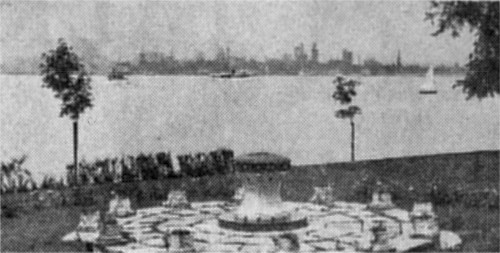
The club has participated fully in all of Canada's wars since. The memorial capstan on the club law carries the names of eighty-two members who were young jolly yachtsmen in this century and gave their all for Canada in two world wars. In 1914-18 and 1939-45, almost 1,000 members of the club, in addition to the eighty-two boys mentioned above, served voluntarily in the three fighting services.