
Three Ships
Toronto Telegram, 24 March 1934
Schooner Days CXXXI (131)
By C.H.J. Snider
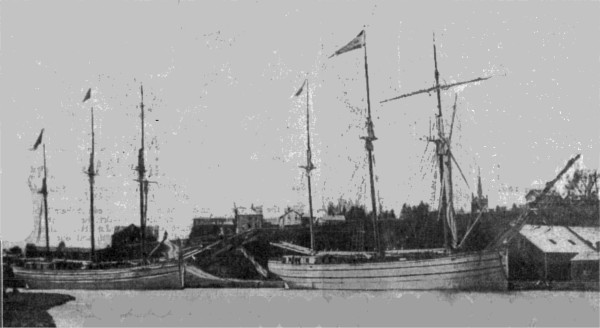
Further the Adventures of Capt. Alexander Ure, Master Mariner, of Toronto, Now in His 88th Year
THE Augusta and the Antelope towed out of Fairhaven on the same towline. It was on the 25th of November, 1900, a dull grey morning with a tempting homeward-bound breeze from the eastward, but the threat of snow in the air.
About the same time Capt. Jas. Quinn, of Oakville, left Oswego in the Jessie Drummond, bound, like the two others, for Toronto, only her cargo was for P. Burns & Co.
The Antelope and the Augusta were both loaded for the Conger docks at the foot of Church street, Toronto. It was Capt. Alexander Ure who had resuscitated each in turn from the limbo of laid-up tow barges at Port Dalhousie, and re-rigged them as the schooners they had once been. The Antelope was a Muir Brothers product of 1873, the Augusta had been built for Sylvester Neelon at St. Catharines a year earlier; each originally a timber drogher, with ports in the stern for loading square timber; the Antelope a two-master, the Augusta three.
Capt. Ure bought the Antelope in 1898 and fitted her with topmasts again at the foot of Church street and sailed her for the season for the Congers; and in 1899 he did the same thing with the Augusta. He retained a large share in the ownership of both vessels, and continued to sail the Augusta, Capt. Wm. Wakeley sailed the Antelope.
As was only natural, on this last trip of the season, with an even start, each skipper pressed his vessel to the uttermost, in order to be the first home and first unloaded. Besides, the threat of snow would make anyone hurry for port.
Wind and sea strengthened and the schooners were shoving acres of white foam over the backs of the grey waves as they caught them in the run up the lake. By noon the Antelope was definitely in the lead. The Drummond starting further down the lake, was out of sight astern. The Augusta was yawing wildly in the increasing sea. The Antelope crew cheered as they saw her clew in her mizzen gafftopsail to keep from broaching-to in the trough.
"Too much for her! They've got to shorten her down or she'll run away with them," Capt. Wakeley opined.
Had he known the straits his fellow-skipper and part owner was in at the moment he would have turned back to help him. Will Wakeley was one of the whitest sailors that ever touched a wheelspoke.
The Antelope drove on, leaving the Augusta by another mile every hour. By dusk, when they were between Darlington and Whitby, the snow commenced. Captain Wakeley caught the glow of the street lights of Toronto, reflected in the clouds thirty miles ahead, and made a careful note of the compass bearing. Snow had already shut out the Augusta astern. In a few minutes it shut out everything on both sides and ahead.
On through the blinding whiteness the Antelope steered on that compass bearing. Before midnight, according to dead-reckoning, she was close to Toronto Island, Capt. Wakeley had clewed up his gafftopsail and squatted the mainsail down beyond the third reef, and hauled the sheet aft, ready for a Jibe. They had no sooner set up the boom-tackle than the red light on the Eastern Gap showed right over the mastheads.
"Let her come!" called Capt. Wakeley to the two men at the wheel, and as they spun the spokes up, hard up, over jibed the mainsail and foresail, and the Antelope turned the invisible corner of the invisible gap and ploughed through into the smooth water of Toronto harbor.
And what was happening to the Augusta?
She was a hard-mouthed brute to steer, anyway. All timber droghers were. But her sashaying around the lake was due to the fact that her rudder-head had become splintered like a broom, until there was no place for the steering gear to take hold. It was the discovery of this which caused Capt. Ure to clew up his after kite, to keep her from turning around on him. Most lake schooners had backing-chains or wire cables, led to ringbolts in the after side of the rudder, to hold the blade straight if the vessel had to be towed stem foremost by a tug, as often happened in docking. Capt. Ure led the Augusta's backing chains in through the quarter chocks and rigged tackles on them; and so, pulleyhaul, she was manhandled all the way up the lake. No wonder she continued to steer wildly.
The big grey seas were spilling in on both sides. Her deck was always under water. The entire crew of four men were needed on the jury steering tackles. Capt. Ure himself hung in the fore rigging, staring through the snow for the first glint of a light. His mate, Jim Young, the only man left, kept heaving the sounding lead; and all the time reporting no bottom. The schooner was staggering through the water at eight or nine miles an hour, so that the lead never got a chance to hang perpendicularly. If it did touch bottom, before either the fact or the depth could be noted in the darkness, the line would be trailing out astern. Flying soundings are never reliable; the proper way is to shake the vessel up till she loses headway -
In a gale from the sou-west, boys,
We hove our ship to.
Our soundings to clear."
That's the way it was done in the Grand Fleet, according to that ancient ballad, "Spanish Ladies," and that's the way it should always be done, in blowy weather. But, alas, that's the way it couldn't be done in the Augusta. With her disabled steering gear they were afraid of her rolling the spars out of her if she ever "came up" on them. So on she ploughed.
"I see a light!" yelled one of the sailors at the backing chain tackles.
"It was on the quarter!" yelled another.
"It's the last light in Victoria Park!" yelled a third.
But it was really the lamp in Port Credit lighthouse, Instantly shut out by the snow.
The mate hove again, but before he could overhaul the freezing line the Augusta fetched up hard and fast on the shale bottom about a mile west of the Credit piers, where the brickyards now are. The seas stove in her boat on the davits, and it looked as though she would be shattered in a few minutes. But she was a stoutly built old waggon, with lots of oak and iron, and once she had taken in enough water to hold her on the bottom she lay quiet, her decks awash.
Capt. Ure gathered his crew aft and prayed for the day. It came, and with it the gallant Capt. Al Hare, of Port Credit, with a fisherman crew, in one of the Credit mackinaws. They took the Augusta's crew off with difficulty. Meanwhile the Sons of England lifeboat, Grace Darling, was staggering up from Toronto with a volunteer crew; for not only was the Augusta ashore, but the Jessie Drummond, the third large schooner, was riding desperately to both her anchors out in the lake two miles further to the westward. She, too. had missed Toronto Point coming up the lake in the snowstorm. Her captain had hauled her into Humber Bay so far that he heard the trains at Sunnyside at midnight; but, seeing neither land nor lights, he had hauled her out again, let go his anchors, and fetched up above the Credit.
Capt. Quinn commandeered the Grace Darling for a tender, and got his windlass castings ashore in her for re-forging in the Port Credit blacksmith shop. He found, on trying to heave up, that the castings had cracked with the plunging of the vessel against her chain cables. Meantime Capt. Ure worked might and main to save his sturdy vessel.
When the subsiding gale permitted the Drummond to weigh anchor with her repaired windlass they got the old Gordon Jerry and the Mary E. Ferguson, stonehookers of long standing, alongside the Augusta, and loaded coal out of her into everything in the Credit that would serve as a coal-scuttle. The Antelope, hastily unloaded is Toronto, came up and anchored as near as she dare; but the wind went round and the Antelope's anchors dragged off the shale into deep water. They got one of Taylor's steam pumps alongside the Augusta, and lowered the water in her two feet; a little more, and she would have floated.
But Just then the pump failed. While the damage was being repaired it blew up a December gale. The lightened Augusta lifted and pounded on the shale bottom. Her oakum was squeezed out in funeral wreaths. Then her planks commenced to fly. Her spars fell. And she was a complete wreck.
A cruel Christmas box for Capt. Alex. Ure, completing thirty years of lake faring!