
Trans-Atlantic Yacht Races of the Past
By HERBERT L. STONE
Adapted from the March 1921 issue of Yachting magazine
The Proposed Ocean Race for the King of Belgium’s Cup offers a chance to live up to the best traditions of the past in this most stirring of sports — records for hard sailing that will be difficult to beat.
Since the days of Eric the Brawler, that doughty Norwegian Viking, nay, even long before that, when the Phoenicians pushed their galleys beyond the confines of the Mediterranean in search of conquest, discovery or trade, the instinct to drive one’s vessel a little faster than the other fellow’s and to be the first to make port has been strong in the breed of sailormen. It was a dominant characteristic in those who sailed the triremes, the caravels of a later era, the clipper ships that raced for supremacy of the seas or the lumbering cargo carriers of an age that put the needs of commerce and carrying capacity above mere speed.
The advent of steam couldn’t kill it and the race to drive a little harder and make a shorter passage is as keen in the skippers and crews of the “iron pots” that plow the Seven Seas as it ever was in the days of iron men and wooden ships.
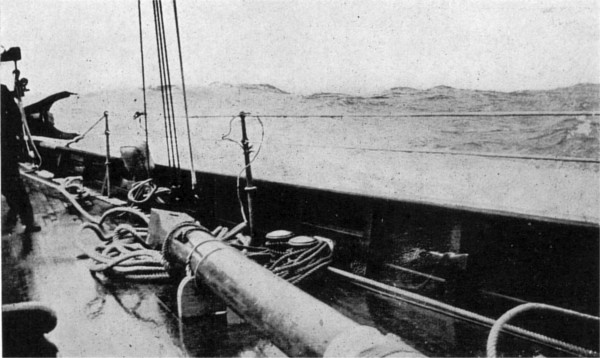
This instinct is not confined alone to those who follow the sea. It is inherent in the human race, and particularly the Anglo-Saxon and northern European races, for those who stayed snugly ashore were as much interested in the results of these contests and took as much pride in the winning of a certain vessel as did the crew aboard her. These long races over trackless seas, where the contestants were unseen and unheard of from the time of departure until they raised a headland off the home port, appealed to the imagination and were invested with a glamor that was hard to resist. When the tea clippers were racing from China in the ’50s, with the knowledge that a high market awaited the first one to land her cargo, there was as much interest in the outcome of the 100 to 120-day race — with every day of it a drive and where sails and spars were willingly sacrificed if it meant an additional knot — and as much money wagered on the result ashore as there was aboard the ships themselves, where skipper and crew alike eagerly bet their hard-earned pay on their own ship to show the way home to the other fellow.
The Australian wool ships of a more recent day, racing home to England from the Antipodes, were responsible for records which steamers have since hardly surpassed, and the arrival of a fleet of these fine ships was a sporting event of first importance. In the trans-Atlantic packet trade, passages of 13 and 14 days were common and over 15 days was considered slow by the crack ships. Except for the fast passenger liners the best of these passages compare favorably with the average voyage in steam today. Reports of single day’s runs of from 350 to 425 miles a day thrilled those ashore as well as those aboard. To make such a run required sail-carrying to the highest degree and a display of nerve and skill almost unequalled in any contest. They tell of skippers who had to put clamps and padlocks on their halyards to prevent the sailors letting them go at night to ease the strain on some overdriven ship.
But this is to be a story of ocean yacht racing and not ocean racing in general, so the foregoing is only by way of introduction and to show that the yacht sailor of today comes by his racing instinct naturally ; and that when a trans-Atlantic race is proposed, it not only appeals to his sporting sense and awakens a desire for something more than the usual short triangular races of the summer season, but urges him to test his skill, nerve and endurance on 3,000 miles of open water, with the glamor of a foreign port for his goal. Those who enter their yachts for the long traverse for the cup just offered by the King of the Belgians this Summer will find no lack of amateur yacht sailors willing to go, and there will be many bitterly disappointed ones left ashore who could not find berths aboard the contestants.
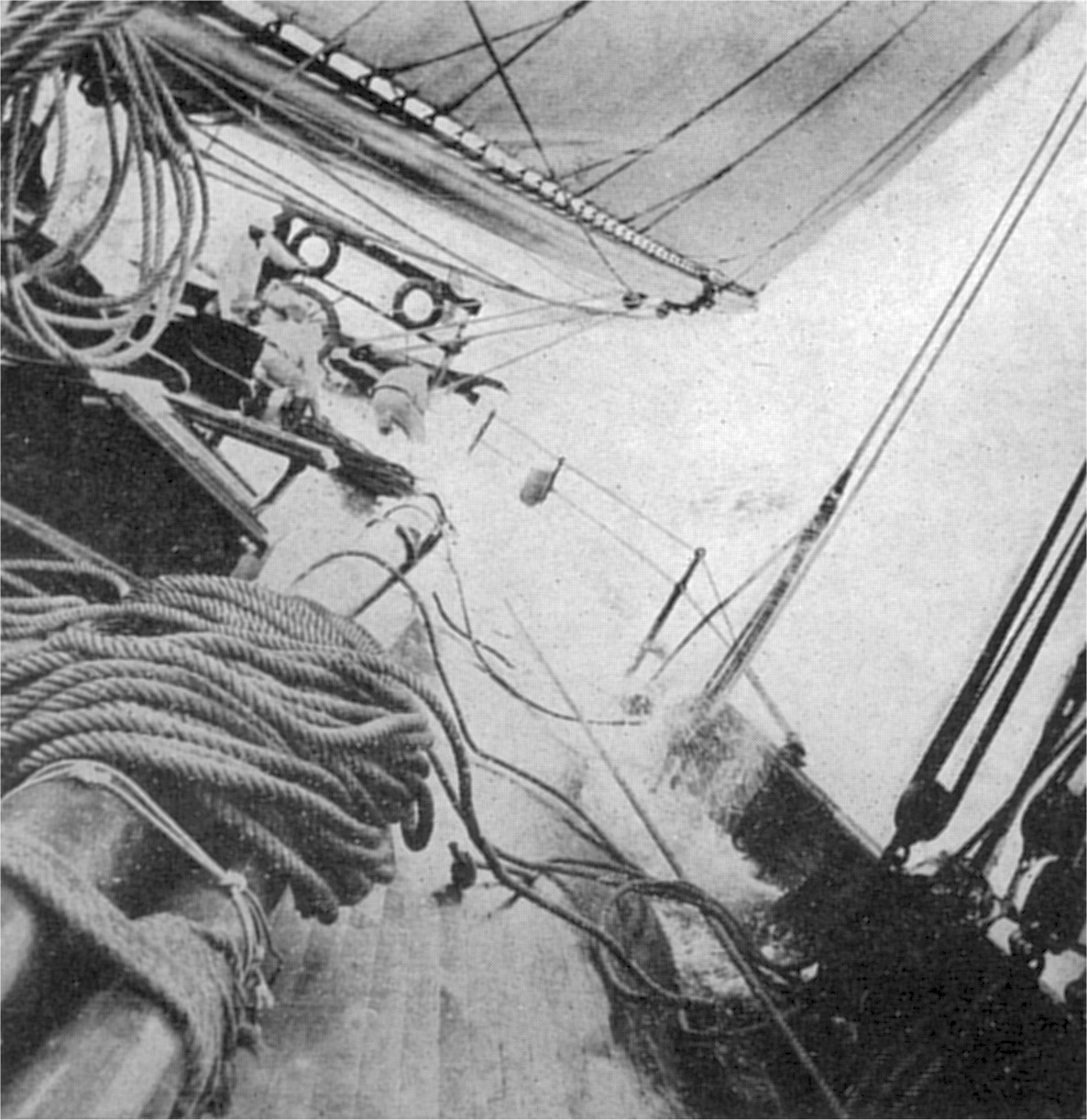
How many yachts will start in this race it is hard to say until the terms of the contest are published in greater detail. No one could have offered a cup that men would be more eager to race for than King Albert. He is popular here in America and in Canada as well as in England, and outside of every other consideration, yacht owners will consider it an honor to race for a trophy offered by him. He is something of a sailor himself, be it said, and if the truth were told, it is probable that he would like nothing better than to find a berth upon one of the competing craft.
In the last trans-Atlantic yacht race, in 1905, which was for a cup offered by the now fallen and discredited German Emperor, there were eleven starters — a fine fleet in which every vessel finished without accident, and in which the sailing record was broken, the winner sailing the long course in 12 days and 4 hours. It transpires also that this cup, which was so widely heralded for its intrinsic as well as its “sentimental” qualities; proved to be only base alloy and of little value when it was broken up during the late unpleasantness. Without attaching too much weight to this little trait of parsimoniousness in the late head of the Imperial German Government, it should be said that yachtsmen should take a pride in seeing that the fleet this year is bigger than that which started in 1905. It would be discourteous not to show a bigger entry list for the King of Belgium’s Cup.
There are plenty of American yachts able to go that would have a good chance in a long thrash of this kind, and plenty of owners with the nerve to go and able to bear the expense — for be it known, it is an expensive matter to fit out and send a yacht to Europe and back. The entries will be, probably, mosily schooners, with perhaps a few large yawls and_ ketches thrown in. In a race without time allowance the larger vessels will, of course, have the advantage, especially if any weather is encountered, for in anything but light breezes the larger yachts can carry sail longer and will be less bothered by the sea that always goes with a breeze of wind. In moderate weather the lighter racing schooners would have the call, and as there are a number of this latter type that will probably enter, the outcome as between these and the large, heavy ocean-going auxiliaries will depend largely upon weather conditions and, what is all-important, upon the course sailed and the way the yachts are driven, day and night. It is in “carrying on” at night that. usually counts most, and the skipper and crew with the nerve to hold on to everything possible in the. blackest of nights, when the seas tumble aboard from all directions, unseen out of the darkness, will usually find himself ahead when the next day’s positions are figured up.
It should be of interest to those who contemplate entering, as well as to those who are only interested in the race as a sporting event of the first magnitude, to know that this is only the second race to be sailed for a trophy, most of the others being match races for a wager, or races for a sweepstakes cash prize, each owner putting up a certain sum, which he was willing to wager on his boat being faster thai his rivals. Also, this is the fifth trans-Atlantic yacht race to be sailed. ‘There have been many fast passages made by yachts sailing alone across the Atlantic, but only four have been sailed when yachts were formally racing against one another.
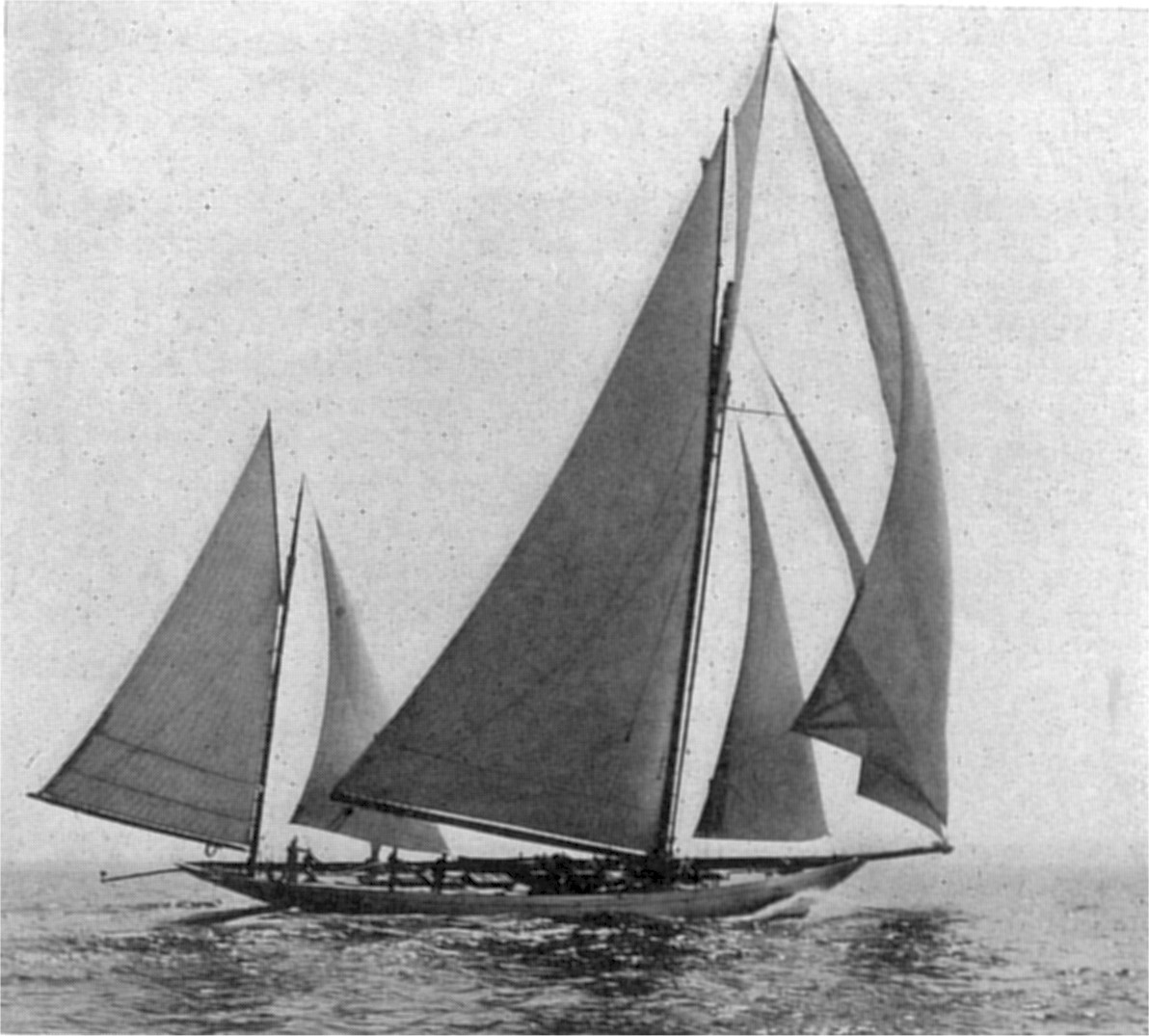
When the America crossed, in 1851, to race against the best Great Britain could produce, and won the cup that now bears her name, she was not racing but sailed over alone, making a very creditable run of 20 days, which was good for a Summer passage of so small a boat, as she was only some ninety feet long on the water, under cruising canvas.
The first real race was the famous one sailed between three American schooner yachts in 1866. It came about in this way. There had been keen rivalry between the centerboard and keel types, and not being satisfied with the results of the season’s racing on sheltered waters, Pierre Lorillard bet George Osgood $10,000 (a large sum of money in those days) that his centerboarder Vesta was a finer type of vessel under all conditions than the latter’s fast keel schooner Fleetwing. [Note: It was variously reported that all three owners put $10,000 into the 'jackpot' for the winning yacht. PA.] To prove this beyond doubt, it was stipulated that the race be sailed in the Winter time, when there was sure to be plenty of wind, and the month of December, 1866, was chosen, the course being from Sandy Hook to the Needles, Isle of Wight. North Atlantic weather in December is not the kind usually chosen in which to do yacht racing, for the “roaring forties,” as they were named by the old packet-ship sailors, were dreaded by all who knew them. This did not deter the yachtsmen of that day, however, for when the match was noised about, James Gordon Bennett, of the New York Herald, asked leave to enter his keel schooner Henrietta, and put up his $10,000, making the stakes $30,000 in all.
The race started December 11, with the yachts under command of some of the best deep-water skippers who ever hung on to to’gallants’Ils in a gale of wind, including “Bully” Samuels, commander of the famous packet ship Dreadnaught, a noted sail carrier, who was on the Henrietta. Each had a large amateur afterguard. In spite of the cold, the harbor was gay with bunting in honor of the event and a big crowd went down the bay on chartered steamboats to see the start and wish the yachtsmen good luck.
It was apparent from the time the yachts disappeared in the gray murk of a winter’s day that it was to be no child’s play for each skipper was “cracking on” with everything his vessel could lug. The boats became separated that first night and did not see anything of each other until their arrival on the other side. A terrific gale swept over the course on December 10, during which Henrietta was hove to under storm trysail, while Vesta and Fleetwing attempted to run before it. This proved disastrous to the Fleetwing, for she was pooped by one vicious sea, broached to, and six of her crew were washed overboard and lost. Ernest Staples, one of the amateurs aboard, jumped to the wheel and put it hard up to keep her off, and she was gotten before it again before any more damage was done.
The whole passage was boisterous and rough, with darkness for fifteen hours out of the twenty-four as they reached higher latitudes, and every hour of the race the yachts were driven. On Christmas day the sails of a schooner yacht were made out from the Isle of Wight, and just before dark that night the schooner Henrietta swept by the Needles, the first of the trio to finish. Her time was 13 days, 2t hours and 45 minutes, and the distance sailed 3,106 nautical miles. The next day the Fleetwing and the Vesta finished, only 40 minutes apart, the former taking second place. Her time was 14 days, 6 hours and Io minutes.
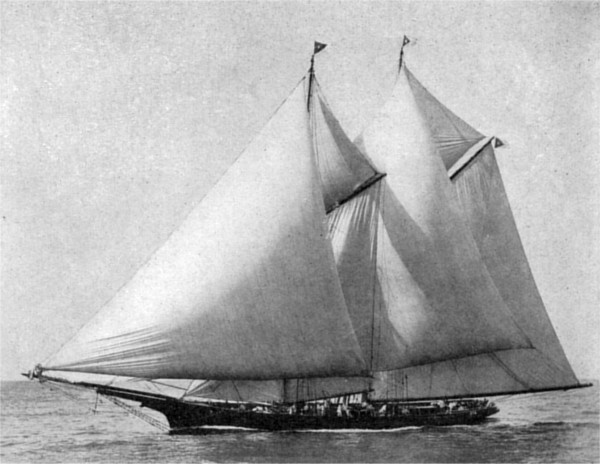
It was four years before another Atlantic race was sailed. In the year 1870, Mr. James Ashbury, an Englishman, had challenged for the America’s cup with his schooner Cambria. Desiring to race across the ocean on his way to Sandy Hook, a match was arranged with the schooner Dauntless, destined to become one of the most famous of American schooner yachts, then owned by James Gordon Bennett, whose schooner Henrietta had won the race of 1866. The course for the race was from Daunt Head, Treland, to Sandy Hook, and the race was started July 4th. Owing to the fact that it was summer, when lighter winds are the order, and that the yachts were coming to the westward while the prevailing winds were ahead, this race was a slow one, although a close one. There was much money wagered on the result, and as “Bully” Samuels and “Marty” Lyons, a famous Sandy Hook pilot, were on the American yacht, it was predicted she would win. However, it was the topsails of Cambria that first lifted above the horizon, headed for the old red lightship, and it was this yacht that swept across the line first, after a slow race of 23 days, 5 hours and 47 minutes.
She was hardly across before the white cloud of Dauntless’ canvas appeared on the skyline, and the American boat finished 1 hour and 17 minutes after the Britisher. Cambria sailed the longer course, her log showing that she sailed 2,881 miles against 2,783 miles for Dauntless. It is said that the latter boat was ahead some 250 miles from the finish, only to have her lead snatched from her by a shift of wind at that time which favored Cambria and gave her the race. But such are the vicissitudes of ocean racing, and it is such vagaries of wind and weather that make this kind of racing the most uncertain.
Seventeen years was to pass before another Atlantic yacht race was sailed. In this time the old Dauntless had passed into the hands of that hard-sailing yachtsman, Caldwell H. Colt, who had raced her very successfully. In 1886 there was built in Brooklyn the fine schooner yacht Coronet of about the same size as the Dauntless, and the former’s owner flung to the winds a challenge for an ocean race. It is said that Commodore Colt couldn’t stand the “arrogance of that man across the East River,” so he took up the “défi” and a match was arranged for a trans-Atlantic race for $10,000 a side. The Dauntless was getting old and it was said there were many soft spots in her hull and that she was in no condition to stand the pounding of an ocean race. Nevertheless, the race was arranged and March, 1887, was fixed for the time, just to insure plenty of wind. They got it, all right. “Bully” Samuels, who had commanded the Henrietta and the Dauntless in the two previous races, was engaged to sail the latter boat. Samuels knew the condition of the Dauntless and was not keen on the enterprise, it is said.
This race is written in yachting history as one of the most memorable ever sailed largely because of the game fight made by Dauntless. Samuels “carried on” all that first blustery March day, and that very first night the old yacht began to leak. Water was up to the saloon floor before it was discovered, and all hands were set to work on the pumps. But did they turn back? Not so that you could notice it! She was shortened down to ease the strain on the hull and in the next 16 days those aboard of her had reason to believe they had pumped the whole Atlantic through the old yacht’s hull.
Coronet won the unequal contest somewhat easily in 14 days, 19 hours and 03 minutes to Roche’s Point, Ireland, the designated finish. Dauntless took 16 days, 1 hour and 43 minutes for a course of 2,947 miles. She is credited with the best day’s run, however, and chalked up 328 miles from noon to noon. Not bad for a leaky schooner yacht, only some 115 feet on the water! The fresh water also leaked out of the tanks, and it is said the guests and crew had to drink champagne to quench their thirst thereafter.
It seems that some friction developed during the race as to how the Dauntless should be sailed, and Samuels turned over the command, when only a few days out, went to his cabin, and the yacht was handled by her owner, Com. Colt, thereafter. This matter was threshed out afterwards in the papers and did not make particularly edifying reading. It was also discovered afterwards that two auger holes had been bored through the hull of Dauntless below the water line in the bows, which was responsible for much of the leaking. It looked like foul play by someone before the race was started, and though Com. Colt employed detectives to ferret the matter out, it is said no solution of the affair was ever arrived at. It is possible the holes were bored for bolts and carelessly left without stopping them in the yard where she was fitted out for the race.
Again a long period elapsed before another race was_ sailed. Eighteen years later, or in 1905, Commodore Robert E. Tod, of the Atlantic Yacht Club, worked hard to get up such a contest. A cup was offered by the German Emperor when the movement for a race came to his attention, and the event attracted the largest fleet that ever raced across the Western Ocean. No less than eleven yachts appeared at the starting line, as has already been told. The fleet was comprised of yachts of all rigs, from the yawl Ailsa to the ship-rigged yacht Valhalla, 208 feet long on the water. Eight of this fleet were American yachts, two were English and one was German, the Hamburg, a 116-foot schooner. The English yachts were the Valhalla and the auxiliary barkentine Sunbeam, owned by Lord Brassey. The American entries were the three-masted schooners Atlantic, owned by Wilson Marshall, and the Utowana, owned by Allison V. Armour, the the bark-rigged Apache, the schooners Endymion, famous for her fast Atlantic passages; Hildegarde, Thistle, owned and sailed by Com. R. E. Tod, and Fleur de Lys (smallest of the fleet and only 87 feet on the water) and the racing yawl Ailsa.
It was a goodly fleet and a big flotilla of yachts and excursion steamers was at the Hook on May 17th, to see the yachts start and wish them God speed. The race is memorable because of the fast time made and the records that were broken. A sou’west gale was encountered about half way across, but the larger yachts carried through it, as, in fact, did most of the racers. Three of them made runs of over 300 miles in that 24 hours of the blow.
As the yachting world knows, the Atlantic, beautifully sailed by Captain “Charley” Barr, of America’s Cup defence fame, won. Bishop’s Rock, in the Isles of Scilly, was sighted from her sloping deck in 11 days, 16 hours and the finish line off the Lizard, Land’s End, England, was crossed in the remarkable time of 12 days, 4 hours and 1 minute, a record for yachts that has never been beaten since [1], and which it is believed has never been equalled under sail. She was driven every foot of the way. Her best day’s run was 341 nautical miles and her average for the 3,013 miles she sailed was 10.32 knots — equal to steamer time. The German schooner Hamburg was the second yacht to finish, almost 24 hours behind the flying Atlantic, her time being 13 days, 02 hours, and 06 minutes, while the big British Valhalla was third, a day later. It was a great race, gamely sailed from start to finish. We may not see as fast a race in the one to come this year, but the yachts that start in this event have a fine record to try to better, and a tradition for hard driving that will insure a contest worthy of those that have already been sailed.
Notes:
[1] For monohulls, it wasn't until 92 years later (1997) that Atlantic's record was beaten by the 80-foot monohull Nicorette, skippered by Ludde Ingvall, who made a crossing in 11 days, 13 hours, and 22 minutes. But Ingvall waited for a favourable weather forecast to set his start date. In an organized race with a fixed departure, The New York Yacht Club's Atlantic Challenge race (May 2002), the yacht Windrose completed the route in 11 days, 10 hours, and 25 minutes. However, in 1980, Éric Tabarly sailing his 55-foot multihull trimaran Paul Ricard was the first to do better than Atlantic's time, completing the crossing in 10 days, 5 hours, and 14 minutes. [P.A.]
See also:
The Kaiser's Cup Race 1905
The (later) Transatlantic Race, Newport to Bergen, 1935
Stormy Weather's account of the Transatlantic Race of 1935
To follow: Yachting magazine 1928-09 XLIV/III : Transatlantic to Spain,